
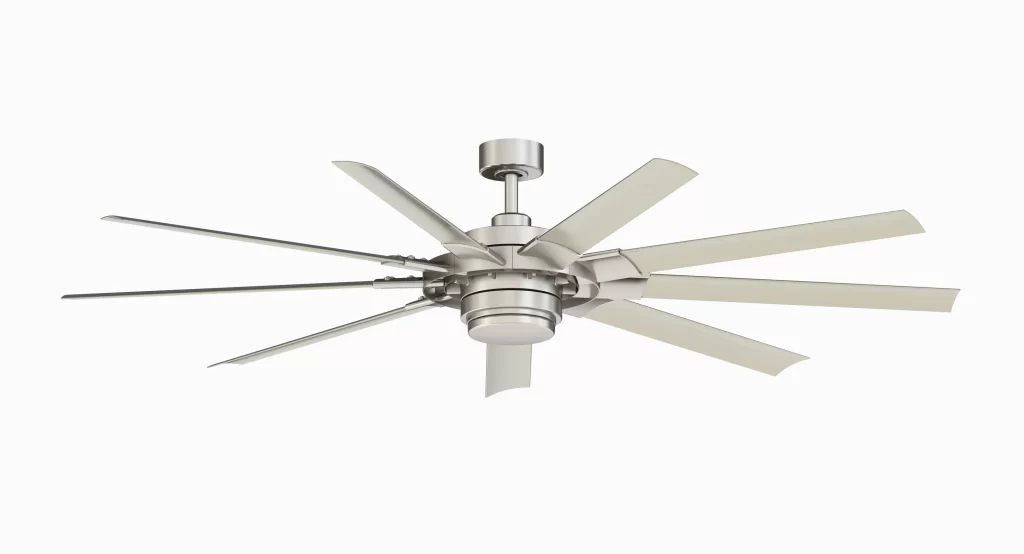
A Fanimation Slinger V2 that will not spin does not automatically have a failed motor. A remote that appears unresponsive may have weak batteries, an incorrect code or the wrong compatibility. A light that switches itself off may be following a selected mode. The first useful step is to identify which functions still work and which version of the fan you own.

This guide covers Fanimation Slinger V2 problems involving starting, remote operation, unexpected stopping, lighting, noise, wobble and weak airflow. It separates simple user checks from work that requires a qualified electrician or an authorised service technician. The symptoms discussed are possibilities, not evidence that all Slinger V2 fans suffer from them or that every fault is caused by the owner.
Before cleaning or inspecting the fan, turn off the circuit at the service panel and prevent accidental restoration. A remote’s Off command is not electrical isolation. Never push a blade to help an energised fan start, insert an object into moving blades or open the canopy while the circuit is live. If the ceiling mounting moves, wiring smells burnt or the breaker repeatedly trips, stop using the fan.
Identify the Fan and Remote Before Resetting Anything
The Slinger name has appeared on more than one product revision. Record the full model number, date code and remote identification. Keep the purchase receipt or installation paperwork if available. A remote photograph, including its battery compartment label, is useful when contacting support, but do not climb to an unsafe position merely to read a label.
The current Fanimation Slinger product page describes a 72-inch, nine-blade fan with a 16-speed reversible motor and TR305S control. Older Slinger-family documentation shows different remotes and operating procedures. Do not assume that a guide for an earlier six-speed Slinger or Slinger II applies to every Slinger V2.
| Detail to record | Why it matters |
|---|---|
| Full fan model and date code | Identifies the correct manual and compatible parts |
| Remote model and battery markings | Prevents using the wrong batteries or reset sequence |
| Installed wall control | Helps identify an unsuitable dimmer or control change |
| What still works | Separates supply, motor, remote and lighting complaints |
The LP8147SLMWBN manual lists a TR305S handset and a specific receiver. Its control instructions use matching code switches. Other Slinger-family instructions describe a timed SET procedure. These are not interchangeable universal resets. Follow the instructions for the actual fan and installed control equipment, particularly if a previous owner has replaced a receiver.
If the model and remote do not seem to match the manual, ask Fanimation to confirm compatibility before buying anything. A remote may transmit a signal and light its indicator yet still be unable to control that receiver. Matching the brand, colour or number of buttons is not enough to establish the correct part.
A Quick Way to Narrow Down the Problem
Test from the floor using the normal controls, with the fan fully assembled and the area clear. Note separately whether the light responds, the motor responds and the remote indicator reacts. Do not keep repeating a test that causes grinding, a burning smell or severe movement at the ceiling.
- Neither light nor motor responds: begin with supply and remote checks.
- Light works but motor does not: investigate the motor command and drive path.
- Motor works but light does not: check lighting controls and the fitted light assembly.
- Unexpected speed or shutdown: rule out supported modes before replacing parts.
If the fan is newly installed, tell the installer whether it ever completed a normal run. A first-start failure raises different questions from a fan that worked for years and stopped after a power outage. If a new wall control or smart switch was fitted just before the problem, include that change in the diagnosis.
For intermittent faults, record the time and circumstances. A regular shutdown after an hour is different from a stop after a few seconds with a scraping sound. A light that changes only when another remote is used suggests a different investigation from one that flickers whenever the motor accelerates.
Fan and Light Both Do Nothing
Begin with the ordinary power controls. Confirm that the wall switch supplying the fan is on and that nobody has intentionally isolated the circuit. If the breaker has tripped, investigate the reason rather than repeatedly resetting it. Do not fit a higher-rated fuse or breaker to keep the fan running.
A room can still have working outlets while the fan’s circuit is off. Conversely, another light going out at the same moment may point toward a supply problem rather than a fault confined to the fan. Record which other equipment was affected, but leave electrical measurements and access to fixed wiring to a qualified person.
Check the handset before condemning the receiver
Fit the correct fresh batteries in the correct orientation, following the markings for your remote. Do not guess the battery type from another Slinger model. Make sure the contacts are clean and undamaged and that the compartment closes securely. Keep loose coin cells and the open remote away from children.
A remote indicator that illuminates does not prove that its battery voltage remains adequate during transmission. Starting with known-good batteries is a reasonable check when the response becomes weak or intermittent. If the handset is visibly damaged, has leaked batteries or will not close properly, stop using it and obtain the correct replacement advice.
Test near the fan rather than from another room. Press one ordinary command, then allow time for the response. Repeated rapid button presses can make it unclear which command the fan is responding to, especially if a mode or direction change is involved. Establish basic operation before investigating maximum range.
When the supply needs testing
If fresh remote batteries and the correct controls produce no response, an electrician can establish whether the fan receives the correct supply and whether connections are sound. That should happen before a motor or receiver is ordered. A dead assembly cannot be diagnosed reliably from the floor when its incoming power has not been confirmed.
Do not remove the canopy and wiggle wires with the power on. A connection fault may be intermittent, and disturbing it without isolating the circuit creates an unnecessary shock and short-circuit risk. Explain whether the problem follows a switch operation, vibration, an outage or a recent installation so the electrician can target the inspection.
Light Works but the Fan Will Not Spin
A working light shows that at least part of the installation has power. It does not prove that the motor circuit, receiver output or motor connections are healthy. It also does not justify assuming the main household fuse has failed; a complete loss of supply would not normally leave the same powered light operating.
Check that a fan-speed command has been selected rather than only a lighting command. Cancel special modes using the instructions for the remote and try an ordinary low-speed start. Observe whether there is no movement, a small attempted movement or a repeated unsuccessful start. These observations are clues, not a diagnosis of a particular failed part.
Do not use the hand-push test
A fan that appears to start only after someone pushes it should be turned off and inspected. Reaching toward energised blades is unsafe and does not distinguish a control fault from mechanical resistance or a motor problem. Do not use a broom handle or other object to perform the same test from a distance.
Generic advice to replace a ceiling-fan capacitor may not fit the Slinger V2’s DC motor and electronic control arrangement. The correct diagnostic path depends on the installed motor and receiver. A technician should verify the relevant connections and control outputs rather than applying a repair intended for an unrelated AC fan.
If the motor tries to move but stops, check from a safe position for obvious obstruction or damage. Any closer inspection requires isolated power and safe access. Do not repeatedly command a stalled fan to run, and do not operate it with blades removed as an improvised test. The assembly should be assessed in the configuration required by its manufacturer.
After a receiver or motor replacement
Confirm that the replacement part matches the full model and date code. A connector fitting physically does not establish electrical compatibility. If the fan behaved differently immediately after the repair, return that information to the installer. The new symptom may involve configuration or an incorrect component rather than another unrelated failure.
Ask the repairer to demonstrate normal starting, speed changes, stopping and lighting after the work. If your original complaint occurred only after a period of operation, a momentary start is not enough to show it has been resolved. Agree on a reasonable verification that reproduces the original conditions safely.
Remote Lights Up but Does Not Control the Fan
Separate a complete failure from one missing function. If every button is ignored, check batteries, supply, code matching and compatibility. If only the light command fails while fan speeds respond, the investigation should include the lighting circuit. If only one handset button is unreliable, the handset itself may need attention.
Do not assume an indicator blink proves that the receiver accepted the command. The light is on the transmitting device. Test with the intended remote close to the fan and remove obvious sources of accidental button presses, such as a tight cover or an object resting on the handset.
For a code-switch version, the transmitter and receiver settings must match the instructions. Photograph the existing settings before changing them. Accessing the receiver in the canopy is electrical work: isolate the circuit and have a qualified person handle it if you are not competent to do so safely. Changing only the remote code can make an otherwise working system stop responding.
A SET or LEARN button on a different remote may require a specific power-restoration sequence. Do not borrow a timing window from another fan. The older Slinger II instructions, for example, describe a SET operation following power restoration, while the Slinger V2 manual linked below uses matching switches. The exact document takes priority over a generic internet reset recipe.
If the manual cannot be matched confidently to the equipment, stop experimenting and contact support. Randomly changing all switches and holding several buttons can leave you with no record of the original configuration. That adds a setup problem to whatever fault first prompted the investigation.
Two fans respond to the same remote
If another fan responds at the same time, consider code overlap or a previously paired control. This is different from a motor failing. Record which handset operates which fan and whether either fan has had a replacement receiver. The installer can then establish distinct supported control configurations.
When a model requires a learning procedure, unintended nearby powered receivers may complicate setup. Follow the manufacturer’s directions for isolating or configuring multiple fans. Do not assume the solution is to replace both remotes. Once corrected, test each fan’s light and speed functions separately before returning both to ordinary use.
Fan Stops by Itself or Changes Speed
Check special modes before assuming the electronics are failing. On supported Slinger V2 controls, Fresh Air deliberately varies the speed, Sleep Timer turns equipment off after a selected period, and Safe Exit delays shutdown. Home Away can switch the light at intervals while the fan remains off. A predictable pattern may therefore be a selected function.
Use the actual remote’s instructions to cancel the mode and choose ordinary operation. Observe the fan for long enough to determine whether the original pattern returns. Do not change wiring or purchase a receiver before ruling out a timer or breeze setting that was activated accidentally.
A mode is not an explanation for every shutdown
A repeated stop accompanied by a strong smell, grinding, excessive heat or an electrical trip should not be dismissed as a timer. Stop using the fan. Likewise, a fan that loses power whenever the wall switch is touched may have a supply or switch problem that requires an electrician.
Write down whether the light stops too. Simultaneous loss of all functions points toward a different path from a motor-only stop with the light remaining responsive. Note whether the fan restarts immediately or only after a cooling period. That time pattern can help a technician investigate an intermittent component.
Behaviour after an outage
Record whether the outage affected only the fan circuit or the whole property. Check normal controls and batteries before attempting reconfiguration. A power event and a failed receiver may occur together, but timing alone does not prove surge damage. A lost setting, a switched-off supply or another electrical issue may produce a similar symptom.
Avoid repeatedly cycling power rapidly in the hope that the fan eventually starts. Use only the reset or power-cycle sequence specified for the installed equipment. If a normal restart does not restore operation, preserve the symptom details and arrange a diagnosis rather than continuing a pattern that makes the fault difficult to reproduce.
Light Does Not Work, Flickers or Seems Too Dim
Check whether the fan has the lighting assembly installed or a decorative cap. Confirm the light command and brightness setting for the remote. Some versions also allow colour-temperature selection, which changes the appearance of the light without being a fault. Do not assume all Slinger V2 packages contain the same lighting components.
If the motor works but the light does not, the incoming supply is not the only question. The LED assembly, its driver or control path and its connections may need checking. An integrated LED arrangement is not necessarily repaired by purchasing an ordinary screw-in bulb. Identify the actual assembly before ordering parts.
Flickering at certain brightness settings
Describe whether flicker happens at every brightness, only near the dimmest setting or during motor changes. Check the installed wall control. A conventional lighting dimmer should not be assumed compatible with a fan’s electronic receiver. Fanimation specifically warns against using a full-range dimmer or rheostat wall controller to regulate this fan’s speed.
Do not bypass the receiver or connect LED parts directly to household supply. Those components may require a particular driver and control arrangement. An electrician or authorised technician can verify the supply and lighting components safely. A replacement selected solely by wattage may still have the wrong electrical characteristics or physical fit.
If flickering began after a wall-control change, provide the installer with both control model numbers and the fan identification. That history is more useful than replacing the LED module without checking compatibility. If other lights in the room also flicker, mention that broader symptom because the cause may not be confined to the fan.
Light turns on unexpectedly
First check Home Away or other supported modes and whether another remote is affecting the receiver. Keep the handset somewhere it cannot be pressed inadvertently. Record whether the light follows a regular pattern, responds to a neighbouring fan’s remote or changes only after power is restored.
If ordinary mode selection and correct coding do not explain it, arrange service. Do not treat unexplained switching as proof that the entire fan must be replaced. The useful objective is to identify whether the command is coming from a setting, another transmitter or a fault in the control equipment.
Clicking, Rattling, Humming or Scraping
Describe the sound before choosing a repair. A click once per revolution, a continuous electrical hum and a loose rattle are different clues. Note the speed at which it appears and whether the light is on. Make a short recording from the floor if it can be done safely without approaching the blades.
Turn off and isolate the fan before any close inspection. Look for visible loose components, damaged blades or something touching the rotating assembly. Do not reach up while it runs to hold a part still and see whether the noise disappears. That can cause injury and does not constitute a safe repair.
Fasteners and decorative covers
A loose cover or blade fixing can create noise, but tightening everything as hard as possible is not the answer. Use the correct tool and the specified assembly procedure. Overtightening can strip threads, distort parts or crack a component. Missing or damaged hardware should be replaced with the correct part rather than a convenient screw of uncertain size.
If the sound appears to come from inside the canopy or motor housing, have the installation inspected. Wiring or connectors touching a housing can rattle, but the canopy also contains electrical connections that must not be disturbed live. An external noise recording and a description of the speed dependence can help guide that inspection.
Electrical hum and wall controls
A hum that began after a dimmer or speed-control installation deserves a compatibility check. Do not assume that setting an unsuitable dimmer to maximum makes it an approved isolating switch. The control method should match Fanimation’s requirements, and any replacement wall control should be installed by a qualified person.
A new scraping or grinding sound should be treated more urgently than an established low-level operating sound. Stop the fan and look for damage through a safe isolated inspection. Do not continue running it for days to see whether it ‘wears in,’ especially if the sound is accompanied by wobble or difficulty starting.
Do not add oil without an approved procedure
A ceiling fan is not automatically serviced by spraying lubricant into the motor. Lubricant can reach electrical parts, collect dust or damage materials without reaching the source of the sound. Use only maintenance specified for the exact assembly. If the suspected problem is internal, ask the manufacturer which parts are serviceable.
Keep cleaning separate from diagnosis. Removing dust may improve balance or reveal a loose part, but it does not establish that a noisy bearing or damaged motor has been repaired. Verify the original symptom after any permitted maintenance and stop if the noise persists or worsens.
Excessive Wobble
The important distinction is between slight movement of a long suspended assembly and movement that is new, increasing or clearly excessive. A visibly moving ceiling box, loosening mounting or damaged blade is not a cosmetic issue. Stop the fan and have its support inspected before trying a balancing kit.
A balancing weight cannot repair an unsuitable ceiling box or a loose hanger. Fanimation’s troubleshooting material identifies the support, downrod connections, blade fixings and blade-holder seating among the areas to check. Structural security comes before fine balancing. Have a qualified installer verify any doubtful mounting.
Inspect the blades consistently
With power isolated and safe access provided, look for a cracked, warped or mismatched blade and uneven dirt accumulation. Compare the blades without bending their brackets. If one blade has been damaged during cleaning or moving furniture, tell the installer; that recent event may explain why the fan suddenly changed.
Clean gently and evenly. Pulling down on a blade while wiping it can distort the assembly or loosen a connection. Do not bend a holder by eye to make the blade tip look level. The correct response to a damaged holder is an approved replacement and inspection, not a forced adjustment of an unknown amount.
Use balancing only after mounting checks
If the support and all assemblies are secure and undamaged, follow the balancing instructions supplied for the fan or approved kit. Change one position at a time and keep track of what improved or worsened the movement. Randomly adding several weights can make the outcome harder to interpret.
Do not substitute tape, coins or improvised objects as permanent blade weights. An object coming loose from a large rotating fan can be dangerous. If balancing cannot bring the fan to an acceptable condition, have the installer check blade compatibility, seating and the suspended assembly rather than continuing to add weight.
After work, observe operation from the floor at the ordinary speeds you use. A fan that is stable at one setting but badly unstable at another still needs attention. Do not stand beneath it holding a ladder or tool while someone repeatedly changes speed to find the worst condition.
Fan Spins but Airflow Feels Weak
Check operating direction and speed. A winter circulation setting can feel very different from a downward summer breeze even though the motor is running normally. Use the remote’s direction procedure; do not grab a blade or try to reverse the motor by hand. Allow the commanded transition to complete before judging the result.
Consider where you are standing. Airflow is not uniform at every point in a large room, and a fan’s advertised air volume is not a promise of the same breeze at every chair. Compare the feeling in the same location, at the same setting, before and after a suspected change.
Installation and room geometry
A high ceiling, nearby obstruction or an unsuitable mounting arrangement can affect useful circulation. Do not immediately choose a longer downrod without checking the permitted installation, clearances and compatible components. An installer should assess whether a different approved arrangement is appropriate for the room.
If airflow has always felt weak but the fan runs normally, the issue may be application or expectation rather than a newly failed motor. If airflow has suddenly fallen at an unchanged setting, record whether the actual rotation appears slower, the control mode has changed or a mechanical symptom has appeared.
A ceiling fan moves air; it does not provide refrigeration. The cooling sensation depends on air movement over people, while room temperature and humidity still matter. Running an otherwise healthy fan at a higher setting may change comfort without reducing the room’s measured temperature in the way an air conditioner would.
Choosing the Right Replacement Part
Use the complete fan model, date code and the actual part description. The LP8147SLMWBN owner’s manual includes an illustrated parts list, but those numbers should not be assumed correct for every finish and revision. Confirm the match with Fanimation before purchasing a receiver, motor, blade set or LED assembly.
| Part | Check before ordering |
|---|---|
| Remote | Battery condition, correct model and coding requirements |
| Receiver | Confirmed supply and compatibility with handset and motor |
| LED assembly | Exact lighting revision and tested control/driver path |
| Blade or holder | Correct matching set and secure undamaged mounting |
| Motor | Evidence of motor fault after supply and control checks |
Ask what test supports the proposed replacement. If a receiver is recommended, the installer should have a reason to distinguish it from a supply or transmitter problem. If a motor is proposed, ask whether the correct control output and connections were checked. A good explanation helps you understand the repair and avoid replacing several healthy parts.
Retain old parts until the repair has been verified, if the repairer permits and they can be stored safely. Photograph labels before disposal. This can help resolve a compatibility question or a warranty claim. Do not reuse a visibly damaged electrical part simply because a new part failed to solve the original symptom.
Maintenance That Helps Prevent Repeat Complaints
Isolate power before cleaning. Use gentle dry dusting and a soft suitable cloth as directed, avoiding water, solvents and aggressive scrubbing. Do not lean on the blades or use them to steady yourself on a ladder. Safe access matters as much as the cleaning method, particularly with a large fan or high ceiling.
Keep the remote away from heat, moisture and accidental button presses. Replace batteries as specified and secure the compartment. If it will be stored for a long period, follow the remote’s battery-removal instructions. A corroded handset is easier to prevent than a control fault that appears after months of storage.
Have unusual movement, new noise or repeated electrical symptoms assessed promptly. Routine checks are most useful when they notice a change from normal operation. Do not treat occasional power cycling as maintenance or keep resetting a breaker until it stops tripping. Those actions can conceal a problem that needs an actual repair.
Frequently Asked Questions
How do I reset a Fanimation Slinger V2 remote?
Identify the remote and fan revision first. Some Slinger-family instructions use a timed SET sequence, while the documented TR305S arrangement uses matching code switches. There is no reliable universal instruction to hold SET for five seconds on every Slinger V2. Use the matching manual or ask Fanimation to identify the installed controls.
Why does the light work when the blades do not?
The light and motor have different control paths. A working light confirms only that some of the system is operating. Check normal fan commands and modes, then have the motor circuit and receiver assessed if needed. Do not assume the main supply fuse or a generic start capacitor is the answer.
Does a flashing remote indicator mean the receiver is faulty?
Not necessarily. Check the remote’s batteries and its specific indicator instructions first. The LP8147SLMWBN troubleshooting section associates a constantly flashing control indicator with low batteries. An indicator on the handset cannot, by itself, diagnose the receiver inside the fan.
On versions with Fresh Air, deliberate speed variation is part of that mode. Return to ordinary operation using the correct instructions and observe again. If the behaviour remains unexplained or is accompanied by noise, heat or stopping, it needs further diagnosis rather than being dismissed as a feature.
Is a small wobble always acceptable?
Judge changes and mounting security, not just the presence of movement. Any new or increasing wobble, loose ceiling support, damaged blade or contact with another surface needs attention. Do not use a balancing kit to hide a structural problem. Stop the fan when the movement appears unsafe.
What information should I send to support?
Provide the model, date code, remote identification, receipt if available and a precise symptom description. State which functions still work and whether the problem followed installation, an outage, cleaning or a part replacement. A safe video of the behaviour can help support distinguish a control issue from mechanical movement.