
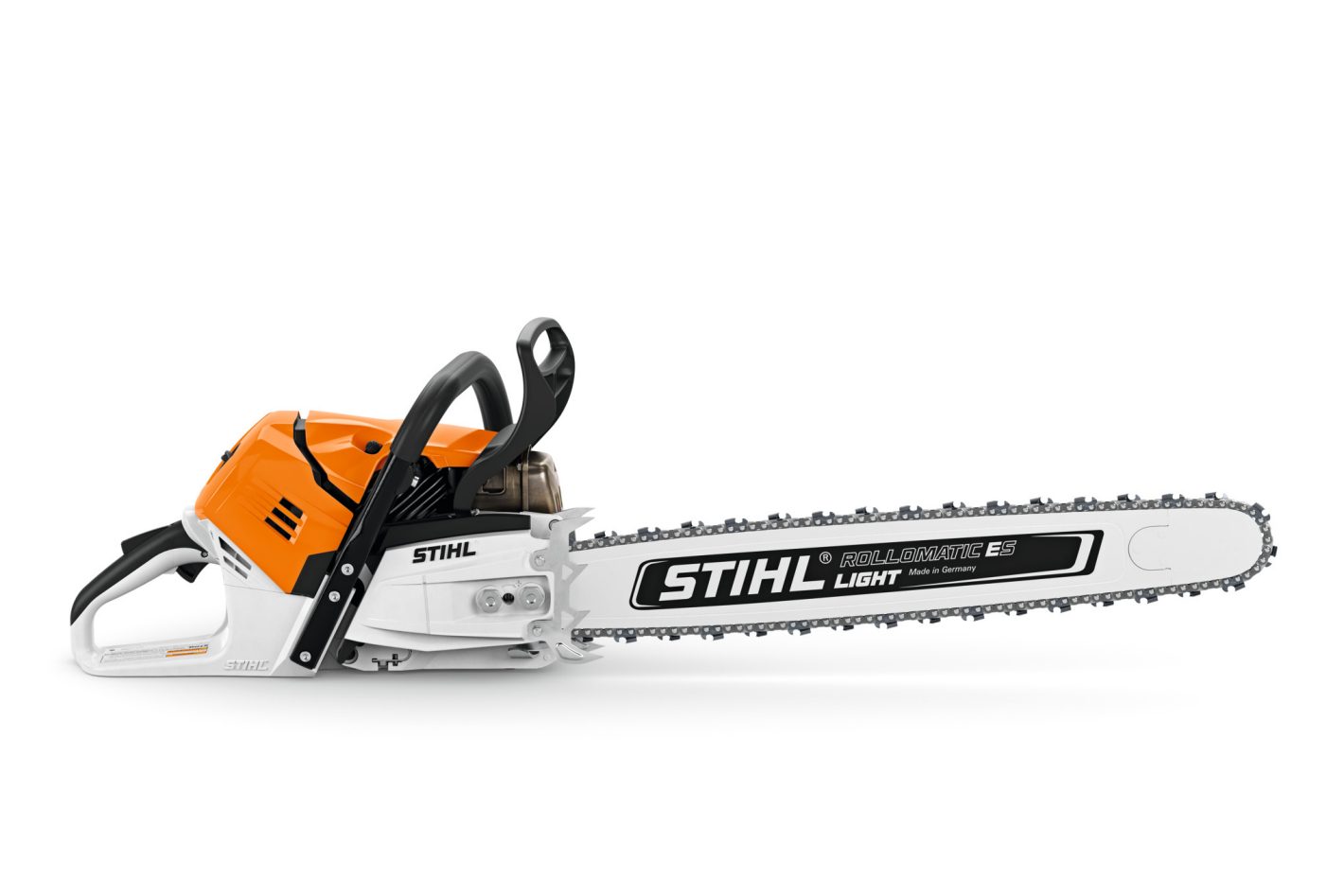
The Stihl MS 500i is the world's first production chainsaw with electronically controlled fuel injection, and although it has earned a reputation as one of the most capable professional saws ever built, its owners consistently report a defined and recurring set of problems: difficult hot restarts, an air filtration system that allows fine dust to reach the engine, a chain oiler that struggles to keep long bars supplied, a soft anti-vibration system on many units, and a small but real number of expensive fuel-injection faults that only a Stihl dealer can diagnose. This article examines each of those problem categories in detail, explains the components involved, and separates the fixes an owner can perform from those that require an authorized dealer equipped with the Stihl MDG 1 diagnostic analyzer.

The MS 500i was launched globally in October 2019 and reached the United States market in 2020. It uses a 79.2 cc two-stroke engine that produces 5.0 kW (6.8 brake horsepower), and it weighs 6.2 kg (13.9 pounds) as a powerhead, giving it what Stihl's corporate press release described as "the best ever power-to-weight ratio – 1.24 kilograms per kilowatt, an exemplarily low value never achieved before by series-manufactured chainsaws." Understanding how this saw differs from a conventional carbureted chainsaw is essential to diagnosing it correctly, because many of the traditional troubleshooting habits that professionals have developed over decades do not apply to a fuel-injected engine.
How the Fuel Injection System Works
Before examining specific faults, it is important to understand the technology, because most of the confusion surrounding the MS 500i comes from operators applying carbureted-saw logic to an injected engine. The MS 500i has no carburetor. Instead, an electronic control unit continuously calculates the correct fuel quantity and the ideal ignition timing, and fuel is injected directly into the crankcase through an injection valve. Sensors measure air pressure, external air temperature, and engine temperature, and pass that information to the control unit, which then determines the optimum fuel quantity and ignition timing for the conditions at hand. This is why the saw compensates automatically for altitude, cold or hot starts, fuel quality, and even a partially clogged air filter, and it is what enables Stihl's headline claim of chain acceleration "from 0 to 100 km/h in just 0.25 seconds."
The fuel delivery path is unusual. The primer bulb, often mistaken for a conventional carburetor purge, does not pull fuel through a carburetor because there is no carburetor. Instead, it pulls fuel from the tank and pressurizes the high-pressure circuit that feeds the injector. The injector itself resembles a large solenoid actuator that opens and closes on command from the control module rather than an automotive-style atomizing injector. Overflow fuel is returned to the tank. Pushing the primer simply circulates fuel and pressurizes the line; it does not squirt fuel into the intake the way a carbureted saw's primer does. There are three fuel screens in the system: the pickup filter in the tank, a screen in the fuel pump, and a fine screen inside the injector itself. The saw also carries a decompression valve to ease starting, an HD2 washable air filter, an automatic adjustable chain oiler, a centrifugal clutch, and a Quickstop chain brake. When a dealer services the saw, the MDG 1 diagnostic software reads the error memory and the start statistics (the number of successful and failed starts), which is a powerful diagnostic aid unavailable on any carbureted saw. Critically, whenever a fuel-system component such as the injector, the control module, or the injection pump is replaced, the saw must be recalibrated with the dealer software before it will idle and run correctly.
Starting Problems
Symptoms
Owners report several distinct starting complaints. The most common by far is the hot restart problem: the saw starts and runs perfectly from cold, but after it has been run hard and shut off, it refuses to restart, or it fires and immediately dies, or it bogs and stalls when the throttle is touched. This condition typically persists for 20 to 30 minutes until the saw cools, after which normal starting returns. A second complaint is a brand-new saw that requires an excessive number of pulls and primer-bulb presses on the second and subsequent starts of the day; one owner with roughly 10 tanks through a new saw described first starts of the day as acceptable at "about 5 to 8 pulls and lots of primer bulb," but second starts as "nothing but a rumble, 30 40 yanks and 100 primer bulb pushes, no joy." A third is simple starting-procedure confusion, where an operator accustomed to a choke lever cannot understand why the saw will not fire.
Causes
The single largest cause of frustration is procedural. The MS 500i has no choke. Operators who expect the multi-stage choke of a conventional Stihl saw flood or mishandle the engine. The genuine hot-start difficulty has two overlapping causes. The first is heat soak and fuel vaporization: on a hot day, after hard use, the fuel in the delivery circuit can vaporize and form vapor bubbles, which is why Stihl documentation and dealers advise pressing the primer bulb a number of times to purge the bubbles before a hot restart. The second is a rich-shutdown condition. As several experienced users describe it, if the saw is run hard and then shut off immediately before it returns to idle, the control system leaves the engine too rich to restart cleanly; as one owner put it, "If I run the saw hard, pull it out of a cut and immediately shut it off, it will not want to start after that." Allowing the saw to idle for roughly 10 seconds before shutting it off resolves this in most cases. Stale or old fuel and inconsistent gas quality also contribute; one Oklahoma dealer reported that switching customers to "premium fuel from a busy gas station that turns their fuel over quickly, resulting in fresher fuel" solved several hot-restart complaints, and noted encountering "both tru-fuel and motomix fuel that was several years expired."
Troubleshooting Steps
First, confirm the correct starting procedure. Engage the chain brake, remove the scabbard, and press the primer bulb the number of times specified in the manual (the manual states "at least 8 times," while many dealers suggest more presses, on the order of a dozen, when hot). Pull the starter rope; the saw should start at idle without any choke or high-idle position. Second, if the saw will not restart when hot, press the primer bulb liberally to clear vapor and try again; do not simply keep yanking the rope. Third, adopt the habit of letting the saw idle for several seconds before shutting it off. Fourth, drain and replace the fuel with fresh, correctly mixed fuel from a high-turnover source and retest. Fifth, if the problem persists across fresh fuel and correct procedure, inspect the spark plug for fouling and the decompression valve for correct operation, and check for air leaks at the intake boot and crankcase seals. Sixth, if none of these resolve the issue, the saw needs to go to a dealer for an MDG 1 diagnostic read.
Solutions
Procedural fixes cost nothing: learn the no-choke start, use the primer generously when hot, and idle down before shutdown. These alone eliminate the majority of reported hot-start complaints. Replacing stale fuel with fresh premium fuel is a simple owner-level fix. If a spark plug is fouled, replace it with the specified plug (the NGK CMR6H, gapped to 0.5 mm / 0.02 inch). If diagnosis reveals a leaking crankcase seal (discussed under Fuel System Problems) or a failing injector or control module, the repair moves into dealer territory and, if the saw is within its warranty period, should be performed under warranty. When any fuel-injection component is replaced, the dealer must recalibrate the saw with the MDG 1 software; a saw that has had a part swapped without recalibration may idle poorly or refuse to idle at all.
Fuel Injection System Problems
Symptoms
Fuel-injection faults are the most serious and the most expensive problems the MS 500i can develop, though they are far less common than the maintenance-related complaints. Symptoms include the saw starting and dying within a few seconds regardless of throttle or priming, the saw only running when it is deliberately flooded, raw fuel appearing at the exhaust, hydro-locking (the engine seizing solid on the starter rope because liquid fuel has filled the cylinder), a fuel-soaked spark plug, and excessive smoke. Another distinct symptom is fuel pooling in the crankcase after shutdown, or fuel leaking from the line where it connects to the injector when the primer is pressed more than a handful of times.
Causes
The most frequently implicated component is the injector. A leaking or dribbling injector allows fuel to seep into the crankcase after shutdown, which produces hydro-locking, raw fuel at the exhaust, and hard hot-starting. Owners and technicians have reported a sealing ring failing on the injector; as one professional relayed of a one-month-old saw running Stihl premix, "Something about a sealing ring goes bad on injector. Under warranty they take care of it. Out of warranty $300 for just injector plus labor time. Then topend cost too." The injector can also become partially clogged: the fine internal screen behind the inlet barb can plug with debris, which slows the primer bulb's return and starves the system. The control module (the injection module) can also fail; because the module commands the injector to open, a module fault can leave the injector stuck closed so the saw pops but will not run. Other possible culprits in a running fault include the pressure and temperature sensors, the stator, and the wiring associated with any of these. Water in the fuel has been reported to cause internal fuel-screen problems downstream of the main fuel filter.
Troubleshooting Steps
Diagnosis of the injection system is genuinely difficult and, for most owners, is not a do-it-yourself task; one technician with a Stihl MDG 1 tester remarked, "It is fairly difficult to diagnose a bad injector sometimes. I've never seen one just stop working, or be detected as 'bad' by my Stihl (MDG1) tester." The injector pressure test is the key diagnostic: with the top cover off and the fuel filler cap loosened to relieve tank pressure, a technician carefully removes the leftmost hose at the fuel pump and applies gentle test pressure to the injector inlet, on the order of 3 to 4 psi, until it bypasses. A healthy injector should hold and not drop below roughly 2.5 psi; if pressure continues to bleed down, the injector is leaking and is bad. A separate pump test involves pulling the impulse (center) hose at the pump: if fuel sprays out when the primer is pumped, the pump diaphragm is ruptured. A slow-retracting primer bulb points to a partially plugged internal injector screen, and the fuel filter should be replaced first to rule out that restriction.
Solutions
A clogged injector screen or a dirty fuel filter is the least expensive outcome and is within reach of a capable owner, although the required replacement of any wetted fuel hose (an EPA-driven requirement when hoses are disconnected) raises the parts cost. A failed injector, a ruptured pump diaphragm, or a failed control module are dealer repairs. Owners have reported that a bad injector out of warranty costs on the order of 300 dollars for the part alone, plus labor, and potentially top-end work if fuel wash has scored the cylinder. The overriding financial reality was captured by one repairer facing an ambiguous fault: "Could be the injector is bad, could be the module, could be fuel sensor, could be stator, could be wiring related to any of the above. Replacing all that costs over half the saw." An accurate diagnosis before ordering parts is therefore essential; firing the "parts cannon" at an injection fault is an expensive mistake. Because early units were more prone to injector issues, and because these faults frequently appear within the warranty window, owners should pursue warranty coverage aggressively. Every injection-component replacement must be followed by MDG 1 recalibration, which, as one technician noted, "is the only way to recalibrate the 500i."
Engine Stalling and Performance Problems
Symptoms
Reported performance problems include the engine stalling shortly after starting (particularly when cold), stalling at idle after a few seconds of running, bogging or leaning out under load, loss of power, and, in the worst cases, a saw that revs normally for a few seconds and then cuts out repeatedly. One owner described a saw that "would start an idle and sound OK and lean out if you put under any load"; another reported a saw that "tends to stall after 2-3 seconds when cold, but not when it is warmed up," where the dealer "could not find anything wrong."
Causes
Because the MS 500i adapts its fuel delivery electronically, many stalling complaints trace to air leaks and fuel-supply restrictions that the control system can no longer compensate for. Documented causes include cracked fuel lines, a cracked intake boot, a ruptured fuel-pump diaphragm inside the primer assembly, a blocked tank vent, and worn crankcase seals. In one thoroughly documented case, a saw that leaned out under load and would not restart on its own was ultimately traced, after a pressure and vacuum test, to a failed power-take-off (clutch-side) crankshaft seal. A blocked tank vent will also prevent the primer bulb from pumping properly, a useful diagnostic clue. Sensor faults, a weak flywheel magnet signal, or oil contamination of the pressure and temperature sensors can also cause a running engine to lose its timing and fuel reference and stall.
Troubleshooting Steps
Approach a stalling MS 500i systematically. Confirm fresh, correctly mixed fuel first. Inspect the fuel lines, the intake boot, and the primer assembly for cracks. Check the tank vent; a suspicious sign is a primer bulb that will not pump unless the fuel cap is loosened. Pull and inspect the fuel filter. Check the fuel-pump diaphragm by the impulse-hose test described earlier. The definitive test for air leaks is a pressure and vacuum test of the crankcase, which will reveal a leaking crankshaft seal or intake leak that no amount of parts-swapping will otherwise find. Finally, a dealer MDG 1 read can display error codes and, in principle, allow a technician to observe sensor outputs during a run until the engine cuts out.
Solutions
Cracked fuel lines, a cracked intake boot, a bad tank vent, and a ruptured pump diaphragm are all repairable, and a mechanically confident owner can perform several of these, though the wetted-hose replacement rule applies. A leaking crankshaft seal is a more involved repair; while some experienced saw builders replace seals themselves, most owners should route this to a dealer, and it should be covered under warranty on a saw still within its term. Sensor, stator, and module faults are dealer repairs requiring recalibration. The practical lesson from owners is that a pressure and vacuum test should come before any parts purchase on a stalling or leaning saw.
Air Filtration Problems
Symptoms
This is one of the two most frequently and passionately reported problems with the MS 500i. Owners in demanding conditions report that fine dust and even small wood chips bypass the air filter and reach the intake and engine, that the filter clogs unusually quickly, and, in severe cases, that fine abrasive material has scored the piston and cylinder and worn out the lower-end bearings prematurely. One high-hour owner who had put roughly 300 cords through a saw in a year wrote, "Wtf is with the air filter on a 500i? mine has sucked dirt since day one… this air filtration system is a failure in the real world," reporting he was on his fifth filter. Milling users and West Coast fallers cutting in bare, dusty, or burned ground report the worst outcomes, including engines showing heavy blow-by and dust-clogged bottom ends after remarkably little running time; one forum analysis of a low-hour milling saw noted "fines that have bypassed the filter system and have clogged up the bottom end and rings of the saw."
Causes
The MS 500i uses the HD2 washable air filter, which Stihl describes as fine-pored and capable of filtering even the finest dirt. The problem is not primarily the filter medium but the sealing arrangement. The filter attaches with a plastic quarter-turn or twist-lock system, and the plastic locating finger can wear over time, allowing the filter to sit imperfectly and permitting fines to pass around the sealing face rather than through the medium. Crucially, unlike several other Stihl pro saws, the MS 500i does not use centrifugal pre-separation (sometimes called air-injection or clean-air technology). According to informed forum discussion, Stihl omitted the pre-separation system on the 500i because the saw's airflow is routed entirely around the cylinder for cooling, and because the filter and intake sit on the tank housing, separated from the crankcase, which makes a pre-filtered airstream impossible in that architecture. The result, as one owner concluded, is that "the 500i only does a mediocre job at filtering out fines," and that "No air injection on the 500i makes them subject to these kinds of failures more often than other models."
Troubleshooting Steps
Inspect the filter and, importantly, the sealing face and the plastic finger every time the cover is opened. Look for fines in the intake throat after removing the filter; visible dust past the seal, not merely dust embedded in the filter, is the warning sign. Check that the cover closes tightly. Monitor for symptoms of dust ingestion, such as unexplained power loss, rising fuel consumption as the tune shifts, or a filter that needs cleaning far more often than any other saw the owner has run.
Solutions
Several owner-level mitigations are widely used. Applying a light film of rubber grease or petroleum jelly to the sealing lip and around the center-stud hole improves the seal. Some owners fit a small washer and a dab of silicone to keep the filter seated. In hard commercial and milling use, the more robust solution is an aftermarket air-filtration system: several kits, some machining an aluminum intake or adapter to accept an oiled foam or oiled-cotton clamp-on filter with an outer sleeve, are available and are marketed specifically to address the 500i's fines problem. Owners who mill or fell in extreme dust should budget for one of these systems and should treat air-filter inspection as a per-tank, not per-day, task. Where dust has already reached the engine, a top-end inspection is warranted, and a scored piston will require replacement.
Overheating Problems
Symptoms
Owners report the bar and chain running hot, the engine running hotter than expected, hot spots and discoloration on the guide bar, unusual vibration or noise associated with heat, and a burnt-wood smell during cutting. A specific and instructive case involved a 500i running a 32-inch bar where the bar and chain became too hot to touch immediately after cutting, while the same saw with a 24-inch bar stayed cool enough to handle; the owner ultimately concluded "the 32 is a bit long for the saw."
Causes
Overheating on the MS 500i usually has a mechanical or operational cause rather than an injection fault. A dull chain, a chain tensioned too tightly, a plugged exhaust or spark-arrestor screen, and, above all, inadequate bar-and-chain lubrication on long bars are the leading contributors. Running a bar near or beyond the saw's practical oiling capacity (discussed in detail below) causes the chain to run dry and hot. A clogged air filter that shifts the effective tune, and overworking the saw by forcing it through cuts beyond its capacity, also generate excess heat. The engine's own cooling depends on clean cooling fins and unobstructed airflow around the cylinder.
Troubleshooting Steps
Determine first whether the heat is in the bar and chain or in the engine. For a hot bar and chain, verify that the oiler is set high enough and that oil is reaching the bar (see Chain Oiling Problems). Confirm the chain is sharp and correctly tensioned, and that the depth gauges or rakers are set appropriately for the bar length. Swap to a shorter bar as a diagnostic; if a 24-inch bar runs cool where a 32-inch bar runs hot, the problem is oiling capacity, not the engine. For engine heat, inspect and clean the cooling fins and the exhaust and spark-arrestor screen, and check the air filter.
Solutions
Keep the chain sharp and correctly tensioned, and set the rakers to match the bar length. Turn the oiler up and, on long bars, adopt the working practice several owners describe: rev the saw between cuts to saturate the chain with oil, and avoid overworking the saw continuously on the longest bars. Clean the cooling fins and clear any exhaust obstruction. Owners have also found that a basic muffler modification or an opened exhaust cover noticeably lowers operating temperature; as one wrote, "a basic muffler mod or adding the WCS or Evens plate opens the exhaust enough to greatly cool things down, even in 100* temps." Such modifications may affect emissions compliance and warranty and should be undertaken with that understanding. The most reliable solution for chronic bar-and-chain overheating is to run a bar length the oiler can actually supply.
Chain Oiling Problems
Symptoms
Owners report inadequate oil output for longer guide bars, a chain that runs dry and hot, a dry or barely oiled bar when the saw is new, hot spots worn through the factory coating on long bars, and, at the opposite extreme, oil dripping or leaking from the saw at rest.
Causes
The central complaint is that the MS 500i's oil pump, even at its maximum setting, delivers marginally enough oil for bars beyond a certain length. This is compounded by a factory-installed detent, or stop pin, that limits how far the oiler adjustment can be turned up. The oiler on the MS 500i is the same pump shared across several Stihl pro saws; as one owner confirmed after cross-referencing parts lists, "The 261, 362, 462, 500, and 661 all share the same oil pump." Stihl confirmed to at least one dealer that there is no separate high-output oiler or upgraded pump available for it, and that even the MS 500i R shares the same oiler. A further restriction is the small, angled oil-supply hole in Stihl guide bars, which is narrower than the outlet slot on the inner side plate and which readily clogs with wood residue. A new saw may oil poorly at first because the pump is not yet primed; one owner recalled that on first use "I was literally pouring oil on the chain it was so dry," but after pushing the pin in and adjusting to maximum, "the oiling was great." Oil dripping at rest is usually caused by overfilling or by insufficient tank ventilation, which pressurizes the tank and forces oil out.
Troubleshooting Steps
Confirm first that the oiler is actually reaching the bar by holding the running chain near a clean surface and looking for a thrown line of oil. If output is low, push in the stop pin to unlock additional adjustment travel, then turn the oiler to maximum. Verify that the bar oil hole and the bar groove are clear of packed sawdust. Check that the bar is not adjusted so far out that the oil hole is partially covered. Confirm the correct bar gauge; a mismatch between bar and chain gauge can affect delivery. For dripping at rest, check for overfilling and loosen the oil cap slightly to test whether tank pressurization is the cause.
Solutions
The first and most important owner fix is to punch in the stop pin and run the oiler at maximum; many owners report this alone transforms a dry saw into one that oils well. Keeping the bar groove and oil hole clean is routine maintenance. Some owners enlarge the bar oil hole with a small drill bit (one reported using "a 4.5mm impact drill bit") to reduce the restriction, and report a noticeable increase in output, though others correctly point out that the pump's fixed output and the internal passage diameters ultimately cap how much oil can flow, so drilling the bar helps only up to a point. The most durable solution is to respect the saw's practical oiling limit: multiple experienced owners conclude that the MS 500i does very well with bars up to 28 inches, that 32 inches is near the limit even with the pin punched, and that "anything bigger is pushing it… from a oiling standpoint even with the pin punched." Running a bar the oiler can supply, at maximum output, with a clean groove, is the reliable answer. For dripping, do not overfill, and ensure the tank vent is functioning.
Clutch and Chain Drive Problems
Symptoms
Reported clutch and drive problems include a loud knocking or rattling noise, a smoking clutch area, a clutch drum that is discolored or damaged from heat, and, in at least one documented case, pieces broken off the clutch that were found rattling loose inside the cover. UK dealer experience posted to Arbtalk reported that of the MS 500i units seen for repair, "Most of them come in for the clutch, I personally think it should be bigger. Maybe from the 661."
Causes
Worn or damaged clutch springs and shoes generate the knocking and rattling noises owners describe. A clutch that is undersized for the saw's output has been cited by the experienced dealer quoted above. Smoking and discoloration at the clutch typically follow from a chain that will not turn freely, from running with the chain brake partially engaged, or from a seized or dragging chain that makes the clutch slip. Broken clutch shoe ears have been reported both from the failure itself and from operators impacting a stubborn clutch too aggressively during removal; one owner recounted, "I've busted off clutch shoe ears when the clutch wouldn't release with an impact. So I kept impacting. Eventually it came off and very similar bits fell out." A clutch drum that wobbles after assembly can interfere with the brake band, the plastic housing, or the oil-pump drive.
Troubleshooting Steps
Investigate unusual noise by removing the clutch cover and inspecting the clutch shoes, springs, and drum, and the needle bearing, for wear, cracks, or heat damage. Confirm the chain turns freely by hand with the brake released and that the brake is not dragging. After any clutch service, check the drum for wobble, which indicates a worn bearing or an assembly problem. Inspect for loose debris inside the cover.
Solutions
Replace worn or damaged clutch springs, shoes, and the drum as required, using genuine parts. Confirm the needle bearing is sound and lightly greased. Ensure the chain brake fully releases and the chain runs freely to prevent heat damage. Because clutch removal on these saws can be stubborn, use the correct procedure (blocking the piston and turning the clutch counterclockwise) rather than repeated heavy impacts, which can break the shoe ears. A wobbling drum must be corrected before further use to protect the brake band and oil-pump drive. Clutch work is within reach of an experienced owner with the right tools, but a smoking clutch discovered in the field should be shut down immediately to prevent consequential damage.
Fuel System Problems
Symptoms
Beyond the injection-specific faults already covered, the broader fuel system produces its own symptoms: a primer bulb that will not pump or is slow to retract, fuel leaks at seams and hose connections, a saw that will not run well unless the fuel cap is loosened, and hard starting or stalling traced to fuel restriction or contamination. One owner troubleshooting a lean-running saw noted that "The primer bulb would not pump fuel well, unless the fuel cap was released."
Causes
A slow-retracting primer bulb typically indicates a partially plugged internal injector screen or a clogged fuel filter. A primer that will not pump at all often indicates a blocked tank vent, because the tank cannot draw replacement air. Cracked or perished fuel lines, a ruptured pump diaphragm, and a plugged pickup filter all restrict fuel. Contaminated or stale fuel, particularly ethanol-blended fuel that has absorbed moisture and phase-separated, degrades running and can clog the fine screens. Wood pulp drawn into the fuel tank has been raised as a longer-term concern for clogging the fine injector tolerances, given that the injector's clearances are much tighter than those of a carbureted saw.
Troubleshooting Steps
Start with the tank vent when the primer will not pump; if loosening the fuel cap restores pumping, the vent is the fault. Replace the fuel filter as the first cheap step for a slow primer or restriction symptoms. Inspect all fuel lines and connections for cracks and weeping. Test the pump diaphragm with the impulse-hose test. Drain and replace stale or suspect fuel. If the fine injector screen is suspected, it can be accessed by removing the inlet barb, though the wetted-hose replacement rule applies to any disconnection.
Solutions
Replacing a blocked tank vent, a clogged fuel filter, or cracked fuel lines are straightforward repairs, keeping in mind the requirement to replace wetted hoses once disconnected, which makes the fuel-pump module comparatively costly because it comes with new injector hoses. Using fresh fuel from a high-turnover source, or premixed ethanol-free fuel, prevents the majority of contamination problems. Keeping dirt and debris out of the tank during refueling protects all three fuel screens and the injector. Diaphragm and injector-related repairs, and any work that disturbs the calibration, are best completed by a dealer with the recalibration software.
Maintenance-Related Failures
Symptoms
A substantial share of the "problems" attributed to the MS 500i are in fact the consequences of deferred or incorrect maintenance: premature engine wear and scored pistons from dust ingestion, hard starting and stalling from stale fuel and clogged filters, bar and chain overheating from a dry or clogged oiler, and, in the most severe cases, main-bearing and crankshaft failures.
Causes
The MS 500i is a high-output professional saw with tight tolerances and, as discussed, an air-filtration architecture that is less forgiving than some of its stablemates. Neglecting the air filter and its seal in dusty conditions is the leading cause of premature engine death. Running stale or ethanol-heavy fuel fouls the fine fuel system. Failing to keep the oiler and bar groove clear leads to heat damage. Crankshaft and main-bearing failures, while relatively uncommon, have been reported; in one owner's rebuild, the clutch-side bearing had disintegrated ("clutch side bearing balls fell out") and the crankshaft lobe had spun out of alignment. The same UK dealer who reported the clutch as the most common repair said of bottom-end failures, "Think we've had one for a main bearing failure, maybe two," which suggests bottom-end failure is not the typical outcome but is a real risk, particularly where dust ingestion has been allowed to occur.
Troubleshooting Steps
Establish a maintenance baseline. Inspect the air filter and its seal frequently, more often in dusty work. Check bar-and-chain lubrication at every refuel. Keep fuel fresh. Watch for the early warning signs of bottom-end trouble: unusual noise, changed running behavior, loss of compression, or metallic debris. A compression test and, where a fault is suspected, a pressure and vacuum test will reveal a tiring engine before it fails outright.
Solutions
The overwhelming majority of maintenance-related failures are preventable, which is the subject of the next section. Where damage has already occurred, a scored piston and cylinder can be replaced, and a spun crankshaft or failed main bearing can be rebuilt, but the parts cost of a bottom-end rebuild can approach the value of a used saw, so prevention is decisively cheaper than repair. Owners should weigh the economics carefully: forum experience shows that owners have replaced whole handle-and-tank assemblies after accidents (one reported spending "close to $400 replacing the handle and tank assembly after a little tree incident") and rebuilt neglected saws, but a saw destroyed by dust ingestion is largely an avoidable loss.
Model-Year and Variant Differences
Early Versus Later Production
The MS 500i launched worldwide in October 2019 and reached the United States in 2020. Shortly after its introduction, the saw was pulled from dealer shelves in North America, which generated considerable online speculation. It is important to state clearly what this was and was not. It was not a formal recall registered with the United States Consumer Product Safety Commission. As of 2026, the MS 500i chainsaw does not appear anywhere on Stihl's official recall list, which is published at stihlusa.com and which lists products such as the MSA 300 chainsaw, the MS 461 chainsaw, the MS 391 powerhead, the TS 440 cut-off machine, and the TS 480i and TS 500i cut-off machines, but not the MS 500i chainsaw. The North American shelf pull was an internal Stihl action, and it affected only the North American market; the saw remained on sale and was described by forum users as a bestseller in Europe, Australia, and New Zealand throughout that period ("It is a one year old story – the MS500i is a bestseller in Europe – without any problems"). The exact official reason was never publicly documented by Stihl on the record, and the "reasons" circulated in forums, ranging from emissions certification to concerns about early over-fueling and muffler flame-ups, remain speculation. What is documented is that early units were more prone to injector issues, and that an over-fueling tendency related to injector behavior was a recognized early concern.
Considerable confusion arises because there is a genuine, formally recalled Stihl product with a similar name: the TS 500i cut-off machine (a concrete saw, not a chainsaw). Per Stihl's official recall notice, "STIHL TS 500i cut-off machines between serial number 180 658 145 and 181 213 014 may have a fuel line that can crack and leak fuel, posing a risk of fire," and owners were directed to "return them to an authorized STIHL Dealer for a free inspection and repair" (contact 800-610-6677). That notice was posted in February 2021. Searching for "500i recall" frequently returns this cut-off-machine recall, and forum users have repeatedly noted the name confusion, one writing, "Everything I have found is the ts500i as well… Think there may be confusion in the names leaving off the first 2 letters." The related TS 440 cut-off machine also carries its own separate recall, originally posted in August 2018. Neither applies to the MS 500i chainsaw.
Later production units are generally regarded as more sorted than the earliest examples, and the injector concerns that dogged some early saws are less prominent in reports of newer units. In 2025 and 2026, Stihl introduced a Centennial Edition of the MS 500i in a black design to mark the company's 100th anniversary, and current saws ship with the Stihl Rapid Hexa saw chain and a lightweight guide bar in many configurations.
The MS 500i R and the Anti-Vibration System
The second most passionately reported issue with the MS 500i, alongside air filtration, is a soft or "floppy" anti-vibration system. Many owners, especially West Coast fallers running long bars, report that the AV springs are too soft for heavy timber work, that the powerhead bottoms out or flops noticeably when the saw is held sideways or cut with the top of the bar, and that a new saw can feel as though an AV buffer is already broken; one owner wrote, "I picked up a 36" 500i today and it felt like an AV buffer was broken. Floppy for sure." The anti-vibration system uses spring and buffer elements to isolate the handle from the engine; on the MS 500i these were specified soft, which benefits comfort and reduces fatigue but compromises control under the heaviest loads. As one West Coast professional summarized his complaints, "both air filters plug quickly as well as the anti vibration springs are soft for west coast work, plus the pull start handle are garbage."
There is a notable variant point here. On many Stihl models, the R (rescue or wrap-handle) version historically came with stiffer AV springs and buffers, and the stiffer components could be bought as a kit. With the MS 500i, however, dealer and forum investigation found that the MS 500i and MS 500i R share the same AV springs; as one owner reported, "All the AV springs are the same from 1/2 to 3/4 wrap on the 500." In other words, buying the R variant does not by itself solve the soft-AV complaint. Owners who find the AV too soft address it with aftermarket suspension kits marketed specifically for the 500i, such as the West Coast Saw Faller's Suspension Kit, or by substituting stiffer springs and firmer rubber buffers in place of the factory springs and foam pieces. Owners who run shorter bars, in the 20-to-25-inch range, frequently report no AV complaint at all, one stating, "I don't have a problem with the anti-vibe, but I use it with a 20" and 25" bar," which indicates the issue is most pronounced with long bars in demanding felling.
It is worth noting that the MS 500i R designation refers to the wrap-handle version favored by fallers; the wrap-handle R weighs slightly more than the standard saw (approximately 6.7 kg / 14.8 lb versus 6.2 kg / 13.9 lb). Owners should not assume the R brings the stiffer AV, larger oiler, or wider clutch cover that R models on some older platforms provided, because on this platform the oiler is shared across variants and the AV springs are common.
Preventive Care and Recommended Servicing Schedule
Preventive maintenance is the single most important determinant of whether an MS 500i gives long, reliable service or becomes one of the cautionary tales in the forums. The following schedule combines Stihl's published intervals with the hard-won practices of professional owners.
Fuel and Oil: Getting the Basics Right
Use fresh, high-quality fuel. Stihl specifies a 50:1 mixture of gasoline to two-stroke oil for the MS 500i, as for all its gasoline equipment (2.6 fluid ounces of oil per US gallon), and recommends a minimum octane rating of 89 (mid-grade). Many experienced owners prefer premium fuel of 91 octane or higher, and strongly favor ethanol-free fuel, because ethanol is hygroscopic, attracts moisture, can phase-separate, and degrades rubber fuel-system components. Stihl explicitly recommends fuel with no more than 10 percent ethanol and warns that "Using fuel with greater than 10% Ethanol content may cause damage to your equipment and may void your STIHL warranty." Use a quality synthetic two-stroke oil; Stihl HP Ultra is the factory recommendation, and Stihl MotoMix premixed ethanol-free fuel is an excellent, if more expensive, way to eliminate mixing errors and stale-fuel problems. Do not use mixed fuel that is more than a few weeks old, and never store mixed fuel longer than three months. While the injection system tolerates a range of mix ratios (owners have run everything from 32:1 to 50:1 without injector trouble), staying with the specified 50:1 and a good synthetic oil protects the bearings and crank over the long term and keeps the saw within warranty terms.
Air Filter
The HD2 air filter should be cleaned regularly, at monthly intervals per Stihl's maintenance schedule, and inspected far more often than the interval alone would suggest, because on this saw the seal is as important as the medium. In heavy or dusty work, inspect the filter and its sealing face and plastic locating finger at every refuel. Do not attempt to clean fine dust out of the HD2 by knocking or brushing alone; the filter is designed to be washed. Rinse coarse dirt off, then clean with a proper cleaning agent, rinse, and allow it to dry fully before refitting. Replace the filter if it is damaged or if the sealing finger has worn. Apply a light film of grease to the sealing lip to improve the seal, and consider an aftermarket filtration system for milling or extreme-dust work.
Fuel Filter, Spark Plug, and Injector
The fuel pickup filter in the tank should be kept clean (cleaned monthly and replaced every 12 months per Stihl's schedule, both by a dealer) to protect the fine injector screen. The spark plug should be inspected periodically and replaced after every 100 hours of operation; the specified plug is the NGK CMR6H, gapped to 0.5 mm (0.02 inch). A fouled or worn plug contributes to hard starting and poor running, and the plug's condition is also a useful readout of fuel-mix quality. Stihl's Service Kit 17 for the MS 500i bundles the HD2 air filter, the spark plug, and the fuel filter together for owner self-service, which is a convenient way to keep the consumables current. The injector and its screen require attention only if symptoms appear; keeping debris out of the fuel and the tank is the best protection for the injector.
Chain, Bar, and Oiler
Keep the chain sharp; a dull chain overheats the bar, overloads the engine, and wastes fuel. Sharpen or replace the chain on a regular basis, and set the depth gauges to the specified 0.65 mm (0.026 inch) for the 3/8-inch chain, adjusting rakers for longer bars. Maintain the guide bar by cleaning the groove, clearing the oil hole, deburring the rails weekly, and dressing the bar to keep it straight; the minimum guide-bar groove depth for the 3/8-inch bar is 6 mm (0.236 inch). Check chain tension frequently and keep it correct: tight enough not to sag, loose enough to turn freely by hand. Confirm chain lubrication at every refuel by checking that oil is thrown from the running chain, and run the oiler with the stop pin pushed in and the output turned up if long bars are used. Match the bar length to the oiler's practical capacity.
Cooling, Clutch, and Bottom End
Keep the cooling fins and the area around the cylinder clean so the engine can shed heat, and clear any exhaust or spark-arrestor obstruction. Inspect the clutch periodically for shoe and spring wear and for drum condition, and lightly grease the clutch needle bearing. Listen for changes in engine noise and watch for changes in running behavior that may indicate bearing wear; a periodic compression check is a cheap early-warning tool. Have the chain brake serviced by a Stihl dealer at the interval appropriate to use (every 3 months for full-time usage, every 6 months for part-time, every 12 months for occasional use).
Off-Season Storage
For storage longer than three months, run the engine dry to prevent fuel from gumming the fine fuel-system components, or store the saw with stabilized fresh fuel and run it periodically. Clean the saw thoroughly, empty and clean the tanks as appropriate, inspect the spark plug, and store the saw in a dry place. Proper storage prevents the hard-starting and clogged-fuel-system complaints that reliably appear at the start of the next season.
When to Use a Dealer and the MDG 1
A capable owner can perform the majority of MS 500i maintenance and many repairs: filter service, spark plug replacement, fuel filter and fuel line replacement, chain and bar maintenance, oiler adjustment, clutch inspection, and even seal replacement for the mechanically confident. What genuinely requires a Stihl dealer is anything involving the fuel-injection electronics: diagnosing an intermittent injection fault, confirming a bad injector or module, and, critically, recalibrating the saw after any fuel-system component is replaced. The MDG 1 diagnostic analyzer reads the saw's error memory and start statistics and is the only way to recalibrate the control unit; without recalibration, a saw with a newly fitted injector or module may not idle correctly. Owners should also route warranty repairs through a dealer, and, given that early injector faults frequently fell within the warranty period, should not hesitate to invoke that coverage. When choosing a dealer, seek one familiar with the 500i specifically, because owners have reported that "None of the dealers that I've talked to seem to know anything about these saws."
Real-World Reliability: The Balanced Verdict
It would misrepresent the evidence to leave the impression that the MS 500i is an unreliable saw. The weight of owner testimony is strongly positive. A celebrated long-term test conducted by NordicWoodJournal, in which professional logger Lars-Erik Larsson ran the saw hard for three months and consumed about 100 liters (25 gallons) of fuel with deliberately no preventive service, found that the saw "just kept on going, without any problems," and started easily even though "The air filter is basically completely clogged," the only negative the testers could find being a little sawdust inside the filter. Many professional owners report hundreds of hours of trouble-free service; one owner reported over 804 hours since March 2019 "and not a single problem." The saw is widely described by loggers and arborists as their favorite, prized for doing 80 cc work in a package light enough to excel at 60 cc work, with acceleration and throttle response unlike any carbureted saw; one owner wrote that after getting his 500i he "refused to use" his MS 441, MS 461, and even his 064.
Against that, the specific and recurring complaints are real and should shape a buyer's expectations and an owner's habits: the air-filtration architecture is less forgiving in dust and milling than the pre-separation Stihl saws; the anti-vibration system is soft for the heaviest long-bar work and is not cured by choosing the R variant; the oiler is at its limit beyond about 28 to 32 inches of bar; hot restarts demand a learned technique rather than the old choke reflexes; and the fuel-injection components, while usually reliable, are expensive and dealer-dependent when they do fail. There was also a genuinely disappointed timber faller who bought a 500i as the only large saw available, found "it barely starts and runs terrible when it's hot," had to pack it out of the hole and grab another saw, and concluded he was "Terribly disappointed spending over $1500 for a saw that I can't depend on." That account is a reminder that individual units and individual conditions vary and that not every experience is a triumph.
The correct conclusion is that the MS 500i rewards an owner who understands it and maintains it, and punishes one who treats it like a simpler saw. Learn the no-choke starting procedure and the idle-down habit; obsess over the air filter and its seal; keep the fuel fresh; punch the oiler pin and match the bar to the oiler; address the AV with an aftermarket kit if the work demands it; and build a relationship with a knowledgeable dealer for the injection system. Do those things and the saw's reliability record is excellent. Neglect them and the very features that make the 500i special, its tight tolerances and its fine-tolerance injection, become the sources of expensive failure.
Recommendations
For a prospective buyer deciding whether the MS 500i is the right saw: if the work is professional felling, bucking, and delimbing where power-to-weight and throttle response matter most, and if the owner will maintain it properly, the 500i is worth the premium and is widely preferred over heavier 80 cc saws. If the primary work is milling or continuous cutting in bare, dusty, or burned ground, plan from the outset to fit an aftermarket air-filtration system, or consider a pre-separation saw such as the MS 462 or MS 661 instead. If the work involves the longest bars in heavy West Coast timber, budget for an aftermarket AV suspension kit and understand that the R variant will not by itself stiffen the anti-vibration system.
For a current owner, act in this order. First, correct technique: learn the no-choke start, use the primer generously when hot, and idle the saw down for several seconds before shutting off. These cost nothing and eliminate most starting complaints. Second, address the two structural weak points proactively: grease and inspect the air-filter seal at every refuel (and fit an aftermarket filter for dusty work), and punch in the oiler stop pin, run the oiler at maximum, and keep the bar to 28 inches where practical and no longer than 32. Third, standardize on fresh, ethanol-free premium fuel with a quality synthetic oil at 50:1, and never run fuel older than a few weeks. Fourth, keep Stihl Service Kit 17 consumables current and replace the spark plug at 100 hours. Fifth, build a relationship with a dealer who knows the 500i and the MDG 1, and route any injection fault or warranty claim to them promptly.
The benchmarks that should change these recommendations are concrete. If you observe fine dust or small chips in the intake throat past the filter seal, stop and fix the filtration before further use, because the next stage is a scored piston. If the bar and chain run too hot to touch immediately after cutting while the oiler is at maximum, shorten the bar. If the saw pops but will not run, or hydro-locks, or shows raw fuel at the exhaust, do not fire the parts cannon; get an MDG 1 diagnosis first, and pursue warranty coverage if the saw is within its term. If a smoking clutch appears in the field, shut the saw down immediately to prevent consequential damage.
Caveats
Several limits on the evidence should be stated plainly. Much of the real-world reliability information in this article comes from owner forums, including ArboristSite, the Outdoor Power Equipment Forum, TractorByNet, Arbtalk, and the Chainsaw Forum, and from dealer commentary within those forums. Forum reports are valuable because they aggregate large numbers of professional users, but they over-represent problems, because owners with functioning saws rarely post, and individual diagnoses are not always confirmed. Where possible, this article has favored reports that were resolved and documented, such as the crankshaft-seal case confirmed by a pressure and vacuum test and the injector faults confirmed by pressure testing or dealer diagnosis.
The reason Stihl pulled the MS 500i from North American shelves shortly after launch was never publicly documented on the record by the company, and the explanations that circulate are speculation. What is firmly established is that this shelf pull was not a listed CPSC recall, that the MS 500i chainsaw carries no CPSC recall as of 2026, and that the similarly named TS 500i is a different product (a cut-off machine) with its own genuine, separate recall for a fuel-line crack. Readers should not conflate the two.
Repair-cost figures cited here, such as the approximately 300-dollar out-of-warranty injector, are owner-reported and will vary by dealer, region, and date, and parts and labor prices rise over time. Finally, some of the remedies described, including muffler modifications and enlarging the bar oil hole, are owner modifications that may affect emissions compliance and warranty coverage; they are reported here because owners use them, not as an endorsement, and they should be undertaken only with a full understanding of those consequences.