
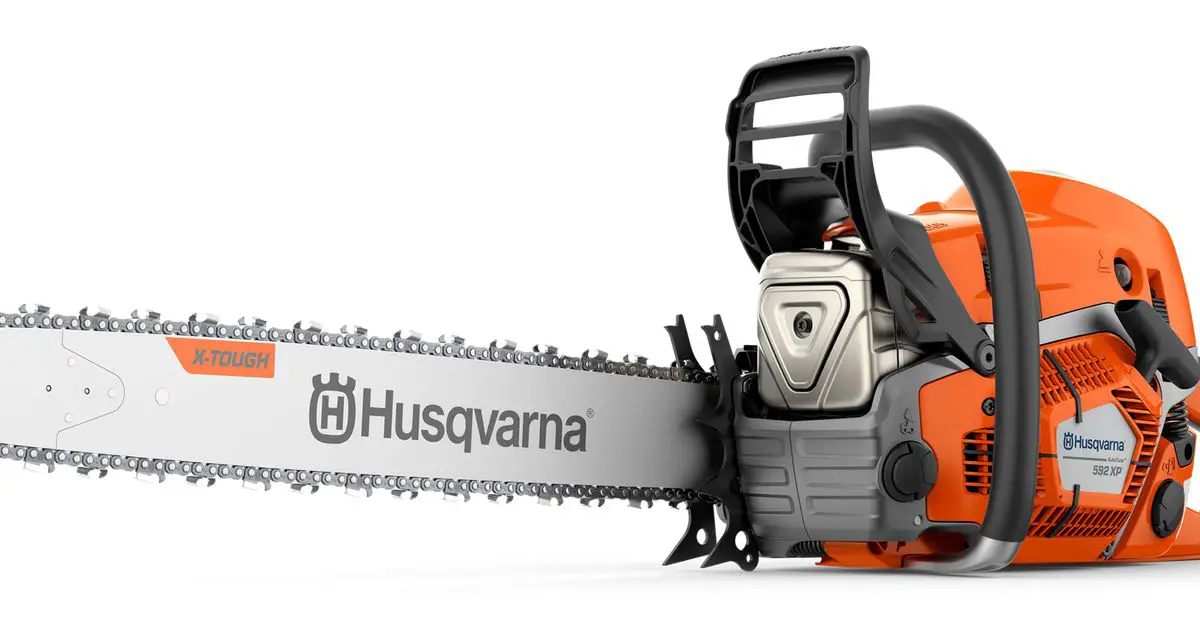
The Husqvarna 592 XP is a genuinely powerful and capable professional saw whose most frequently reported problems are concentrated in early-production units and in a handful of specific systems—AutoTune calibration drifting rich after warm-up, a chain oiler that is stingy on longer bars, an intake boot that cracks in cold weather, and a muffler that vibrates itself apart—almost all of which are diagnosable and fixable rather than fatal design flaws. This article examines each major problem category in detail, explains the underlying components, and provides structured troubleshooting steps and solutions drawn from the operator's manual, the workshop manual, and the real-world experience of loggers and saw technicians on forums such as ArboristSite (arboristsite.com) and the Outdoor Power Equipment (OPE) Forum (opeforum.com).

TL;DR
- The 592 XP is a strong performer (92.7 cc, 7.6 hp) but early-production units (2021– 2022) earned a reputation for teething problems: AutoTune running rich after warm-up, weak bar oiling, cracked intake boots in cold weather, and self-destructing mufflers; most later units and most owners report far fewer issues.
- The great majority of reported faults are serviceable: an AutoTune master reset, an oiler adjustment or worm-gear replacement, a superseded intake-boot part number (531381101), and a revised muffler (598429901) resolve the headline complaints, and there is no U.S. recall on file for the 592 XP or 592 XPG.
- Buyers who want maximum reliability should buy from a servicing dealer, break the saw in over several tanks, keep the AutoTune firmware current, run the oiler wide open on 28-inch and 36-inch bars, and inspect the muffler and intake boot regularly— especially when cutting in freezing temperatures.
Key Findings
- AutoTune 3.0 calibration is the single most-discussed problem. Multiple owners report the saw running well for the first day or two, then progressively running rich after warm-up, bogging, and dying after a tank or two. Dealers reset it with the diagnostic tool and it recurs; in several documented cases the true root cause was an air leak (cracked intake boot), a bad ignition coil, or a defective fuel filter, and the AutoTune was simply compensating.
- Chain oiling on the 592 XP is widely described as stingy, particularly on 24-inch bars and longer. The adjustable oil pump has no flow at idle, and its plastic adjustment-screw collar has broken on early units, causing oil to flow out uncontrolled.
- Cold-weather intake-boot cracking is a confirmed pattern: the inlet pipe/air-filter adapter tears in sub-freezing operation, causing an air leak, hard starting, and a saw that will not stay running. Husqvarna superseded the non-G intake part 593257901 with 531381101.
- Muffler failure ("self-modifying") is common: the small fastener holding the triangular cover vibrates a hole through the muffler body, and welds crack around the mounting tubes. Husqvarna's original 90 cc muffler kit 546909101 has been superseded by 598429901.
- Excessive vibration on early units drove secondary failures: the top/cylinder cover had insufficient clearance and hammered the cooling fins, and outer felling spikes broke.
- There is no U.S. recall (CPSC) for the 592 XP or 592 XPG; the changes above are running part supersessions in the parts catalog, not safety recalls.
Technical background: what is inside the 592 XP
The Husqvarna 592 XP is a 92.7 cm³ (roughly 90 cc-class) professional chainsaw introduced to the North American market in the spring of 2022, positioned above the 572 XP and alongside the long-lived 395 XP, which it is intended to supplement rather than fully replace (Pro Tool Reviews; Husqvarna US). Per Husqvarna specification data (published via SawSuppliers and Acme Tools): "Output shaft power 7.6 hp … Maximum power speed 9,600 rpm … Idling speed 2,800 rpm … Clutch engagement speed (±120) 4,300 rpm … Torque, max. 5.87 Nm at 7,800 rpm." It uses an NGK CMR6H spark plug and an adjustable oil pump with no flow at idle, and it accepts guide bars from 18 to 36 inches. The heated-handle variant, the 592 XPG, adds front and rear heated handles and an electrically heated carburetor controlled by a thermostat to prevent carburetor icing in cold, damp conditions (Husqvarna 592 XP G). Husqvarna also markets the saw on cutting capacity: per Pro Tool Reviews, "According to third-party tests, the Husqvarna 592 XP provides 5% more cutting capacity than its next closest competition—the Stihl MS 661 C-M," with Husqvarna's own benchmark stated as "when compared to closest competitor in the same displacement class, Stihl MS 661 C-M."
Several proprietary systems define how the saw behaves and how it fails:
- X-Torq engine. Husqvarna's stratified-scavenging two-stroke design routes a charge of clean air ahead of the fuel mixture to reduce fuel consumption and emissions. Because it is a strato engine with relatively high-strung tuning, it is more sensitive to air leaks and fuel-quality variation than a simple old-school two-stroke.
- AutoTune 3.0 carburetion. This digital engine-management system replaces manual high- and low-speed carburetor adjustment. It continuously reads running conditions and adjusts the fuel-air mixture for altitude, temperature, and fuel quality. Per Husqvarna's official 592 XP G page, AutoTune 3.0 "automatically optimizes the engine 10 times faster than previous versions." Critically, AutoTune has no user screws; when it misbehaves, diagnosis and reset require a dealer's diagnostic/service tool.
- Ignition module. The AutoTune coil/ignition module (OEM 529965401, superseded to 529965402 on the 592 XP and XPG) both fires the plug and participates in engine management. A weak or defective module can cause no-start, running-rich, or will-not-rev symptoms.
- Clutch assembly and chain drive. A centrifugal clutch engages the rim sprocket at approximately 4,300 rpm. The rim sprocket (part 501598002) rides on a needle bearing that must be greased periodically; it is a designed wear item (592 XP spare parts list).
- Chain brake. An inertia-activated brake band stops the chain in a kickback. It must be inspected for band wear and correct function.
- Automatic chain oiler. An adjustable, gear-driven oil pump delivers bar-and-chain oil, with no output at idle. The adjustment screw is retained by a small wire clip that allows roughly a quarter to half turn between stops (ArboristSite oiler thread).
- Crankshaft and bearings. A forged three-piece crankshaft runs in crankcase bearings inside a robust magnesium crankcase designed to handle the leverage of a 36-inch bar.
- Anti-vibration (LowVib) system. Rubber AV elements isolate the handles from the powerhead. On the 592 XP the AV elements are not symmetric: the left element (597909701) is notably softer than the right (595013901) (OPE Forum).
- Air filtration (Air Injection). A centrifugal pre-cleaner throws the majority of dust out before it reaches a large heavy-duty filter, extending filter life.
- Cooling system. Flywheel fins force air across the cylinder cooling fins. The cylinder/top cover must maintain clearance from those fins.
- Decompression valve. A push-button decompression valve reduces cranking effort for starting; several owners note it can leak or seize if over-tightened, and some remove it entirely.
The context that matters for troubleshooting is that the 592 XP is a new-generation, tightly tuned, electronically managed saw. Most of its reported "problems" fall into two buckets: genuine early-production quality-control defects (intake boots, mufflers, a bad batch of coils, over-torqued fasteners from the factory) and normal strato/AutoTune behavior that owners of older manual-carb saws are not used to (needing a break-in period, needing an occasional reset, and a deliberately conservative oiler).
Model-year and variant differences
Understanding which saw you have is central to diagnosing it. The 592 XP reached U.S. dealers in spring 2022; European availability preceded North America, and the earliest units in professional service date to roughly 2021–2022 production. Forum consensus is clear that early-production saws carry the bulk of the complaints and that later units are noticeably improved. On the OPE Forum "woes and fixes" thread, the technician known as Stump Shot repeatedly identifies the most troubled saws as "one of the very first to come out." Fellow members note the later mufflers feel heavier and thicker than the originals, consistent with the muffler part supersession described below. Key variant and revision points:
- 592 XP versus 592 XPG. The XPG adds heated front and rear handles plus an electrically heated carburetor with thermostat control. The heating provisions make the XPG the better choice for cold-climate work, but they add wiring, a thermostat, and a stator/generator load that are additional potential failure points; the XPG also uses different (winter-oriented) intake hardware. There is no separate G-specific intake-boot part number in the parts catalog; the shared intake 531381101 covers the platform, and the G's cold-weather advantage comes from its heated handles and heated carburetor rather than a different boot. Per Husqvarna's official 592 XP G page, "The 592 XP® G delivers an industry-leading 7.6 hp with a powerhead weight of just 16.3 lbs."
- Early versus later production. The intake boot (originally 593257901) was superseded to 531381101 (HusqvParts); the muffler kit (originally 546909101) was superseded to 598429901 (Encompass; HL Supply); and the AutoTune ignition module was superseded from 529965401 to 529965402. A forum member also recalls that a crankcase/case-side reinforcement was added after the first production run because felling spikes were breaking the corner off the case—but this is an unverified recollection, with no serial-number cutoff or part-number pair to confirm it, and should be treated as such.
- 585 versus 592 XP. The 585 is the non-XP, carbureted (manual needle) sibling with a smaller 86 cc engine and no AutoTune. It shares the platform and much hardware (including the intake and muffler) with the 592 XP, which is why parts and failure patterns overlap in forum discussions (ArboristSite: 585 not AutoTune).
For buyers uneasy about AutoTune, the 585 exists as a manual-carb alternative on the same platform; some owners deliberately choose it to avoid electronic-tuning complexity, at the cost of AutoTune's altitude and temperature compensation.
Starting Problems
Symptoms
Owners report several distinct starting complaints: a saw that "barely would start and would not stay running," a saw that fires briefly and dies, hard hot-starting between cuts, and a primer/purge bulb that never fills with fuel. On early units, a factory-over-tightened decompression valve or spark plug has also been implicated in poor running.
Causes
- Air leak from a cracked intake boot. This is the most consequential starting fault. When the inlet pipe/air-filter adapter tears (especially in cold weather), the engine draws unmetered air, will not idle, and will barely run. In one documented shop case, the giveaways were a misaligned primer bulb, a dislodged right-side air-filter adapter AV, and a torn intake boot (OPE Forum).
- AutoTune compensating for a mechanical fault. Because AutoTune adjusts mixture automatically, an underlying air leak, weak coil, or clogged fuel filter can present first as a hard-starting or won't-stay-running complaint.
- Bad ignition coil. Early saws were affected by what dealers described as a bad batch of coils (ArboristSite).
- Fuel delivery. A defective fuel filter drawing through only a small area, a collapsing fuel line, or a blocked tank vent starve the engine.
- Decompression valve leak. A decomp valve with carbon under the seat, or one over-tightened at the factory, can leak combustion pressure and make starting harder.
- Flooded or fouled plug / blocked starter pawls. Standard causes carried over from the manual's troubleshooting chart.
Troubleshooting Steps
- Confirm the basics first: fresh fuel at the correct mix, a clean air filter, and a properly gapped, tight, clean NGK CMR6H spark plug.
- Inspect the intake boot and the air-filter adapter carefully for tears, and confirm the AV elements hold the assembly square. Remove the cylinder cover and air filter to see the boot fully; a cracked boot is often invisible with the cover on.
- Check the fuel system: pull the fuel line and confirm strong flow; inspect the fuel filter for contamination; verify the tank vent by loosening the fuel cap—if the saw clears and then bogs again, suspect the vent.
- If the purge bulb never fills, note it but do not assume it is the fault; several owners report a 592 XP that starts and runs normally despite an air-only purge bulb.
- Confirm spark with a tester and inspect the coil; on early saws, ask the dealer whether the coil is the superseded 529965402.
- Inspect the decompression valve for leakage; clean or plug it if it leaks.
- If the saw still will not run correctly and no mechanical fault is found, connect it to the Husqvarna service tool to confirm firmware is current and perform a master reset only if a mechanical fault has first been corrected.
Solutions
Replace a cracked intake boot with the superseded part 531381101 and, in cold climates, add the recoil-starter winter kit. Replace a defective fuel filter or fuel line. Replace a bad coil with the current 529965402 module (which may need to be paired to the carburetor by the dealer). Clean or plug a leaking decomp valve. Only after correcting mechanical faults, perform an AutoTune master reset with the dealer tool—never as a first step, because resetting to compensate for a mechanical fault only hides the problem.
AutoTune™ System Problems
Symptoms
The signature complaint is a saw that runs well for the first day or two, then progressively runs rich after it warms up—bogging, four-stroking, loading up, and dying after a tank or two, sometimes struggling even on the first tank of the day. One professional summed it up: "it runs so rich it bugs out and dies after a tank or two." Dealers reset the saw, it runs fine for a few days, then runs rich again (ArboristSite).
Causes
- AutoTune adapting around a mechanical fault. This is the crucial diagnostic insight repeated by experienced technicians: AutoTune will richen or lean the mixture to compensate for a cracked intake boot, a cracked muffler, a clogged or missing air filter, a bad coil, or a fuel-delivery fault. The rich-running symptom is frequently the effect, not the cause. In one detailed case on the 562 XP platform, a saw that fired but ran super-rich was ultimately traced to air leaks at the manifold and gaskets, not to AutoTune itself (ArboristSite 562 XP thread).
- Firmware not current. Out-of-date firmware can prevent correct self-tuning.
- Break-in behavior. Like other AutoTune/M-Tronic saws, the 592 XP can take several tanks to settle in and run its best.
- Aftermarket modifications. Muffler mods and porting change the exhaust and require an AutoTune reset to recalibrate (ArboristSite muffler-mod thread).
- Bad batch of coils on early units. Because the coil participates in engine management, a defective module produced running faults that mimicked AutoTune problems.
Troubleshooting Steps
- Do not begin by resetting AutoTune. First rule out mechanical causes: inspect the intake boot, muffler, air filter, fuel filter, and coil, exactly as in the Starting Problems section.
- Perform a field calibration/relearn: with the saw warm, let it idle to settle the low-speed calibration (about three minutes), then make a long, full-throttle cut with the bar buried for roughly 45–60 seconds; you may hear the engine change frequency as it re-tunes (iFixit AutoTune reset).
- If field calibration does not hold, take the saw to a dealer to confirm and update firmware with the service tool.
- If the saw has been modified (muffler opened, ported), reset AutoTune after the modification.
- Only if AutoTune has been set incorrectly to compensate for a now-corrected mechanical failure should a dealer perform a master reset (ArboristSite: Husky AutoTune reset).
Solutions
The durable fix is almost always to find and correct the mechanical fault the AutoTune is masking—most commonly a cold-cracked intake boot or a cracked muffler—and then let the system relearn or perform a dealer master reset. Keep firmware current. Allow a genuine break-in of several tanks before judging the saw. After any exhaust modification, reset AutoTune so it recalibrates to the new configuration. Owners who cannot get a dealer to resolve a persistent rich condition have, in the worst documented cases, exchanged the saw under warranty; but the pattern in the forums is that the saw runs "like a beast" once the underlying fault is corrected.
Chain Oiling Problems
Symptoms
The most common oiling complaint is insufficient oil reaching the bar: the top of the bar shows only modest oil in the channel while the underside is nearly dry, the bar rails discolor or "change color," paint burns off the bar, and chains cook and wear rapidly—one owner reported "killing/burning up a chain every cord of wood" even with the oiler at maximum and the chain kept sharp (OPE Forum 562 XP oiler thread). A separate early-unit failure is the plastic collar around the oil-adjustment bolt breaking, after which oil flows out of the control bolt uncontrolled (OPE Forum).
Causes
- Conservative factory oiler setting for longer bars. The 592 XP's oil output is widely described as stingy on 24-inch and longer bars; owners note a 92 cc saw should arguably oil more than the smaller 572 from the factory, yet it does not (ArboristSite feedback thread p.3).
- Oil viscosity in cold weather. Inexpensive bar oil thickens ("turns to molasses") in cold weather and flows slowly, starving the bar.
- Broken adjustment-screw collar / missing retaining clip. On early units the plastic collar around the adjuster broke; the small wire clip that indexes and retains the screw can be missing, letting the screw vibrate out or the oil dump.
- Wrong or failed oil-pump worm gear. On the closely related 562 XP, owners found the oil-pump worm wheel failed and that different production years used different part numbers—an instructive parallel for the 592 platform.
- Counterproductive modifications. Slotting the bar oil hole to increase flow actually reduces oil pressure on an already-stingy pump and can make oiling worse and more prone to clogging.
Troubleshooting Steps
- Verify oil is leaving the tank: run the saw without the bar and confirm the pump ejects oil; then reinstall the bar and check for a light spray of oil thrown off the bar tip onto a clean piece of cardboard.
- Set the adjuster to maximum flow (turn counterclockwise) and re-test; the adjuster indexes between stops and should not be forced past them (Husqvarna support: adjust chain oil flow).
- Confirm the retaining wire clip is present and the adjustment collar is intact.
- Clean the bar groove, the oil holes in the bar and saw, and the oil screen; clear the bar-tip sprocket and its lubrication hole.
- In cold weather, switch to a proper winter-weight bar oil rather than thinning inexpensive oil.
- If the bar remains dry with the oiler wide open and passages clear, suspect the oil-pump worm gear/pump assembly and have the correct part verified against your saw's build.
Solutions
Run the oiler at or near maximum on 28-inch and 36-inch bars. Replace a broken adjuster collar or missing retaining clip under warranty on early saws. Use Husqvarna bar oil (or a quality equivalent) at the correct seasonal viscosity. Do not slot the bar oil hole. If flow remains inadequate after adjustment and cleaning, replace the oil-pump assembly with the correct worm-gear part for your saw's production. Some professionals, to guarantee oiling on big bars, push the oiler pin to increase flow, but note this can affect warranty and should be discussed with a dealer.
Clutch & Chain Drive Problems
Symptoms
Reported complaints include the chain repeatedly slipping off the bar and wrecking chains, the chain locking up, and general clutch/drive wear over hard professional use (ChainsawTalk).
Causes
- Worn or damaged rim sprocket. The rim (501598002) is a designed wear item; a worn rim causes poor chain seating and slippage.
- Worn, bent, or unevenly worn guide bar. A bar that has worn harder on one side, or is bent, throws the chain.
- Dry or seized bar-tip sprocket. Often the downstream result of the oiling problems above; a seized tip sprocket can lock the chain.
- Incorrect chain tension or mismatched pitch/gauge. A chain too loose derails; a mismatched pitch/gauge binds.
- Clutch drum needle-bearing wear. The needle bearing under the clutch drum requires periodic greasing; neglect leads to drum and clutch wear.
Troubleshooting Steps
- With the engine off, check whether the chain runs freely along the bar by hand; if it binds by hand, suspect wrong gauge/pitch or a damaged bar.
- Inspect the rim sprocket for worn or cracked teeth and replace if the drive links have worn visible grooves into it.
- Inspect the guide bar for uneven rail wear, burrs, and straightness; dress the rails and deburr, or replace the bar.
- Confirm the bar-tip sprocket turns freely and its lubrication hole is clear.
- Set chain tension correctly—snug enough that the drive links do not show at the bottom of the bar but the chain still pulls freely.
- Remove the clutch drum and inspect and grease the needle bearing; check the clutch shoes and springs for wear.
Solutions
Replace worn rim sprockets (an inexpensive, routine part) and worn bars. Correct chain tension and confirm matching pitch and gauge. Keep the bar-tip sprocket lubricated by fixing the oiling problem at its source. Grease the clutch-drum needle bearing on the weekly/monthly schedule and replace worn clutch components as needed.
Overheating Problems
Symptoms
Reduced power and potential engine damage from heat, and—specific to the 592 XP— cooling fins physically hammered and damaged by the top/cylinder cover.
Causes
- Insufficient top-cover clearance on early units. Multiple owners report the top cover had inadequate clearance to the cylinder head and "hammered the cooling fins," reducing cooling and damaging the fins; owners heard Husqvarna was modifying the top-cover design (ArboristSite feedback p.3; Hands-On Experience 592XP p.3).
- Lean running. A cracked intake boot or a cracked muffler causing an air leak can lean the mixture and raise temperatures—though notably, on the 592 the AutoTune often richens instead, which in at least one shop case prevented a lean-seizure when the intake tore.
- Clogged cooling fins and flywheel fins. Sawdust and pitch packed into the fins block airflow.
- Clogged air filter. Restricts airflow and reduces performance.
Troubleshooting Steps
- Inspect the clearance between the top/cylinder cover and the cooling fins for contact marks; look for flattened or hammered fins.
- Clean the cooling system: clean between the cylinder fins and clean the flywheel fins, per the weekly/monthly schedule.
- Clean or replace the air filter.
- Inspect the intake boot and muffler for cracks that could alter the mixture.
- Verify AutoTune is calibrated and firmware is current.
Solutions
Have the top cover inspected and, if it is contacting the fins, replaced with the revised design or shimmed/relieved by a competent technician; report fin-hammering to the dealer, as it is a recognized early-unit defect. Keep the cooling fins and flywheel clean. Correct any air leak. Maintain a clean filter and a correctly calibrated AutoTune.
Fuel System Problems
Symptoms
Bogging as if starved for fuel after roughly the first tankfuls, hard hot-starting, fuel leakage, and fuel bubbling in hot conditions. One six-week-old saw "started bogging out like it was running low on fuel," would run and cut for a bit, then cut out (OPE Forum 592xp with issues).
Causes
- Defective fuel filter. In a documented case, the filter drew fuel through only one small area on the bottom and was the cause of persistent bogging; replacing it cured the saw.
- Tank vent fault. A blocked vent creates a vacuum that starves the engine—testable by loosening the cap.
- Collapsing fuel line. A line that collapses under suction intermittently starves fuel.
- Fuel leakage and AV degradation. Leaking fuel can soak an AV element and turn it spongy (the "wet noodle" left AV), and raises safety concerns; leaks come from lines, fittings, and tank seals.
- Hot-fuel handling. The tightly packed layout can promote fuel bubbling/hot-start difficulty, a common trait of modern compact pro saws.
- Wrong fuel or stale fuel. Old fuel and incorrect octane cause hard starting and poor running; the tank must never be filled with chain oil by mistake.
Troubleshooting Steps
- Replace or bench-test the fuel filter; inspect it for partial blockage.
- Test the tank vent by loosening the cap when the fault appears; if the saw clears and then bogs again, the vent is suspect.
- Inspect the fuel line for collapse and the tank, cap, and fittings for leaks.
- Perform the manual's tank pressure/vacuum test (negative pressure 0.10–0.45 bar; positive pressure must stop at max 0.07 bar) to confirm tank integrity (workshop manual).
- Confirm correct fuel: fresh gasoline at the correct octane mixed with quality two-stroke oil (Husqvarna recommends its own two-stroke oil).
Solutions
Replace defective fuel filters and collapsed lines; clear or replace a faulty vent. Repair fuel leaks promptly and replace any AV element degraded by fuel. Use fresh, correctly mixed fuel and store the saw drained for long periods. For hot-start difficulty, follow the correct single starting procedure and allow brief cooling; persistent vapor-style hot-start issues warrant a dealer inspection of fuel routing.
Excessive Vibration Problems
Symptoms
Vibration higher than expected, discomfort and fatigue over long cutting sessions, and— more importantly on this saw—vibration-driven secondary damage: the muffler cover fastener vibrating a hole through the muffler, cooling fins hammered by the top cover, outer felling spikes breaking, and the muffler self-destructing. Comparative figures are notable: per Stihl-tools.com's three-saw comparison, "The Husqvarna 592 XP has the lowest noise level (112 dB(A)) but the highest vibration (6.6 m/s² front and rear)," versus the MS 500i's 4.2/4.0 m/s² and the MS 661's 6.9/5.6 m/s² (Stihl-tools.com).
Causes
- Worn or degraded AV elements. The 592 XP's left AV element (597909701) is notably softer than the right (595013901); fuel contamination can turn an AV element spongy, worsening vibration.
- Loose or worn components. Loose fasteners, a worn clutch assembly, and imbalanced or improperly tensioned chains all raise vibration.
- Design/quality issues on early units. Insufficient top-cover clearance and standard felling dogs contributed to vibration-related damage.
Troubleshooting Steps
- Inspect all AV elements for cracks, softening, or fuel contamination and confirm both are correctly seated and attached.
- Tighten and inspect all fasteners; the muffler and its cover fastener deserve particular attention because they vibrate loose and crack.
- Inspect the chain for correct tension and even sharpening; a poorly sharpened or unevenly tensioned chain increases vibration.
- Inspect the clutch for wear.
- Inspect the muffler and cooling fins for the vibration-driven damage described above.
Solutions
Replace degraded AV elements (and fix any fuel leak that damaged them). Keep fasteners tight and inspect the muffler frequently. Maintain correct chain tension and sharpening. Where the muffler cover fastener has begun to vibrate a hole, the field fix reported by technicians is to run the muffler without the triangular cover before it self-destructs, or to fit the revised/heavier muffler; consider an aftermarket billet muffler for saws in hard professional service. Address any top-cover-to-fin contact as under Overheating.
Maintenance-Related Failures
Symptoms
Failures that trace directly to deferred or incorrect maintenance: power loss and hard starting from a clogged air filter, fouled or worn spark plugs, dull chains cutting slowly and stressing the engine, worn bars and sprockets throwing chains, cooked chains from a neglected oiler, and clutch-bearing wear from lack of grease. Early units also suffered from factory assembly issues—over-tightened muffler bolts, spark plugs, and decompression valves (one 592 had the decomp take the threads out of the cylinder), and muffler-gasket debris found inside during teardown (OPE Forum: 592XP Oddness).
Causes
- Deferred cleaning and inspection. Dust, sawdust, and pitch accumulating in the filter, cooling fins, and clutch area.
- Neglected wear items. Rim sprocket, bar, chain, spark plug, fuel filter, and clutch-drum needle bearing are all designed to be serviced or replaced on schedule.
- Incorrect consumables. Wrong fuel mix, low-octane fuel, thick or inappropriate bar oil, and non-recommended spark plugs.
- Factory assembly defects on early units. Over-torqued fasteners and gasket debris— an argument for having a new saw checked over before hard use.
Troubleshooting Steps
- Follow the maintenance schedule below rigorously and inspect wear items at each interval.
- On a new early-production saw, consider having a competent shop verify fastener torque (muffler bolts, spark plug, decomp valve) and check for assembly debris before putting it into service.
- Diagnose any performance change against the manual's troubleshooting chart, which maps symptoms (hard starting, low power, will not idle) to specific causes (dirty filter, clogged fuel filter, incorrect fuel, loose plug).
Solutions
Adhere to the servicing schedule, use only correct consumables, and replace wear items proactively rather than waiting for a failure. Address factory assembly defects early and under warranty. A pre-assembled OEM pro maintenance kit for the 592 XP is available that bundles the common wear parts (two heavy-duty air filters, rim sprocket and washer, NGK CMR6H spark plug, fuel filter, chain guide plate, chain catcher, air purge, and E-clip) (Bailey's).
Preventive Maintenance and Servicing Schedule
Husqvarna's operator's manual divides 592 XP maintenance into daily, weekly, and monthly intervals (operator's manual). Following it is the single most effective way to avoid the failures above.
Daily maintenance
- Clean the external surfaces and make sure there is no oil on the handles.
- Clean the air filter; replace if damaged. A clean filter prevents carburetor malfunctions, starting problems, and power loss—critical on an AutoTune saw because a clogged filter changes the mixture the system must compensate for.
- Check that the saw chain does not move at idle.
- Check the chain brake and the stop switch for correct function.
- Check the throttle trigger and throttle-trigger lockout.
- Check the chain catcher and the chain drive sprocket.
- Sharpen the chain and check chain tension; use the recommended file gauge and keep the correct depth-gauge setting.
- Confirm the bar and chain are receiving adequate lubrication.
- Clean the muffler and exhaust area of debris.
Weekly maintenance
- Clean the cooling system, including the flywheel fins and between the cylinder fins— this directly prevents the overheating/fin-damage failure mode.
- Inspect the starter, starter cord, and return spring; clean the starter air intake.
- Turn the guide bar to even out wear, check its lubrication hole, deburr the rails, and clean the groove.
- Lubricate the clutch-drum needle bearing.
- Clean the carburetor area (external).
- Inspect the muffler and spark-arrestor screen for damage—especially important given the muffler's tendency to crack.
Monthly maintenance
- Inspect the fuel filter and fuel hose; replace as needed.
- Examine the spark plug and replace if necessary (use only the recommended resistor plug, NGK CMR6H).
- Check all cables and connections (and, on the XPG, the heated-handle wiring).
- Inspect the clutch assembly and clutch drum for wear.
- Check the brake band.
- Empty and clean the fuel tank and the chain-oil tank interiors. Fuel and oil. Use fresh gasoline at the correct octane mixed with quality two-stroke oil— Husqvarna recommends its own two-stroke oil for best results and engine life. Use Husqvarna bar-and-chain oil at a seasonally correct viscosity, and never thin cheap oil as a substitute for proper winter-weight oil. Never run the saw on stale fuel and never fill the fuel tank with chain oil.
Cold-weather practice. Because cold operation is implicated in intake-boot cracking and slow oil flow, install the recoil-starter winter kit for freezing conditions, use winter-weight bar oil, and inspect the intake boot regularly. The 592 XPG's heated handles and heated carburetor make it the better platform for sustained cold-weather work.
AutoTune and firmware. Keep the AutoTune firmware current via a servicing dealer, perform a field calibration after significant altitude or temperature changes, and reserve master resets for cases where a mechanical fault has been corrected.
Comparison context: 592 XP versus 390 XP and Stihl MS 500i
The 592 XP's reputation is best understood against its stablemate and its chief rival. The older 390 XP (and the 394/395 family) is regarded as a torque-monster of proven long-term reliability; several professionals hesitated to adopt the 592 precisely because the 5-series line has historically needed running revisions (as the 550 and 562 did with Mk II updates), and some chose a 390/395 for that reason (OPE Forum 390 vs 592). The 592 is lighter, more powerful stock-for-stock, more fuel-efficient, and more ergonomic (side-mounted tensioner), but it is also more highly strung and, in early production, less proven. Notably, on a mill, professionals prefer the 395: "The 592 is an awesome saw, but it's not an upgrade for a 395 on a mill" (OPE Forum: Milling with a 592 XP).
Against the Stihl MS 500i—a fuel-injected 79.2 cc saw—opinion is genuinely divided. The 500i is lighter, has lower measured vibration, and is frequently praised for refined throttle response and reliability that "stands alone." Some professionals nonetheless consider the 572 and 592 "more durable and dependable saws"; others call the 5-series "junk" and the 500i the clear winner (Fire and Saw). The honest reading of the forums is that the 500i's fuel injection has proven robust, while the 592 XP delivers more raw power and a larger fuel tank but carries more early-production risk. For a buyer prioritizing proven reliability, the 500i or a 395 XP is the conservative choice; for a buyer prioritizing power-to-weight and daily production cutting who will maintain the saw and use a good dealer, the 592 XP is a strong pick once its early bugs are addressed.
Recommendations
At purchase (all buyers):
- Buy from a servicing dealer, not merely the cheapest online source. Warranty support on AutoTune saws depends heavily on dealer access to the diagnostic tool, and several owners report dealers declining warranty service on saws they did not sell (ArboristSite: Husqvarna AutoTune).
- If buying used or new-old-stock, establish the production date. Prefer later-production units, which carry the superseded intake (531381101), revised muffler (598429901), and updated coil (529965402).
- Have a new early-production saw checked for over-torqued fasteners (muffler bolts, spark plug, decomp valve) and assembly debris before hard use.
During break-in (first several tanks):
- Expect AutoTune to take several tanks to settle; do not judge running quality on the first tank.
- Run the oiler at or near maximum on 24-inch bars and longer, and verify oil is reaching the bar tip on cardboard.
- Register the saw and confirm firmware is current.
In service (ongoing):
- Follow the daily/weekly/monthly schedule above without exception; the cooling-fin cleaning and muffler inspection in particular head off two of the saw's signature failures.
- Inspect the intake boot and muffler regularly, especially before and during cold-weather work; fit the winter kit and use winter-weight oil below freezing.
- Diagnose rich-running by finding the mechanical cause first (intake boot, muffler, filter, coil, fuel filter) before resetting AutoTune.
Thresholds that should change your action:
- If a rich-running or won't-stay-running fault persists after firmware update, a confirmed air-tight intake, a good muffler, and a fresh fuel filter, escalate to a dealer for coil testing and, if within the return/warranty window, consider exchange.
- If the top cover is contacting and hammering the cooling fins, stop hard use and have the cover replaced/relieved—continued running risks cooling damage.
- If the muffler cover fastener has begun to vibrate a hole, replace the muffler (revised OEM or aftermarket billet) rather than continuing to run it toward self-destruction.
- If oil output remains inadequate at maximum with clear passages, replace the oil-pump assembly (correct worm-gear part) rather than slotting the bar.
Caveats
- Much of the most detailed field evidence comes from professional loggers and saw technicians on the OPE Forum and ArboristSite, plus owner reviews. This is high-value, first-hand experience, but forum reports are anecdotal and skew toward saws that had problems; many owners report trouble-free service and describe the 592 XP as "totally freaking awesome" and "the best out-of-the-box saw that size" they have run. The problems catalogued here are real but not universal.
- The claim that Husqvarna added a crankcase/case-side reinforcement after the first production run is an unverified forum recollection, offered by the poster himself as uncertain; no serial-number cutoff or part-number pair confirms it. Treat it accordingly.
- The "bad batch of ignition coils" is a credible dealer-stated claim relayed by owners, not a published service bulletin; there is no bulletin number in the public record.
- There is no U.S. CPSC recall for the 592 XP or 592 XPG. The intake, muffler, and coil changes are running part supersessions in the parts catalog, not safety recalls. The only historical Husqvarna chainsaw recall is unrelated: per the CPSC recall of April 8, 1997 (Recall 97-098), Husqvarna Forest & Garden recalled about 277,000 chain saws— models 42, 51, 55, 242, 254 (serials 531 and below) and 61, 257 (serials 324 and below) —because "Heat from the saw's muffler can melt the saw's front hand guard," following "one report of a death in Canada and one report of a serious hand injury."
- Published displacement is sometimes cited as 92.7 cc and occasionally rounded to "90 cc class" or misstated as 90.7 cc; the manufacturer's figure is 92.7 cm³. Vibration and power figures vary by source and test standard; the comparative vibration figure cited is from one third-party comparison and should be read as indicative, not definitive.
- Some remedies noted here (pushing the oiler pin, running without the muffler cover, removing the decomp valve, muffler modifications) are field practices reported by professionals that may affect warranty, emissions compliance, or safety; discuss them with a dealer before acting.