
Table of Contents

Introduction
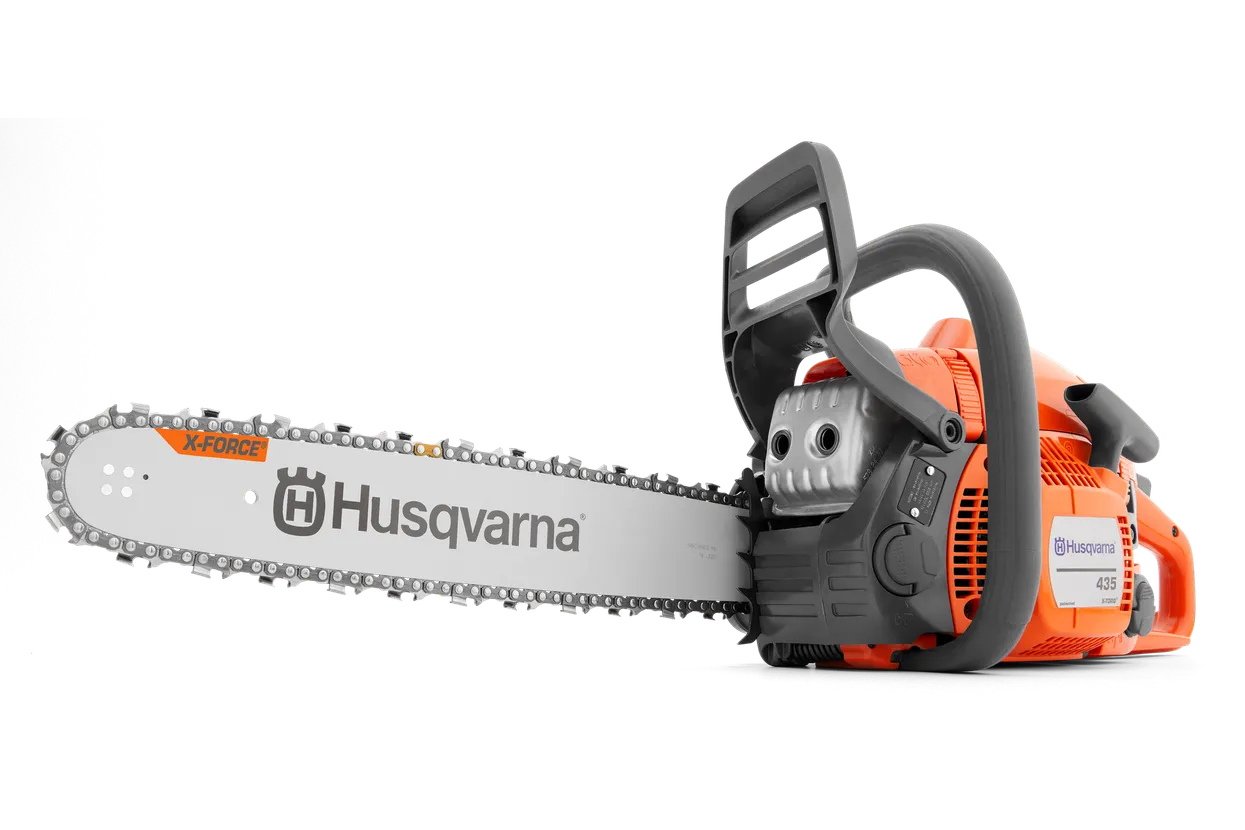
The Husqvarna 435 is one of the most widely sold homeowner-grade gasoline chainsaws in the United States. Built around a 40.9 cubic-centimeter, two-stroke X-Torq engine rated by Husqvarna at 2.2 horsepower output shaft power, and typically supplied with a 16-inch guide bar (the saw accepts bars from 13 to 18 inches), it is marketed for firewood cutting, limbing, pruning, and general property maintenance. It is sold through Lowe's, Tractor Supply, Northern Tool, Amazon, and independent Husqvarna dealers, and it is frequently purchased as a first chainsaw by people who have never owned or serviced a two-stroke engine before.
That combination of factors — an inexpensive homeowner saw, tight modern emissions tuning, and a large population of inexperienced owners — explains why the 435 generates such a large volume of troubleshooting discussion online. The saw is capable and, when correctly tuned and maintained, well regarded. However, it is also the subject of a substantial number of complaints, and the same handful of problems recur again and again: it will not start, it starts and then stalls, it will not idle, it will not restart when hot, it will not oil the bar, and it leaks oil in storage.
This article examines each of those problem categories in turn. For every category it provides the reported symptoms, the underlying causes, a structured set of troubleshooting steps, and concrete solutions, drawing on the official Husqvarna workshop and operator manuals as well as extensive owner feedback from ArboristSite, Arbtalk, the Chainsaw Forum, Hearth.com, Reddit, and retailer review sections. It closes with a preventive maintenance schedule taken directly from the Husqvarna operator manual and adapted for United States conditions, and with guidance on when a repair should be handed to an authorized service center.
A note on terminology and specifications before proceeding. Husqvarna's own workshop manual technical data lists the 40.9 cubic-centimeter engine (41-millimeter bore, 31-millimeter stroke) under the "440e" designation, while the "435/e" is listed at 37.0 cubic centimeters; the North American retail "435" is nonetheless marketed and sold at 40.9 cubic centimeters. The carburetor settings, idle speed, spark plug, and brake-band specifications quoted throughout this article are identical across the 435, 435e, and 440e variants, so they apply regardless of which displacement figure appears on a given data plate.
Model Years and Variants
The 435 family has been in production since roughly 2008 and has appeared in several closely related forms. Understanding the differences helps when ordering parts and when interpreting owner reports.
- 435 — The base model, generally supplied with a conventional screw-tensioned bar and the standard fuel and oil caps.
- 435e — The "e" designation adds tool-less (side-mounted) chain tensioning. Owners on ArboristSite note that the "e" adds roughly 0.44 pound to the weight, most of which is the tool-less tensioner hardware; mechanically the powerhead is essentially the same saw.
- 435e II (435 e-series II) — The second-generation revision. It retains the 40.9 cubic-centimeter X-Torq engine and 2.2 horsepower rating but adds a slimmer body, flip-up fuel and oil caps (similar in concept to the Stihl design), an improved Smart Start recoil that starts on a slower pull, and a three-piece crankshaft. One long-time owner on ArboristSite reported seven to eight years of ownership "without any major problems," which is a useful counterweight to the more numerous complaint threads.
- 435 X-Torq / "435 X-Torq" — This is not a separate model so much as a description; all 435 units use the X-Torq stratified-scavenging engine. Owners frequently refer to their saw as a "435 X-Torq," and Husqvarna's marketing uses the X-Torq label prominently, claiming it reduces emissions by up to 60 percent and increases fuel efficiency by up to 20 percent.
- T435 — A distinct top-handle arborist saw that shares the "435" number but is a different machine with a different chain-oil capacity and a different spark plug gap. Owners should not assume T435 parts or specifications transfer to the rear-handle 435.
Across these variants, the problem profile is remarkably consistent because the core engine, carburetor, ignition, and oiler designs carried through with only minor changes. The tool-less tensioner on the "e" models introduces a small additional set of chain-tension complaints, and the earliest 2008-era "Mark 1" saws attract the most air-leak and carburetor complaints, but the fundamental issues — carburetor tuning, ignition coil failure, weak oiling, and clamshell-case air leaks — appear across the whole range.
Technical Background: How the 435 Works
A brief description of the key components makes the troubleshooting that follows easier to understand.
The X-Torq engine is a two-stroke design that uses stratified scavenging: a charge of clean air is delivered ahead of the fuel-air mixture to reduce the amount of unburned fuel lost through the exhaust port, lowering emissions and fuel consumption. A practical consequence for the owner is that the intake system has an extra air path, and the intake boot (the plastic-and-rubber pipe between the carburetor and cylinder) is a known weak point that can deform and cause running problems. The engine develops its maximum power at 9,000 revolutions per minute. The carburetor on the 435 is a diaphragm type. Both Zama (model C1T-EL41 / C1T-EL41A, Husqvarna part 506450501) and Walbro units have been fitted over the production run; the workshop manual technical data cites a Walbro MBU-33 and a Zama EL 41. It has three adjustment screws: L (low-speed mixture), H (high-speed mixture), and T (idle speed). Many United States-market saws left the factory with limiter caps on the L and H screws to meet emissions rules, and adjusting them requires a splined "Pac-Man" carburetor tool rather than a plain screwdriver.
The ignition coil (ignition module) sits next to the flywheel and generates the high-voltage pulse for the spark plug. It is a sealed, non-serviceable part. The correct spark plug is an NGK BPMR7A or Champion RCJ7Y, gapped to 0.5 millimeter (0.020 inch).
The recoil starter, fuel lines, fuel filter (a weighted pickup inside the tank, for 3/16-inch inside-diameter line), and air filter make up the rest of the induction and starting systems. The clutch assembly is a centrifugal type; the chain brake is an inertia-activated band that wraps the clutch drum. The automatic chain oiler uses a fixed-output (non-adjustable) oil pump rated at approximately 13 milliliters per minute, driven by a worm gear off the crankshaft, fed from the oil tank through a small oil filter and a one-way duckbill vent. The guide bar, anti-vibration (LowVib) system, and crankshaft seals round out the components most often implicated in failures.
Starting Problems
Symptoms
Owners report a cluster of related starting complaints: the saw will not start at all out of the box or after storage; it requires an excessive number of pulls; it pops on choke but dies the instant the choke is turned off; it starts only when the throttle is held wide open; or the recoil is extremely hard to pull. Retailer reviews on Lowe's include multiple accounts of brand-new saws that would not start, including one buyer who wrote that he "pulled the cord at least 50 times, and nothing."
Causes
The dominant causes, in rough order of frequency reported on the forums, are:
- Stale or incorrect fuel. Gasoline that is more than 30 days old, or fuel with a high ethanol content, degrades and leaves varnish in the carburetor. This is the single most common root cause cited across every source.
- Operator technique / starting procedure. Two-stroke engines almost never start cold with the throttle fully closed; the 435 uses a Smart Start combined choke/fast-idle system that must be worked in the correct sequence. Several "dead saw" complaints resolve once the owner follows the starting decal precisely.
- Fouled, worn, or incorrectly gapped spark plug.
- Clogged air filter producing an over-rich condition.
- Clogged fuel filter or cracked fuel lines starving the carburetor.
- Carburetor out of adjustment or gummed — extremely common on saws that sat with fuel in them, and on new saws that left the factory tuned lean.
- Ignition coil failure — the classic pattern is a saw that starts and runs fine cold but will not restart once hot (covered in detail under Engine Stalling).
- Low or no compression from a worn piston, ring, or a leaking gasket, or in severe cases a hydro-locked crankcase from repeated flooded start attempts.
Troubleshooting Steps
- Confirm the basics before touching anything. Verify there is fresh fuel in the tank, the stop switch is in the run position, and the choke/Smart Start control is being used in the correct sequence per the decal: full choke, pull until it "pops," then push the control to the half-choke/fast-idle position and continue pulling.
- Perform a spark test. Remove the spark plug, reconnect it to the plug cap, ground the metal body against the cylinder, and pull the recoil. A healthy spark is fat and blue. Note the caveat repeatedly stressed by experienced technicians on Arbtalk: a spark that is visible against the cylinder is not proof of a good coil — a proper test requires the spark to jump a 4-to-5-millimeter (roughly 6-millimeter) air gap on a tester. A coil that sparks when grounded but cannot jump that gap is failing.
- Inspect the spark plug condition. A black, wet, or sooty plug indicates a rich condition or flooding; a bone-white plug indicates a lean condition. Confirm the gap is 0.5 millimeter (0.020 inch).
- Check for fuel delivery. Confirm the fuel filter is clean and the lines are supple and uncracked. A quick field test described by technicians is to disconnect the line at the carburetor and draw fuel through with a syringe, which also tests the tank vent.
- Test compression. Husqvarna's manual does not publish a cranking-compression figure and instead specifies pressure-decay leak testing, but field technicians and owners widely treat roughly 100 to 150 pounds per square inch as healthy for this engine, and readings below about 90 as a problem. One JustAnswer case documented a saw producing only 35 to 60 pounds per square inch that would run for only 10 to 15 seconds; the technician correctly identified low compression as the cause. If a compression gauge is unavailable, the "finger over the plug hole" test should produce strong suction.
- Check the recoil and for hydro-lock. If the rope is nearly impossible to pull but turns freely with the plug removed, suspect either excessive compression from carbon buildup or a crankcase full of fuel (hydro-lock). With the plug out, invert the saw and pull several times to expel excess fuel.
Solutions
- Drain old fuel and refill with fresh 50:1 mix made with ethanol-free or, at worst, no-more-than-10-percent-ethanol gasoline of 89 octane or higher. This alone resolves a large fraction of no-start complaints.
- Replace the spark plug with the correct NGK BPMR7A or Champion RCJ7Y, gapped to 0.5 millimeter. Owners have reported that even a plug fouled and gapped slightly wrong (for example 0.6 millimeter) caused hard starting that a fresh, correctly gapped plug cured.
- Clean or replace the air filter and fuel filter. Both are inexpensive and Husqvarna recommends annual fuel-filter replacement.
- Clean or rebuild the carburetor. Light cases respond to carburetor cleaner; gummed units need disassembly and a rebuild kit (or, given that a complete aftermarket Zama-pattern carburetor often costs little more than a rebuild kit, outright replacement).
- Replace the ignition coil if the spark fails the air-gap test or if the saw exhibits the hot-restart failure pattern.
- For low compression, the repair escalates to piston, ring, gasket, or crankcase-seal work, which for a homeowner saw of this value is often uneconomic and is a point at which many owners simply replace the saw.
Engine Stalling and Idle Problems
Symptoms
This is the second large complaint cluster. Reported behaviors include: the saw starts and runs well for 10 to 20 minutes and then dies, sometimes mid-cut, and will not restart until it cools; it will not settle to a stable idle, or takes a long time to drop to idle; it dies the moment the throttle is released; the idle is erratic and the chain creeps at idle; and the saw is especially prone to cutting out when tilted or moved. One Hearth.com owner described a saw that "starts and runs no problem, for about 15 minutes, then dies," then would not restart until it had cooled.
Causes
- Ignition coil breaking down when hot. This is the signature 435 failure. The coil works cold but, as it heats, its output collapses and the saw dies; after cooling it runs again. Multiple ArboristSite and Arbtalk threads converge on the coil as the culprit, and one poster summarized the pattern bluntly: after swapping in an OEM coil, "it works absolutely fine." A UK technician on Arbtalk noted this is "a common issue with this grade of saws," describing an identical fault on a 455 where the coil "wouldn't jump a 2mm gap."
- Carburetor tuning, especially a lean or gummed low-speed circuit. A saw that dies on deceleration or will not hold idle very often needs the L needle richened or the low-speed circuit cleaned. Husqvarna's manual warns that "if the L-jet is set too lean it may cause starting difficulties and poor acceleration."
- Air leaks at the crankcase seals, cylinder base, or the intake boot cause an unstable, lean, wandering idle and a carburetor that "will not stay tuned."
- Blocked fuel tank vent / plugged tank valve. One Hearth.com owner found the fuel cap hissing when loosened, indicating the tank was not venting and was starving the engine under vacuum — a classic "runs then dies" cause.
- Clogged spark arrestor screen in the muffler, which chokes the exhaust as carbon accumulates.
- Overheating from prolonged heavy use, which these light clamshell saws are not designed for; owners and technicians repeatedly warn that using the 435 for extended felling and bucking of large hardwood "lights the fuse" for crank-seal and compression failure.
Troubleshooting Steps
- Reproduce the fault and test spark hot. Run the saw until it dies, then immediately perform the air-gap spark test. If the spark is gone or weak when hot but returns when cold, the coil is confirmed bad.
- Check the fuel cap / tank vent. Loosen the cap when the saw dies; if it hisses and the saw then restarts, the vent is blocked.
- Inspect and clean the spark arrestor screen.
- Perform a carburetor-cleaner air-leak test. With the saw idling, spray a small amount of carburetor or brake cleaner around the intake boot, carburetor base, and crankcase seams. A change in engine speed indicates an air leak at that point. (Note the well-documented false positive: spraying directly at a worn carburetor throttle shaft will also change the idle, and that is not fixable by sealing — it indicates a worn shaft or a warped carburetor face.)
- Perform a formal pressure and vacuum test if an air leak is suspected (see the Air Leak section below).
- Verify carburetor settings against the factory baseline before condemning other parts.
Solutions
- Replace the ignition coil with the correct part number for the specific 435 variant (owners caution that there are several coil part numbers across the production run, so the flywheel/serial data must be matched). Aftermarket coils are available for around 30 dollars; OEM is preferred for reliability.
- Tune the carburetor (see the dedicated Fuel System section for the procedure and factory baseline). Richening the L needle by as little as one-quarter turn has repeatedly cured hot-idle stalling and hot-start complaints.
- Clean or replace the fuel tank vent / one-way valve.
- Clean or replace the spark arrestor screen.
- Repair the air leak by replacing the intake boot, crankcase seals, or base gasket as the pressure/vacuum test dictates.
- Match the saw to the work. For sustained cutting of large, dense wood, step up to a Rancher-class or professional saw; the 435 is a limbing, pruning, and light-firewood tool.
Fuel System and Carburetor Problems
Symptoms
Bogging when the throttle is opened, hesitation on acceleration, four-stroking or blubbering at high speed, a saw that runs only with the choke partly on, chronic inability to hold a tune, black smoke, and fouled plugs. Carburetor tuning difficulty is one of the single most frequently mentioned frustrations in 435 reviews; one Amazon/forum reviewer's advice to fellow owners was simply, "buy the carb adjustment tool."
Causes
- Ethanol damage and varnish from modern pump gasoline, degrading diaphragms, fuel lines, and blocking the tiny carburetor passages.
- Factory-lean tuning and limiter caps. United States emissions rules mean many 435 saws shipped tuned lean with capped L and H screws, so they run poorly until an owner obtains the splined tool and adjusts them.
- Worn carburetor throttle shaft or warped carburetor-to-boot mating face, causing an unfixable air leak at the carburetor.
- Cracked or misrouted fuel and primer lines, including cases where a previous owner reassembled the primer-bulb hoses backward.
- Missing crankcase impulse to the fuel pump, from a torn impulse passage in the intake boot.
- A damaged Welch plug inside the carburetor — owners note the 435 carburetor is prone to having the internal Welch plug seal broken by over-priming, after which "they never run right again."
Troubleshooting Steps
- Start with fuel and filters. Confirm fresh 50:1 fuel, a clean air filter, a clean fuel filter, and intact fuel lines before adjusting anything.
- Inspect the primer bulb and line routing against the service manual; confirm the primer acts as a proper check valve.
- Perform the carburetor-cleaner air-leak test on the boot and carburetor base as described above.
- Obtain the correct adjustment tool. The 435 needs a splined carburetor tool (widely available online for a few dollars, sold as a "Poulan/Husqvarna Pac-Man" tool); Husqvarna's own screwdriver is part 530 03 55-60. If caps must be removed, they can be pried off, but doing so may affect emissions compliance and warranty.
Solutions
Carburetor adjustment procedure (L, H, T). Work on a warm engine with a clean air filter and a chain that is correctly tensioned, and ideally use a tachometer:
- Set the baseline. Gently seat both the L and H needles clockwise (do not force them), then back each out to the factory preset. For the 435, the Husqvarna workshop manual specifies the L needle at 2.5 turns out and, when fitting a new H needle, 2 turns out from lightly seated.
- Adjust idle with the T screw. Start the saw; turn the T screw so the engine idles smoothly without the chain rotating. The recommended idle speed is 2,900 revolutions per minute; per Husqvarna's published technical data the clutch engages at approximately 4,300 revolutions per minute (plus or minus 120), so the chain must be stationary well below that.
- Fine-tune the L needle. Adjust for the cleanest, fastest idle and crisp throttle pickup, then enrich very slightly (counterclockwise) so the saw accelerates without hesitation. Too lean here causes stalling and bogging on acceleration; too rich causes a "blubbery," slow-to-rev idle.
- Set the H needle last, using a tachometer. The manual's maximum recommended speed with speed limitation is 12,500 to 13,000 revolutions per minute (the engine makes maximum power at 9,000 revolutions per minute). The high-speed mixture must not be set too lean: the manual warns that a lean H setting causes "less power, poor acceleration and could suffer damage to the engine." Correctly set, the saw should four-stroke (burble) slightly at wide-open throttle out of the cut and clean up under load. Never tune the H screw dangerously lean to chase peak RPM.
- Verify in the cut. Make test cuts; the saw should pull without bogging and settle to a chain-free idle.
Other fuel-system repairs:
- Replace fuel lines and the fuel filter using the correct 3/16-inch line and OEM-pattern weighted filter (Husqvarna 503443201). The workshop manual warns specifically against using knurled pliers on the fuel hose, as this can damage it and cause leaks or fracture.
- Rebuild or replace the carburetor. Because a complete Zama C1T-EL41 replacement is often priced close to a rebuild kit, many owners simply replace it. Owners repeatedly warn that cheap aftermarket carburetors sometimes lack correctly drilled passages, so a genuine Zama or Walbro unit is the safer choice.
- Replace the intake boot if the impulse passage is torn or the boot is deformed.
Ignition Coil Problems
Symptoms
The defining symptom is heat-related failure: the saw starts and runs perfectly when cold, then dies after 10 to 30 minutes and refuses to restart until it has cooled, sometimes for an hour or more. In more advanced failure the saw will not start at all. Because a grounded plug may still show a visible spark, owners frequently misdiagnose this as a fuel problem and waste money on carburetors before arriving at the coil.
Causes
- Thermal breakdown of the coil windings/electronics, where rising temperature increases resistance and collapses the spark. This is a known weak point on this grade of saw.
- Incorrect coil-to-flywheel air gap (specification is roughly 0.3 millimeter, commonly set with a business card or feeler stock), which can cause weak or mistimed spark.
- A loose flywheel or sheared flywheel key, which mistimes the spark.
- Chafed or damaged coil/high-tension lead or a cracked plug cap, causing intermittent no-spark.
Troubleshooting Steps
- Run the saw until it dies, then test for spark immediately using an inline spark tester that requires the spark to jump a defined gap (4 to 6 millimeters). A coil that will not jump the gap when hot is bad even if it sparked when cold and grounded.
- Substitute a known-good coil. The most decisive test, used repeatedly on the forums, is to swap in a coil from another running saw; if the 435 then runs, the original coil is confirmed bad. One owner swapped a coil from a 440, ran fine, then confirmed the fault.
- Check the flywheel key and air gap before condemning the coil, and inspect the high-tension lead and plug cap for chafing or arcing.
Solutions
- Replace the ignition coil with the correct part for the specific serial/variant. Set the coil-to-flywheel air gap to specification using a shim or business card. Owners report the saw "running like a top again" after coil replacement.
- Replace a sheared flywheel key and retorque the flywheel nut (25 to 30 newton-meters per the workshop manual) if timing is the issue.
- Repair or replace a chafed HT lead / plug cap.
Air Leaks and Crankshaft Seal Problems
Symptoms
A saw that will not hold a carburetor tune, that "races" or runs lean at high RPM, that surges between rich and lean, that idles erratically, or that bogs and stalls specifically when tilted or held horizontally for a notch cut. Owners refer to the 435's "infamous air leaks," and technicians note the clamshell (split-case) design has "a proclivity for leaking around the seals and clam shell."
Causes
- Failed crankshaft (main bearing) seals, especially after the saw has been overheated by heavy use.
- Leaking crankcase/clamshell case joint or cylinder base gasket.
- A torn or deteriorated impulse hose / intake boot — the impulse passage on the 435 is built into the rubber intake boot, which is prone to deforming under load and cutting off the pressure signal to the fuel pump.
- Loose cylinder base bolts — technicians note "the 435 cylinder bolts are known for coming loose."
- A worn carburetor throttle shaft, which mimics an air leak in the spray test.
Troubleshooting Steps
- Carburetor-cleaner spray test around the boot, carburetor base, and case seams, watching for RPM change (with the throttle-shaft false-positive caveat noted above).
- Formal pressure and vacuum test. Block the intake and exhaust ports (or test through the spark plug hole), then apply pressure and vacuum with a hand pump and gauge. Per Madsen's widely cited procedure, apply roughly 6 to 8 pounds per square inch; if the gauge drops more than about one pound per minute, there is a leak. Locate it by spraying soapy water or WD-40 on suspect areas and watching for bubbles or for the leak to stop.
- Test vacuum before pressure. Experienced technicians stress checking vacuum first, because applying pressure can push a weak seal closed and give a false "pass"; a case that holds pressure but not vacuum points to the main bearing seals.
- Check that the cylinder base bolts are tight.
Solutions
- Replace the crankshaft seals (the pressure/vacuum test will indicate flywheel-side, clutch-side, or both). This requires pulling the flywheel and clutch.
- Replace the base gasket or reseal the case joint; some owners apply a thin coat of a fuel-resistant sealant such as Permatex at the joint faces.
- Replace the intake boot if the impulse passage is compromised.
- Retorque the cylinder bolts to specification.
- Replace the carburetor if a worn throttle shaft is the source.
- A candid caveat from the community: on a saw of this value, a full seal-and-gasket rebuild can cost more in parts and time than the saw is worth, and several owners and technicians openly advise weighing repair against replacement.
Hard Starting When Hot
Symptoms
The saw starts easily cold and on the first pull when hot immediately after shutdown, but becomes extremely difficult or impossible to start after it has sat "heat-soaked" for 10 to 20 minutes, only to start normally again once fully cool. Owners describe pulling until their "arm falls off" with no result.
Causes
- Ignition coil heat breakdown (as above) — the leading cause.
- Vapor lock / fuel vaporization from heat soak, aggravated by some canned pre-mixed fuels. Several owners reported that switching from canned pre-mix back to freshly mixed pump gasoline eliminated hot-start trouble.
- An over-rich hot-start condition from using the choke or primer when the engine is already hot, which wets and shorts the plug. As one technician explained, a hot engine "does not need additional enrichment to start and if too rich can wet the spark plug and short the spark."
- Fuel tank pressure — a tank that does not vent builds pressure as the fuel warms.
Troubleshooting Steps
- Do not choke a hot engine. Attempt the hot restart with no choke and no priming, throttle held open.
- Pull the plug when it will not start hot and check whether it is wet (too rich) or the spark is absent (coil).
- Relieve tank pressure by briefly loosening the fuel cap; if the saw then starts, address the vent.
- Test spark hot with an air-gap tester to confirm or exclude the coil.
Solutions
- Replace the coil if the hot spark test fails.
- Switch to fresh, properly mixed fuel if canned pre-mix correlates with the problem; ensure the fuel is not old.
- Richen the L needle slightly (about one-quarter turn) — a fix multiple owners report as curing hot-start and hot-idle problems.
- Adopt a correct hot-start technique: no choke, throttle open, and if the saw was just refueled, allow a moment before restarting.
Chain Oiling Problems
Symptoms
Two opposite but related complaints dominate. First, the oiler does not deliver enough oil, or none at all: the bar and chain run dry, there is no oil "spray-off" when the saw is revved against a light surface, and the bar and chain overheat and wear prematurely. Second, the saw leaks bar oil into its case or storage container when not in use. One JustAnswer owner reported both at once: "when stored in the case, chain oil seeps out," and separately the saw "has stopped oiling the bar."
Causes
- Clogged oil passages — the oil outlet hole in the saw body, the transfer hole and groove in the guide bar, and the oil filter in the tank all pack with a paste of sawdust and oil.
- A clogged or defective duckbill / tank vent valve, which prevents the tank from equalizing pressure so the pump cannot draw oil.
- A stripped oil-pump worm gear or a dislodged pump drive pin. The pump's throw comes from an eccentric acting against a steel pin pressed into the crankcase; if that pin falls out, there is no pump stroke and no oil delivery.
- Weak pump design. The 435 uses a fixed-output, non-adjustable pump, and many owners regard it as a marginal oiler even when working correctly; one long-standing complaint thread flatly calls the non-adjustable oiler a design shortcoming.
- Bar oil too thick for the conditions, which starves the pump in cold weather; and lugging the saw near stall, which reduces oil output.
- Storage leaking is largely inherent: with the tank vented, oil can weep past the pump and out the outlet over time, especially if the tank is left full.
Troubleshooting Steps
- Confirm oil level and correct bar-and-chain oil first.
- Test the pump directly. Remove the bar and chain, start the saw, and rev it gently while watching the oil outlet hole in the saw body; oil should ooze or spit out. If oil appears here but not on the chain, the blockage is in the bar. If no oil appears, the pump, filter, or vent is at fault.
- Clean the bar. Remove the bar, clean the groove and the oil holes on both sides (rotating the bar for even wear), and clear the outlet hole and channel with a thin wire.
- Check the tank vent. A telling test: with the outlet plate off, loosening the oil filler cap causes oil to run out of the outlet hole — this indicates a pressure/vent problem, pointing to the duckbill valve.
- Inspect the oil filter and worm gear. The filter and its hose sit in the underside of the tank (the fuel tank must usually be removed to reach them); the worm gear and pump sit under the clutch/flywheel.
Solutions
- Clean all oil passages and the bar — this restores flow in a large share of "not oiling" cases, and several owners note the fix is only temporary if they keep letting the passages pack up.
- Replace the duckbill/vent valve if the tank is not venting. It is a small grey one-way valve inside the tank and must be extracted (often destructively) and replaced along with the porous breather plug.
- Replace the oil filter, oil line, worm gear, or pump as the direct pump test indicates. A stripped worm gear requires pulling the clutch/flywheel; many owners have a shop do this for a modest labor charge.
- Use an appropriate-viscosity bar oil for the season — thinner oil (or a small proportion of a thinner fluid) in cold weather to keep the marginal pump flowing.
- Manage storage leaking by storing the saw with the bar-oil level low or empty for long storage, keeping the saw flat, and placing an absorbent pad under it. Some owners run the tank nearly dry before storage.
Chain Brake and Clutch Problems
Symptoms
The most common complaint is not a failure of the brake itself but difficulty reinstalling the clutch (chain/sprocket) cover after removing the bar for cleaning or a chain change: the cover "will not go back on." Other reports include a worn brake band, a brake that does not engage crisply, and clutch-related running symptoms such as a chain that will not spin under load or a chain that creeps at idle.
Causes
- The chain brake is engaged while the cover is off. When the front hand guard is forward, the brake band constricts around where the clutch drum sits, so the cover physically cannot slide back over the drum. This is the near-universal cause of the "cover will not fit" problem.
- Sawdust packed around the brake band, constricting it.
- A worn brake band — Husqvarna specifies replacement when less than 0.6 millimeter (0.024 inch) remains at the most worn point.
- A worn clutch, clutch drum, or clutch spring, which can cause slipping under load; and an incorrectly set idle or worn clutch that lets the chain turn at idle.
Troubleshooting Steps
- Disengage the chain brake before refitting the cover by pulling the front hand guard back to the run position; if the band is engaged, rotate the small "Y"-shaped brake actuator clockwise to release it, aligning it with the hand-guard slot.
- Blow out sawdust from inside the clutch cover and around the brake band with compressed air.
- Test the brake function per the manual: with the engine off, drop the bar tip onto a stump so the saw rotates around the rear handle — the brake should apply; and at full throttle, tilt the left wrist onto the hand guard — the chain should stop immediately.
- Measure the brake band thickness at its thinnest point.
- Inspect the clutch center, drum, and spring for wear (a monthly maintenance item per Husqvarna).
Solutions
- Release the brake and clear debris to reinstall the cover — this resolves the overwhelming majority of "cover will not go on" complaints without any parts.
- Replace the brake band if it is below the 0.6-millimeter limit or cracked. Individual chain-brake and clutch-cover parts are inexpensive and available through parts suppliers such as PartsTree.
- Replace a worn clutch, drum, or spring if slipping under load is confirmed; the workshop manual gives a clutch refitting torque of at least 20 newton-meters.
- Readjust the idle with the T screw so the chain is stationary at idle; if the idle cannot be set low enough to stop the chain, Husqvarna warns to stop using the saw until it is repaired.
Chain Tension and Cutting Performance Problems
Symptoms
The chain comes off the bar, cuts crookedly or pulls to one side, produces fine powder or smoke instead of chips, binds in the cut, cuts slowly, or overheats. Some owners of the narrow-kerf factory chain report it binds in large green wood because it does not clear chips well.
Causes
- Incorrect chain tension — too loose and the chain derails or cuts unevenly; too tight and it overheats and wears the bar and chain.
- A dull chain, or a chain sharpened unevenly so one side cuts more aggressively, which makes the saw curve to one side.
- Incorrect depth-gauge (raker) height.
- A worn, bent, or burred guide bar, or uneven bar rails, which steers the cut.
- A chain installed backward.
- Inadequate lubrication (see Chain Oiling), which causes heat, binding, and accelerated wear.
- A worn drive sprocket.
Troubleshooting Steps
- Check tension cold: the chain should be snug against the underside of the bar, lift about an eighth of an inch from the rail, and snap back, while still pulling freely by hand. Recheck frequently, as a new chain stretches.
- Inspect the cutters for even length and sharpness; look for rounded or rock-damaged teeth on one side, which cause pulling.
- Check the depth gauges with a gauge tool.
- Inspect the bar for straightness, burred rails, a clean groove, and a clear oil hole; rotate the bar periodically for even wear.
- Confirm chain direction — cutters on the top of the bar must point forward toward the nose.
- Verify oiling is adequate.
Solutions
- Set tension correctly using the scrench (or the tool-less tensioner on "e" models), and retension a new chain often during its first uses.
- Sharpen the chain correctly: for the 435's chain, use the file size specified for the pitch (commonly 5/32-inch for .325 pitch or 3/16-inch depending on the chain fitted), file all cutters to the same length at the same top-plate angle (approximately 30 degrees), filing from the inside face out, and lower the depth gauges to specification. Replace the chain when cutters reach the wear mark (roughly 4 millimeters / 5/32-inch of cutter remaining).
- Replace or dress the guide bar if it is bent, burred, or has worn rails; file off rail burrs weekly.
- Reinstall the chain in the correct direction if it was reversed.
- Replace a worn drive sprocket.
- Consider a full-chisel chain in place of the narrow-kerf factory chain for better chip clearance in larger or greener wood, as several owners recommend.
Excessive Vibration Problems
Symptoms
Increased vibration through the handles compared with when the saw was new, leading to hand fatigue and reduced control. The 435's LowVib system normally keeps vibration low, so a marked increase indicates a fault.
Causes
- Worn, cracked, or collapsed anti-vibration mounts (isolators). These rubber-and-spring elements harden and crack with age and are the primary cause of increased vibration on the 435; they are a weekly inspection item in Husqvarna's schedule.
- Loose fasteners — engine, handle, or cover screws that have backed out.
- An unbalanced or damaged cutting attachment — a bent bar, a damaged chain, or a chain sharpened very unevenly.
- Worn crankshaft bearings, which produce vibration and require professional attention.
Troubleshooting Steps
- Inspect all anti-vibration mounts for cracks, tears, or collapse.
- Check that all nuts and screws are tight (a daily maintenance item).
- Inspect the bar and chain for damage and uneven sharpening.
- If mounts and fasteners are sound, have a technician check the crankshaft bearings.
Solutions
- Replace worn anti-vibration mounts as a set. The 435 uses several rubber isolators (Husqvarna 503898301 and related part numbers; complete aftermarket kits are sold on Amazon and through parts suppliers). Replacing them restores the original low-vibration feel, as one technician described after a worn-mount replacement resolved a customer's vibration complaint.
- Tighten all fasteners to specification.
- Replace or true the bar and replace or correctly sharpen the chain.
- Have the crankshaft bearings serviced by an authorized center if they are the source; on a homeowner saw this is a point to weigh repair against replacement.
Maintenance-Related Failures
Many of the problems above are not manufacturing defects at all but the predictable result of deferred maintenance. The recurring maintenance-related failure modes are worth naming explicitly:
- Stale-fuel carburetor gumming from leaving ethanol-blended fuel in the saw between uses — the number-one avoidable failure.
- Air-filter neglect producing a rich mixture, hard starting, and fouled plugs.
- Fuel-filter neglect causing fuel starvation and stalling.
- Running a dull chain, which overloads the engine, increases kickback risk, overheats the bar, and accelerates sprocket and bar wear.
- Chronic under-lubrication from ignored oiler passages, destroying bars and chains.
- Overheating from overloading the saw beyond its homeowner-class design, which cooks crank seals and compression — the most expensive maintenance-related failure and one repeatedly emphasized by experienced technicians.
- Cooling-fin and cooling-system neglect, which raises operating temperature and aggravates coil and seal failures.
The common thread is that the 435 rewards disciplined, simple, routine care and punishes neglect quickly because its homeowner-grade components have little margin.
Preventive Care and Recommended Servicing Schedule
The following schedule is taken directly from the Husqvarna 435 operator manual and adapted with United States fuel guidance. Following it prevents the large majority of the problems described above.
Daily maintenance (before or after each use)
- Clean the outside of the machine.
- Check that the throttle lockout and throttle control operate safely.
- Clean the chain brake and check that it operates safely; check the chain catcher and replace if damaged.
- Turn the bar regularly for even wear; check the bar lubrication hole is clear; clean the bar groove; lubricate the sprocket tip if fitted.
- Check that the bar and chain are receiving sufficient oil.
- Inspect the chain for cracked rivets or links, stiffness, and abnormal wear; replace if necessary.
- Sharpen the chain and check its tension and condition; check the drive sprocket for wear.
- Clean the starter air intake.
- Check that all nuts and screws are tight.
- Check that the stop switch works.
- Check for fuel leaks from the engine, tank, or lines.
Weekly maintenance
- Check the cooling system (on saws without a catalytic converter).
- Check the starter, starter cord, and return spring.
- Check that the anti-vibration (LowVib) elements are undamaged.
- Lubricate the clutch drum bearing.
- File off any burrs from the edges of the bar.
- Clean or replace the spark arrestor screen in the muffler.
- Clean the carburetor compartment.
- Clean the air filter; replace if necessary.
Monthly maintenance
- Check the chain brake band for wear; replace when less than 0.6 millimeter (0.024 inch) remains at the most worn point.
- Check the clutch center, drum, and spring for wear.
- Clean the spark plug and confirm the electrode gap is 0.5 millimeter (0.020 inch).
- Clean the outside of the carburetor.
- Check the fuel hose for cracks or damage; replace if necessary.
- Empty and clean the inside of the fuel tank.
- Empty and clean the inside of the oil tank.
- Check all cables and connections.
Seasonal and consumable items
- Replace the fuel filter at least once per season (more often with ethanol fuel).
- Replace the spark plug annually or when fouled.
- Inspect and replace anti-vibration mounts when cracked.
- Clean the cooling fins and cylinder cooling system to prevent overheating.
Fuel guidance for the United States market
- Use a 50:1 mix: 2.6 fluid ounces of two-stroke oil per 1 gallon of gasoline.
- Use a high-quality JASO FD or ISO-L-EGD certified two-stroke oil, such as Husqvarna XP+.
- Use 89-octane or higher gasoline with no more than 10 percent ethanol (E10); Husqvarna strictly warns against fuel with more than 10 percent ethanol.
- Ethanol-free gasoline is strongly preferred. It is widely available in the United States at marinas, small airports, and stations listed on ethanol-free-fuel locator services; many stations sell "recreational" non-ethanol fuel.
- For occasional users, canned pre-mixed ethanol-free fuel (such as Husqvarna XP+ Pre-Mixed, 95-octane, sold at Lowe's and Tractor Supply) eliminates mixing error and stores for years. Note the caveat that a minority of owners have associated canned pre-mix with hot-start difficulty; if that occurs, switch to fresh, correctly mixed pump gasoline.
- Use fuel within 30 days, or add a stabilizer; discard after 90 days. For storage longer than a month, run the carburetor dry.
- Husqvarna offers an extended warranty (up to 4 years on handheld gas equipment) when the saw is purchased with Husqvarna pre-mixed fuel — a meaningful incentive for United States buyers.
Recalls and Service Bulletins
There is no safety recall or public service bulletin specific to the Husqvarna 435 gasoline chainsaw on record with the United States Consumer Product Safety Commission as of this writing. Husqvarna recalls in recent years have targeted other product lines. Notably, the Automower 435X AWD and 535 AWD robotic mowers were recalled in a CPSC alert dated February 17, 2022 (about 1,400 units sold from March 2020 through July 2021 for about 4,500 dollars each) because "the lithium-ion battery in the lawnmower can overheat, posing a risk of fire"; Husqvarna had "received five reports of batteries overheating, including two reports of fires." Separately, on February 8, 2024 (Release No. 24-113), Husqvarna recalled about 403,000 gas grass trimmers in the United States (models 330LK, 130C, and 130L) because "incorrect wiring in the ignition module … can cause an electrical spark or arcing, posing a fire hazard if gas is on or near the unit," with 12 United States reports of fire, arcing, or sparking, two reports of property damage, and one burn injury. Neither of these — nor the various mower and motorcycle recalls — involves the 435 chainsaw. Owners occasionally conflate the "435X" Automower recall with the "435" chainsaw; they are unrelated products.
The absence of a recall does not mean the 435 is free of systemic issues. The recurring coil, oiler, and air-leak complaints documented throughout this article are quality-and-design concerns that owners and independent technicians widely acknowledge, but they have not risen to the level of a formal recall or been the subject of a published safety bulletin. Owners should register their saw and consult an authorized dealer about any applicable technical bulletins for their specific serial number.
When to Seek an Authorized Husqvarna Service Center
Homeowners can reasonably handle fuel replacement, air- and fuel-filter service, spark-plug replacement, chain sharpening and tensioning, bar cleaning and rotation, oiler-passage cleaning, carburetor adjustment (with the correct tool), and anti-vibration mount replacement. The following situations warrant a professional or an authorized Husqvarna service center:
- Suspected low compression, piston or cylinder scoring, or a hydro-lock that will not clear — internal engine work.
- Confirmed crankshaft seal or crankcase-case air leaks requiring flywheel and clutch removal and pressure/vacuum verification.
- Ignition faults beyond a simple coil swap, including flywheel-key and timing problems.
- Oil-pump worm-gear or pump replacement requiring clutch/flywheel removal, if the owner is not equipped for it.
- A chain brake that cannot be adjusted so the chain stops at idle — a safety-critical condition; Husqvarna directs owners not to use the saw until it is repaired.
- Warranty work — attempting carburetor limiter-cap removal or unauthorized repairs can void the standard two-year consumer warranty.
United States owners can locate an authorized service center through Husqvarna's dealer locator. A recurring frustration in retailer reviews is that authorized centers can be booked 90 or more days out in peak season and that Lowe's imposes a very short (reported as 48-hour) return window on chainsaws, so owners should test a new saw immediately after purchase and register it promptly.
Conclusion
The Husqvarna 435 is a capable, lightweight, homeowner-class chainsaw that suffers from a well-defined and repetitive set of problems. The overwhelming majority of them trace back to five root causes: stale or ethanol-laden fuel, a carburetor that is lean, gummed, or simply untuned from the factory, an ignition coil that breaks down when hot, a marginal and clog-prone chain oiler, and air leaks in the split-case engine that are often the consequence of overheating from overwork. Almost every starting, stalling, idling, and hot-start complaint in the owner community maps onto one of those causes.
The good news is that most of these faults are diagnosable with basic tools — a spark tester, a compression gauge, a can of carburetor cleaner, and a splined carburetor adjustment tool — and repairable at home for modest cost. Fresh fuel, clean filters, a correctly gapped plug, a properly adjusted carburetor, and disciplined adherence to the daily, weekly, and monthly maintenance schedule will keep the great majority of 435 saws running reliably. The faults that justify professional intervention — internal engine damage, crank-seal air leaks, and unadjustable chain brakes — are also the faults at which, on a saw of this price class, the owner should honestly weigh the cost of repair against replacement. Used within its intended role of limbing, pruning, and light firewood work, and maintained as Husqvarna specifies, the 435 earns the loyalty that many long-term owners express; pushed beyond that role or neglected, it earns the frustration that fills the forums.