
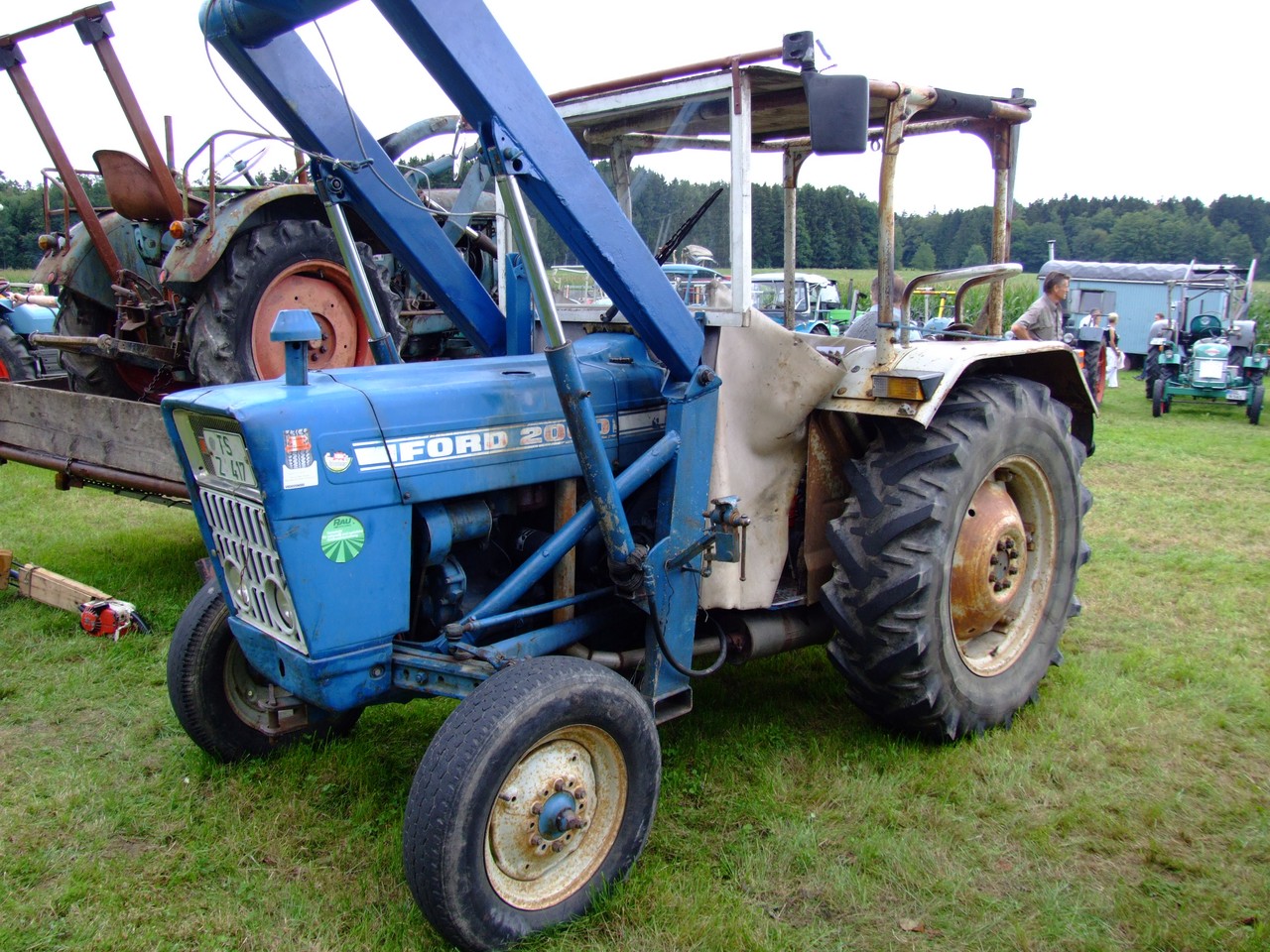
The Ford 2000 is one of the most widely owned vintage utility tractors in the United States, and after 50 to 60 years of service the most common problems owners encounter are hard starting, weak or slow hydraulic lift, clutch and transmission wear, power take-off (PTO) engagement failures, overheating, worn steering, and charging-system faults. Almost all of these are diagnosable and repairable by a mechanically capable owner using basic tools, a service manual, and a methodical approach. This article examines each major problem category, explains the components involved, and provides symptom-based troubleshooting steps and durable solutions.

It is essential to understand at the outset that Ford sold two entirely different tractors under the "2000" name. According to TractorData, the earlier model (1962 to 1965) used a 4-cylinder engine, while the later model (1965 to 1975) used a 3-cylinder engine and was, in TractorData's exact words, "an entirely different machine than the earlier (four-cylinder) model."
Both were built in Highland Park, Michigan, and the later model carried an original price of $5,675 in 1975. The 4-cylinder version left the factory with a 6-volt positive-ground electrical system, whereas the 3-cylinder version used a 12-volt negative-ground system.
The two share only paint and decals. When ordering parts or diagnosing problems, owners must first establish which tractor they own, because internal components, wiring, and part numbers differ substantially. This article focuses primarily on the far more common 3-cylinder model while noting differences for the 4-cylinder wherever they matter.
Table of Contents
Model Years, Variants, and How They Affect Problems
The 3-cylinder Ford 2000 used a 158 cubic inch (2.6 liter) engine offered in gasoline (8:1 compression, 36 horsepower) and diesel (16.5:1 compression, 39 horsepower) forms, both with a bore and stroke of 4.20 by 3.80 inches and a firing order of 1-2-3, per TractorData. The gasoline engine used a Holley carburetor and a distributor ignition; the diesel used a CAV (Lucas) DPA rotary distributor injection pump. In the University of Nebraska Tractor Test Laboratory records, the diesel 4-speed/12-speed unit (Test 958) produced a tested 32.09 PTO horsepower (23.9 kW) and 28.10 drawbar horsepower (21.0 kW), while the gasoline 12-speed (Test 884) produced 30.57 PTO horsepower.
Transmission variants strongly influence which problems an owner will encounter. TractorData's transmission page lists four manual gearboxes for the 3-cylinder tractor: a 4-speed, a 6-speed, an 8-speed, and a 12-speed (a 4-speed with an over/under auxiliary). All are unsynchronized. In addition, the earlier 4-cylinder tractor and some industrial units were available with the Select-O-Speed (SOS) power-shift transmission. The 4-speed does not have live PTO; the 8-speed and 12-speed could be equipped with a two-stage clutch and live PTO.
These distinctions matter because clutch, PTO, and transmission complaints have different root causes depending on whether the tractor has a single-stage or two-stage clutch and whether the PTO is transmission-driven or live.
The Select-O-Speed transmission deserves special mention because it is the single most notorious component in the model's history. It earned the nickname "Select-O-Junk" among some owners. As the contributor "Ultradog" put it bluntly on the Yesterday's Tractors Ford board, "more Fords have been scrapped on account of those transmissions than all other Ford tractor transmissions combined." The transmission is, however, serviceable and reliable when properly maintained, and it is covered in its own section below.
Engine Starting & Performance Problems
Symptoms
The classic complaint on the gasoline 3-cylinder Ford 2000 is that it starts easily when warm but "will not fire without ether" on the first start of the day, regardless of weather, as one owner on the Tractor Forum described. Other reported symptoms include prolonged cranking before the engine catches; the engine starting readily only when the tractor is towed or pull-started; rough running or running on only two of three cylinders; running for roughly 30 minutes then quitting until it cools; and flooding with fuel leaking from the carburetor. On the diesel, the dominant symptom is hard starting after the tractor sits, often requiring the fuel lines to be bled multiple times before the engine will fire, as described on Yesterday's Tractors.
Causes
On the gasoline engine, hard starting has several recurring causes. The Holley carburetor fitted to these engines is, in the blunt words of one experienced contributor on the Tractor Forum, "notoriously lousy," and a dirty carburetor, an incorrect float level, a leaking needle and seat, or a poorly seated air-horn gasket will all cause hard starting. Ignition faults are equally common: worn or misgapped points, a weak coil, a cracked distributor cap admitting moisture, corroded or broken centrifugal-advance springs, and incorrect timing. A ballast resistor that is not wired to be bypassed during cranking will produce a weak spark while the key is in the start position. Low compression from worn rings or valves, and a slow cranking speed caused by an undersized battery, corroded cables, or a worn starter, round out the list. Autolite 437 spark plugs are frequently recommended; other plugs may not fire a flooded engine. On the diesel, hard starting after sitting is almost always air in the fuel system. Air enters through loose fittings, a cracked lift-pump diaphragm, a clogged tank strainer, or a leaking O-ring in the injection pump top cover. A gummed or stuck metering valve in the CAV pump, a clogged return-line orifice, or a blocked fuel-tank vent will prevent proper fuel delivery. Low compression and slow cranking speed also make the high-compression diesel hard to start.
Troubleshooting Steps
Approach starting problems systematically rather than "fiddling with the carb," which the specialist site myfordtractors.com warns is where most people wrongly begin: "the Carb is always the LEAST LIKELY source of trouble."
Confirm the engine has the three things it needs: compression, fuel, and spark at the correct time.
- Verify cranking speed and battery voltage. Measure voltage at the starter stud to case while cranking; the contributor "JMOR" on Yesterday's Tractors uses a benchmark of 10 volts at the starter stud while cranking. If voltage drops well below that, clean and tighten every connection in the battery-to-starter loop and confirm the correct battery is fitted.
- On the gasoline engine, check for spark: pull a plug, ground it, and crank. A strong blue spark is required; an orange spark indicates a weak ignition. Inspect points, condenser, cap, rotor, and coil, and confirm the firing order is 1-2-3.
- Confirm ignition timing with a timing light. Retarded timing produces the exact "starts when towed but not on the starter" symptom that several owners on My Tractor Forum reported.
- Perform a compression test if performance is poor. Low, uneven readings point to rings, valves, or a head-gasket problem.
- On the diesel, bleed the system methodically: open the bleed screw on the fuel filter until fuel runs without bubbles, then the bleed screw on the CAV pump (the 5/16 inch bleeder inside the 7/16 inch body), and finally crack the injector lines at the injectors while cranking to purge air. If fuel squirts from the pump bleed screw but not from the injector lines, suspect a stuck metering valve, as documented on the Tractor Forum.
Solutions
For the gasoline engine, the most reliable fix is a thorough carburetor cleaning or rebuild with a correct float setting, a fresh tune-up with correct plugs and points, correct timing, and, where the ignition or charging system is marginal, conversion of the original generator to an alternator. One owner on the Tractor Forum reported that after a mechanic "cleaned the carburetor thoroughly and replaced the mangled air gap gasket, re-gapped the spark plugs, changed the timing, and replaced the original Ford generator with an alternator," the tractor "starts and runs like a new machine."
Fit the correct battery: the correct battery for the 3-cylinder gasoline tractor is a group 17TF; an undersized automotive battery will crank too slowly even if its cold-cranking rating looks adequate. Follow the operator's manual starting procedure: throttle closed, choke as needed in cold weather, gradually reducing choke, and avoid over-choking, which floods these engines easily.
For the diesel, tighten every fuel fitting, replace the fuel filters, replace a cracked lift-pump diaphragm, clean the tank strainer and return-line orifice, and reseal the injection-pump top cover with a proper kit if it leaks. A gummed metering valve can often be freed by lifting the top cover and working it loose; if the pump is worn, a rebuild is far cheaper than a replacement, though timing and calibration should be done by a diesel shop. As a stopgap when the engine is hard to start hot, one Yesterday's Tractors member pours warm water over the injection pump rather than bleeding.
Hydraulic System Problems
Symptoms
Hydraulic complaints are among the most common on the Ford 2000. Owners report the three-point lift being very slow to raise (30 seconds or more), lifting only after the tractor has run several minutes, working when cold but failing entirely once warm (or the reverse), not lifting as high as it should, raising in jerks, failing to hold a load and slowly dropping an implement, and, in the worst cases, not lifting at all. On tractors used in draft control, an inability to raise the implement out of the ground at the end of a row is reported.
Causes
The Ford 2000 uses an open-center hydraulic system with a piston pump, rated by TractorData at 2500 psi (172.4 bar) and 4.0 gallons per minute (15.1 lpm), with a total system capacity of 6.3 gallons (23.8 liters) shared with the rear axle; the separate steering circuit flows 4.25 gpm at 700 psi. The rear lift capacity is 2,800 pounds (1,270 kg). Common causes of poor performance, drawn from numerous forum threads, include: a clogged suction screen or return filter; worn check balls, springs, and seats in the piston pump; a stuck control-valve spool or stuck unloader/relief valve; a worn cam-follower pin (a frequently cited wear item); worn or missing piston seals and rings, which cause the lift to drop; contaminated or water-laden fluid (described repeatedly as "chocolate milk" or "chocolate-vanilla swirl"); air being drawn into the suction side through a leaking supply line or pump shaft seal; and, on tractors equipped with one, a flow-control valve set to slow.
An important variant note: the 4-cylinder Ford 2000 does not have the same filter arrangement as the 3-cylinder model, and the base 2000 did not have a flow-control valve (that was a feature of the 3000 and larger). Some 2000 tractors have had 3000 parts fitted over the years, so an unexpected flow-control knob may be present.
Troubleshooting Steps
- Check the fluid level and, critically, the condition of the fluid. If it looks milky, it is contaminated with water and must be changed. The specialist site myfordtractors.com explains that most water enters not through the shifter boot but through condensation inside the sump, and recommends periodically cracking the drain plug at the pump to let accumulated water run out.
- Bleed the pump. With the engine running, loosen the bleed plug on the hydraulic pump until fluid flows, watch for bubbles, and close it when the bubbles stop. Repeat at the test port on the 3-by-5 inch plate on the top cover.
- Determine whether the pump is developing pressure. If power steering (which on many units has its own pump) works but the lift does not, the fault is downstream in the lift circuit. A pressure gauge at the pump confirms output.
- Inspect and clean both filters: the wire-mesh suction screen (which requires removing the PTO shaft to access) and the replaceable return-side paper filter. Plugged filters are a frequent cause of slow operation, as owners on TractorByNet document.
- If the lift will not hold a load, suspect worn piston seals or a leaking control valve; if it raises jerkily or will not stop midway, suspect a worn cam-follower pin and worn lift linkage.
Solutions
Begin with the least invasive, highest-probability fixes: change the fluid and both filters. Multiple owners report dramatic improvement from this step alone. One owner on My Tractor Forum, after cleaning the sludge, replacing the filters and piston seals, and correctly adjusting the spool linkage, wrote that the lift "moved before I can turn my head around. And they stay put!"
If bleeding and filtration do not resolve slow or weak lift, rebuild the piston pump with a kit (check balls, springs, seats) and replace the pump shaft seal, which cures air being drawn in on the suction side, as one owner found on Yesterday's Tractors. Replace the worn cam-follower pin and worn piston seals when the lift will not hold. Adjust the spool-position turnbuckles per the I&T or Ford service manual, because incorrectly adjusted linkage (often set to obsolete instructions) prevents full lift travel. The lift cover is heavy and requires a hoist or a strong helper; a service manual is essential before opening it.
Transmission & Clutch Problems
Symptoms
Reported clutch symptoms include a clutch that will not disengage (the tractor lurches or will not free of gear), a clutch that slips under load (weak pulling or weak PTO), a pedal that goes to the floor too easily, grinding when shifting, and a loud squawking or squealing on engagement (a failing throw-out bearing). Transmission symptoms include difficulty getting into gear, grinding when shifting, jumping or popping out of gear (notably first gear on a downhill), the tractor becoming stuck in two gears at once and locking up completely, and a transmission that will not go into any gear at all.
Causes
The Ford 2000 uses a dry-disc clutch, either single-stage (4-speed and 6-speed) or two-stage with live PTO (8-speed and 12-speed). A clutch that will not disengage after the tractor has sat is very commonly caused by a rear main seal leak that puts oil on the disc and glues it to the flywheel, as explained on Yesterday's Tractors. Clutch slip is caused by worn friction material, a weak or broken pressure plate, or oil contamination. On the two-stage clutch, a recurring failure is that the adjuster legs (fingers) break; when one breaks, the others are overloaded and break in turn, as one owner documented on Yesterday's Tractors. A worn or incorrect throw-out bearing causes squawking.
The unsynchronized transmission grinds when shifted on the move; this is normal behavior for a non-synchronized gearbox and is minimized by coming to a full stop before shifting. Jumping out of gear and locking in two gears at once are caused by worn shift gates, a worn shifter lever and guide pin, and sloppy shifting practice, according to the detailed explanation hosted by the Ford Fordson Collectors Association. Missing detent balls and springs, or gears rusted out of neutral position, will prevent the tractor from going into gear.
Troubleshooting Steps
- For a clutch that will not disengage, first check pedal free travel, which should be about 1.25 to 1.5 inches. If a stuck disc is suspected from sitting, try to break it loose by driving in a high gear, holding the pedal down, and applying the brakes firmly; if that fails, the tractor must be split.
- For clutch slip or weak PTO, verify free play. Too little free play causes slip; excessive free play does not. If free play is correct and slip persists, the tractor must be split to inspect the disc and pressure plate.
- For a transmission stuck in two gears, do not force it. As the Ford Fordson Collectors Association warns, do not rev and pop the clutch, jerk, or drag the tractor, because "brute force is NOT the answer" and will break gears. Instead, remove the shifter cover, disconnect the battery, and rotate the engine backward (using the fan belt or the flywheel ring gear) to relieve pressure on the two engaged gears so the shift collars can be returned to neutral.
- For a tractor that will not go into gear, remove the top cover carefully (protecting the neutral-switch wires and detent springs) and confirm the shift rails move freely and the detent balls and springs are present, as advised on TractorByNet.
Solutions
When the clutch must be replaced, split the tractor and replace the complete clutch, including the pilot and release bearings, rather than individual parts. Because the 3-cylinder 2000 shares its clutch with the 3000, buying parts specified for the 3000 reduces the risk of receiving the wrong part; a frequent contributor on Yesterday's Tractors advises counting the input-shaft splines before ordering, because spline counts varied over the years. Inspect the throw-out bearing carefully; one owner on My Tractor Forum received an incorrect grease-type bearing from a reman kit when a sealed bearing was required, and had to split the tractor a second time. To prevent a stuck clutch during storage, owners block the clutch pedal down with a piece of 2-by-4 lumber or a clamp.
For the transmission, replace worn shift gates or a worn shifter cover and adopt disciplined straight-line shifting through neutral. If gear teeth were damaged by forcing a locked transmission, the unit must be split and the gears replaced.
Select-O-Speed Transmission Problems
Symptoms
The Select-O-Speed power-shift transmission exhibits distinctive symptoms because it uses hydraulically applied bands and clutches. Reported problems include the transmission staying in Park, dropping into Neutral in certain selector positions, functioning only in reverse, functioning only in certain speeds, slipping under load in a particular gear (commonly second), locking up in certain gears, and a broken or detached selector cable that leaves the shift lever moving freely with no detents.
Causes
According to the troubleshooting chart hosted by the Ford Fordson Collectors Association, the underlying causes map precisely to which bands and clutches are or are not applying and releasing. Low fluid pressure, caused by low fluid level, a plugged or incorrectly installed suction screen, a leaking pump gasket or pressure line, a defective torque-limiting clutch, or leakage between the valve-body halves, causes the transmission to stay in Park or to be held without stalling the engine.
A band that is out of adjustment, a broken servo spring, a stuck spool valve, worn clutch discs, or a broken selector cable each produce a specific pattern of neutral or lockup conditions. Neglect is the overwhelming cause of SOS failure: the transmission requires diligent fluid and filter changes and periodic band adjustment, which many owners never performed. As the contributor "dean" explained on Yesterday's Tractors, the 1963 to 1964 units "have an internal oil filter beneath the top cover. This filter is no longer available and was generally neglected," whereas 1965 and later models have a larger, externally replaceable filter.
Troubleshooting Steps
- Change the fluid and filter first, and check the fluid level, before diagnosing anything internal. The fluid must meet the Ford 134D specification.
- Perform the two quick checks recommended by SOS specialists on Yesterday's Tractors: verify the traction (transmission) disconnect has not disconnected itself or broken, and verify whether the PTO works. If the PTO does not work, the torque-limiting clutch disc or input shaft is likely bad, requiring a split.
- Adjust the bands per the correct service manual. The 1965 to 1975 Ford 2000/3000/4000 SOS band adjustment is covered in the Ford factory service manual and the I&T FO-31 aftermarket manual; the earlier and later SOS versions differ.
- If band adjustment and a fluid service do not restore function, connect a 300 psi gauge and follow the manual's pressure-test procedure to isolate the failing circuit.
Solutions
For an SOS that is fundamentally sound, disciplined maintenance (fluid, filter, and band adjustment) restores and preserves function; one owner with an SOS-equipped Ford noted that "when pushing snow, it will run circles around my Farmall 706." When internal components have failed, the realistic options are a professional rebuild by an SOS specialist, replacement with a rebuilt unit tested on a stand (services such as Arthur's Tractors test every transmission before shipment), or conversion to a manual gearbox from a donor tractor. A rebuild can be expensive, and owners have converted to manual transmissions for a fraction of the cost. If purchasing an SOS-equipped tractor, service the transmission immediately and verify that every gear works before relying on it.
PTO & 3-Point Hitch Problems
Symptoms
The most common PTO complaint is that the PTO will not engage while the engine is running, producing a grinding sound, though it can be engaged with the engine off and then run normally after starting. Others report a weak PTO that slips under load, a PTO that will not disengage when the clutch is fully depressed, a PTO shaft that will not turn an implement even though it spins freely with no load, and a PTO lever that is frozen and will not move. On the three-point hitch, symptoms overlap with the hydraulic-system problems described above: failure to lift, failure to hold, and jerky operation.
Causes
The Ford 2000 offered transmission (non-live) PTO on the 4-speed and 6-speed, and live PTO via a two-stage clutch on the 8-speed and 12-speed. Grinding on engagement with a warm engine and the clutch fully depressed usually indicates that the PTO stage of the two-stage clutch is worn or out of adjustment, or, on a single-stage transmission PTO, that the operator is attempting to engage without the driveline having stopped. A PTO that will not disengage with the clutch fully down indicates a stuck PTO clutch. A weak PTO is caused by clutch slip, since the PTO drive is otherwise a purely mechanical system unaffected by fluid level, as explained on the Heavy Equipment Forums. A shaft that spins with no load but will not drive an implement points to a stuck or worn clutch that cannot transmit torque, or to twisted or damaged shaft splines. A frozen PTO lever is caused by rust or jammed linkage.
Troubleshooting Steps
- Establish whether the tractor has live PTO (two-stage clutch) or transmission PTO. On the two-stage clutch, pressing the pedal halfway disengages the transmission while the PTO continues; pressing it fully disengages both.
- Try engaging the PTO with the engine off; if it engages and then runs when the engine is started, but will not engage while running, the fault is in the PTO clutch stage or its adjustment.
- Adjust the clutch linkage at the clevis near the front of the linkage. As advised on the Tractor Forum, make a one-turn adjustment to shorten the linkage, then half-turn adjustments, checking each time; stop as soon as the PTO works, because over-adjustment shortens clutch life.
- To free a stuck PTO clutch, put a load on the PTO (for example, a bush hog or post-hole auger), start the engine with the PTO engaged, and depress the clutch to try to break the disc loose; alternatively, block the clutch pedal down for several days and apply brake cleaner to the disc if accessible.
- If the PTO shaft spins freely but will not drive an implement, pull the shaft and inspect for twisted or damaged splines.
Solutions
If clutch-linkage adjustment does not restore PTO function, the tractor must be split to replace the two-stage clutch; this is the same operation as a main-clutch replacement and should include the pilot and release bearings. When using a rotary cutter or other high-inertia implement on a transmission (non-live) PTO tractor, fit an overrunning clutch to the PTO stub to prevent the implement from driving the tractor; grease it at every use because the inexpensive units wear quickly.
A frozen PTO lever generally requires removing the lift cover to free or replace the linkage. For three-point hitch lift problems, follow the hydraulic-system solutions above.
Steering & Brake Problems
Symptoms
Steering complaints include excessive free play at the steering wheel, a delay between turning the wheel and the front wheels responding, hard steering (especially on tractors without power steering), the tractor wandering or pulling to one side, and oil leaking from the steering box. Brake complaints include weak or nonexistent braking even with full pedal effort, one brake grabbing while the other does not, pedals that stick down and must be pulled up by hand, and oil-soaked brake shoes.
Causes
The Ford 2000 was available with manual or optional power steering. The manual steering box uses a worm-and-ballnut mechanism driving twin sector shafts. Excessive play and a delay in response are caused by wear in the ballnut and sector-gear teeth, worn thrust bearings, worn drag-link and tie-rod ends, worn steering-column bearings, and wallowed sector-arm splines, as described in detail on Yesterday's Tractors. Water intrusion into the steering box (owners have drained "a pint or so" of water from a box) causes internal rust that destroys bearings and gears. Hard steering on manual-steering tractors is inherent but is worsened by binding king pins and dry, hardened grease.
The brakes are external, differential-mounted, expanding-shoe drum brakes without an automatic self-adjuster. Weak braking is caused by worn shoes, glazed shoes, drums that have been turned oversize so the shoe arc no longer matches, and, very commonly, oil-soaked shoes resulting from a leaking rear axle seal. Sticking pedals are caused by a corroded brake camshaft binding in its bore, often because grit works into the pivot every time the brakes are applied and there is no grease fitting, as one owner traced on TractorByNet.
Troubleshooting Steps
- For steering play, first inspect and replace the drag-link and tie-rod ends, which are frequently the largest source of slop. On My Tractor Forum, one owner found "the drag link ends which are like tie rod ends are extremely worn on both sides" accounted for most of the play.
- Adjust the sector-shaft end play with the steering box centered. The correct procedure, per an owner exchange on Yesterday's Tractors, is to back off both sectors, adjust the left-hand sector to the main nut for zero backlash, then adjust the right-hand sector to match.
- If the steering box leaks or contains water and metal sludge, it must be opened and rebuilt; inspect the ballnut and sector-gear teeth for wear.
- For weak brakes, jack up the tractor, remove the plug at the bottom of the backing plate, and turn the star-wheel adjuster with a screwdriver until the wheel just cannot be turned by hand, then back it off slightly.
- For oil-soaked shoes, remove the drum and confirm a leaking rear axle seal; the shoes and the seal must both be addressed.
- For sticking pedals, disconnect the linkage to isolate whether the pedal or the camshaft is binding; if the camshaft, pull the drum, remove the shaft, clean and lubricate the pivot bore.
Solutions
For steering, replace worn tie-rod and drag-link ends first, as this is inexpensive and often sufficient. When the box itself is worn, rebuild it with new bearings, races, and seals; a good used ballnut/wormshaft and sector gear from a salvage box is often more economical than piecing together new parts, and a steering-gearbox reseal kit is available from suppliers such as Broken Tractor. Owners without power steering who find manual steering too heavy can fit a power-steering conversion kit. For brakes, if star-wheel adjustment does not restore braking, replace the shoes; if the drums have been turned oversize, replace both shoes and drums, as one owner on the Tractor Forum found that only new drums restored proper braking.
Glazed shoes can be roughened with coarse sandpaper. Oil-soaked shoes require replacing the rear axle seal (see the maintenance section) and the shoes. Sticking brake camshafts should be cleaned, lubricated, and, where the design permits, kept greased.
Electrical System Problems
Symptoms
Electrical complaints center on the charging system and starting circuit. Owners report the battery not charging (voltage staying around 12.2 to 12.4 volts with the engine running rather than rising to 13.5 to 14.5 volts), the tractor dying in the field after the battery is depleted, a generator making a chirping or squealing noise, slow cranking, a single loud click at the starter with no cranking, rapid repeated clicking, and a starter that will not turn even when jumped.
Causes
TractorData lists the 3-cylinder Ford 2000 as having a 12-volt negative-ground system with a generator rated at 22 charging amps and an external voltage regulator; the battery is 80 amp-hour on the gasoline unit and 128 amp-hour on the diesel. The 4-cylinder tractor used a 6-volt positive-ground system.
Charging failures are caused by a worn or burned-up generator, a faulty Lucas voltage regulator (widely regarded as unreliable), incorrectly wired regulator terminals, a loose or defective belt, and corroded connections. A generator, unlike an alternator, charges poorly or not at all at idle and is capped at roughly 20 to 25 amps. Slow cranking and no-crank conditions are most often caused by poor connections rather than a bad starter: corroded battery terminals, undersized cables fitted by a previous owner, a poor starter-to-frame ground, and an undersized battery. Because these starters draw 250 to 300 amperes, even a few milliohms of added resistance in the loop is significant. Genuine starter faults include worn brushes, brush dust shorting the commutator, and a failed outboard bearing.
Troubleshooting Steps
- For charging problems, measure battery voltage with the engine off (a healthy 12-volt battery reads about 12.5 to 12.7 volts) and again with the engine running; charging voltage should rise to roughly 14.5 volts.
- Confirm the correct wiring. The generator should have two wires to two regulator terminals; a single connected wire, as one owner on My Tractor Forum found, indicates a wiring fault.
- Test the generator by disconnecting it, running a jumper from the battery to the armature and field terminals, and confirming it motors; if it spins, the generator is likely serviceable and the regulator is suspect.
- For slow or no cranking, clean every connection in the battery-to-starter loop to bare metal, including the negative lead to the frame and the starter mounting interface, and confirm the correct heavy-gauge cables and correct battery (group 17TF for the gasoline tractor) are fitted, as advised on My Tractor Forum.
- If cranking is still slow after the connections are clean and the battery is correct, remove the starter and have it bench-tested, which is free at many parts stores.
Solutions
For charging faults, the most durable and widely recommended solution is to convert the generator and external regulator to a self-regulating alternator (for example, a Delco 10SI). Owners on TractorByNet note the alternator charges at idle, is more dependable, and often costs less than repairing the generator. A complication is the tachometer, which on many Ford 2000 tractors is driven mechanically off the back of the generator; owners who want to keep the tachometer must buy an alternator with a tach drive (more expensive) or convert the oil-pump drive and tachometer using 3600-series parts. A three-wire alternator is preferred over a one-wire because it retains the charge-warning light and charges more dependably. Where the original generator is to be retained, a new voltage regulator (inexpensive) and correct polarization usually restore charging. For cranking problems, the fix is usually corrected connections, correct cables, and the correct battery; a worn starter should be rebuilt (often around the cost of a quality new unit) or replaced with a quality new starter, and a supplementary ground strap from the battery negative to a starter mounting bolt is a worthwhile addition.
Cooling System Problems
Symptoms
Overheating is the principal cooling complaint: the temperature gauge climbing into the red within 10 to 15 minutes of running, coolant loss, and, in some cases, coolant being pushed out of the radiator overflow whether the engine is hot or cold.
Causes
TractorData lists the cooling-system capacity as 13.2 quarts (12.5 liters).
Overheating on the Ford 2000 is caused by a clogged or scaled radiator core, a low coolant level, a failed or missing thermostat, a weak or failed water pump (corroded or eroded impeller vanes), collapsed or deteriorated hoses, a slipping fan belt, and external radiator fins packed with chaff and debris. Coolant being forced out continuously, especially with the cap off, and particularly on the diesel, can indicate a failed head gasket allowing combustion pressure into the cooling system, as noted on Yesterday's Tractors.
Troubleshooting Steps
- Confirm the coolant level and inspect the radiator core condition. One owner on Yesterday's Tractors found the core "looked very bad" and had it professionally cleaned (rodded).
- Check the thermostat and radiator cap. Fit a correct thermostat (a 180 to 188 degree unit is commonly used) and a correct pressure cap.
- Verify water-pump circulation. With the thermostat removed, confirm coolant is being pumped; a candy thermometer in the top tank is a cheap way to check whether the gauge reading is accurate.
- Inspect the fan belt tension and the hoses for internal collapse.
- If coolant is continuously expelled and the above are sound, test for combustion gases in the coolant to check for a head-gasket failure.
Solutions
Have the radiator professionally cleaned or re-cored if it is scaled or blocked, and clear the external fins of debris. Replace a failed thermostat, water pump, deteriorated hoses, and a glazed or loose fan belt. Confirm the temperature gauge and sending unit are accurate before condemning the engine, because a faulty gauge can mimic overheating. If a head-gasket failure is confirmed, the head must be removed, inspected for flatness, and the gasket replaced. Maintain a 50/50 mix of antifreeze and water, and flush the system periodically.
Maintenance-Related Failures
Symptoms
Many of the problems above are, at root, maintenance-related failures. The recurring symptoms are milky (water-contaminated) hydraulic and transmission fluid; oil-soaked brakes from unaddressed axle-seal leaks; a stuck clutch from a rear main seal leak on a tractor left with the pedal up; hard starting from neglected filters and tune-up items; and premature wear of steering and front-axle components from missed lubrication.
Causes
The dominant cause is deferred maintenance on a machine that is now 50 to 60 years old. Water accumulates in the transmission and hydraulic sump through condensation because the sump is largely air space; without periodic draining and fluid changes, the water causes corrosion, sticking valves, broken springs, and pump wear. Rear axle inner seals fail with age, allowing gear oil to reach the brake shoes; the outer seal failing admits dirt to the wheel bearing, as owners document on Yesterday's Tractors. The Ford "Lifetime Lubrication" spindles introduced in 1963 have grease fittings hidden under rubber plugs that owners often never service, leading to king-pin and spindle wear and hard steering.
Troubleshooting Steps
- Inspect the hydraulic and transmission fluid for a milky appearance and drain any accumulated water from the sump drain plugs, prioritizing the plug at the pump.
- Pull the brake drums to check for oil contamination, which indicates a failing axle seal.
- Confirm the front-axle spindles, tie rods, and drag link have grease fittings (removing the rubber plugs on "Lifetime Lubrication" units) and grease them.
- Verify that the tractor is stored under cover, because most water contamination comes from condensation in machines left outdoors.
Solutions
The rear axle seal replacement is a defined procedure: remove the wheel, drum, and shoes, unbolt the bearing retainer, and slide out the axle shaft, retainer, bearing, and brake backing plate as a unit, taking care to preserve the shims My Tractor Forum that set bearing end play (specified at 4 to 12 thousandths of an inch measured with both axles installed).
On collar-retained axles, the collar must be drilled and split (or pulled with the special tool) and the bearing pressed off; replace the inner seal, outer seal, and bushing, and repack the bearing. Adopt disciplined preventive maintenance thereafter, and store the tractor under a roof to limit condensation.
Preventive Maintenance and Recommended Servicing Schedule
Preventive maintenance is the single most effective defense against every problem described above. The following schedule combines the factory intervals from the Ford Operator's Manual with modern practice; owners should treat the factory figures as authoritative and consult their own manual for their specific serial number.
Engine oil and filter. Capacity is 8 US quarts, per TractorData and the operator's manual. The factory interval is every 150 hours, with the oil filter changed at the same service; modern practice with current oils commonly ranges from 100 to 300 hours or at least once per year. Straight SAE 20 was the original recommendation; many owners now use a 15W-40 fleet diesel-grade oil in both gasoline and diesel engines.
Transmission and hydraulic fluid. These share the rear-axle sump on the 3-cylinder tractor TractorByNet and must use a fluid meeting the Ford M2C134 / 134D specification (the original M-2C53-A spec has been superseded).
Hydraulic system capacity is 6.3 gallons (23.8 liters); the 4-speed transmission holds 6.6 quarts and the 8-speed holds 12.5 liters, per TractorData. The factory manual has the hydraulic filters inspected and replaced only every 2400 hours, while modern aftermarket summaries recommend changing the transmission and hydraulic fluid roughly every 1200 hours; because water contamination is the chief enemy, draining accumulated water from the sump plugs periodically and changing fluid at least every year or two of active use is prudent. A manual transmission may use 80W-90 gear oil, but most owners use 134D throughout to avoid cross-contamination.
Fuel filter. On the diesel, replace the fuel filter element roughly every 1200 hours or annually, drain water from the sediment bowl and tank regularly, and clean the tank strainer. On the gasoline engine, service the multiple in-line and tank filters (there are three, sometimes four) whenever hard starting or fuel starvation appears.
Air cleaner. Early units used an oil-bath air cleaner serviced every 600 hours; later units used a paper element, which should be inspected regularly and replaced when dirty.
Cooling system. Capacity is 13.2 quarts (12.5 liters). Maintain a 50/50 antifreeze mix, inspect hoses and clamps, keep the external fins clear, and drain, flush, and refill the system roughly every 24 months.
Clutch. Maintain clutch-pedal free travel of 1.25 to 1.5 inches by adjusting the linkage clevis; do not over-adjust. Where a clutch-release-bearing greaser is fitted, turn the greaser cap down one half turn every 50 hours (a full turn under continuous loader work).
Block the pedal down during long storage to prevent a stuck disc.
Steering. Grease the front-axle spindles, king pins, tie-rod ends, and drag-link ends (removing the "Lifetime Lubrication" plugs where present) on the chassis-lubrication schedule (commonly every 50 hours, more often under loader work). Keep the manual steering box filled with the correct lubricant and reseal it if it leaks or admits water.
Brakes. Inspect and adjust the expanding-shoe brakes with the star-wheel adjuster as needed to maintain proper pedal travel, keep the camshaft pivots clean and lubricated, and address any rear-axle seal leak promptly before oil ruins the shoes.
Electrical system. Check battery electrolyte and terminal condition, keep all connections clean and tight, confirm the belt tension, and verify charging voltage periodically. Fit the correct battery (group 17TF for the 3-cylinder gasoline tractor).
Valve clearance. Check and adjust valve tappet clearance annually or when the valvetrain becomes noisy. The correct cold clearances per the Ford operator's manual are 0.014 to 0.016 inch for the intake valves and 0.017 to 0.019 inch for the exhaust valves.
Conclusion
The Ford 2000 remains a durable, repairable, and well-supported tractor more than half a century after production, and the overwhelming majority of the problems owners face are the predictable consequences of age and deferred maintenance rather than fundamental design flaws. Hard starting is almost always a fuel, ignition, or cranking-circuit issue that yields to a methodical tune-up; slow or weak hydraulics are usually cured by fresh fluid, clean filters, and a pump rebuild; clutch, PTO, and transmission faults are mechanical and well documented; steering and brake wear is straightforward to renew; and charging problems are best solved by an alternator conversion. The Select-O-Speed transmission is the one component that warrants caution, but even it is reliable when maintained. An owner who identifies the correct variant, obtains a proper service manual, follows the preventive-maintenance schedule, and stores the tractor under cover can expect the Ford 2000 to continue working reliably for many more years.