
Table of Contents

Introduction and Technical Overview
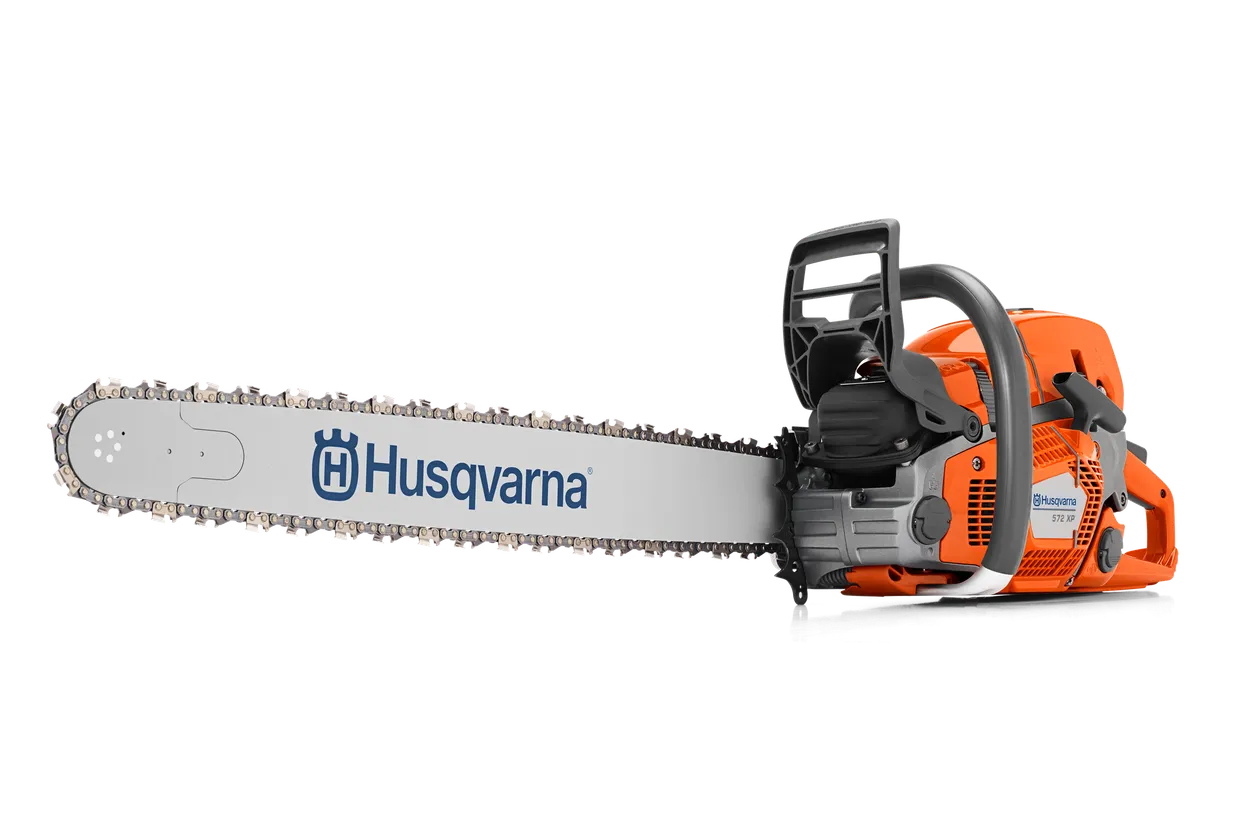
The Husqvarna 572 XP is a professional-grade gasoline chainsaw introduced in 2018 as the successor to the long-running 372 XP. It is aimed squarely at loggers, forestry contractors, and tree-care professionals in the United States who require "big saw" cutting capacity in a mid-weight chassis. The saw is built around a 70.6 cubic centimeter (4.3 cubic inch) X-Torq engine that produces a rated 5.8 horsepower (4.3 kilowatts) at 9,900 revolutions per minute, with a powerhead weight of 14.5 pounds (6.6 kilograms). According to the Husqvarna US product page, "the 572 XP® has a better power-to-weight ratio and 12% higher cutting capacity than previous Husqvarna models in the same class."
Understanding the 572 XP requires familiarity with its principal systems, because nearly every reported problem traces back to one of them:
- X-Torq engine. A stratified-scavenging two-stroke design that routes a charge of clean air to the transfer ports to reduce fuel consumption and exhaust emissions. Its strato ports and dual intake path make air-leak diagnosis more involved than on older saws.
- AutoTune electronic carburetion system. An electronically controlled carburetor that continuously adjusts the fuel mixture for altitude, temperature, humidity, and fuel quality without manual high- and low-speed screws. The 572 XP uses a third-generation AutoTune that adjusts far faster than the first-generation units on saws such as the 576 XP.
- Ignition module (coil). Delivers spark and, on AutoTune saws, works together with the carburetor electronics to monitor engine speed and run time. A failing coil produces intermittent hot-running and no-start faults.
- Decompression valve. A push-button valve that lowers cylinder pressure to ease pull-starting. A leaking decompression valve can create an air leak and hard-starting.
- Clutch assembly and chain drive. A centrifugal clutch that, per the Husqvarna US specifications, has a "clutch engagement speed (±120) 3,700 rpm." The clutch drum rides on a needle bearing that requires periodic greasing.
- Chain brake. An inertia- and hand-activated band brake that stops the chain during kickback.
- Automatic chain oiler. An adjustable oil pump driven off the clutch that meters bar-and-chain lubricant.
- Crankshaft bearings. Main bearings that support the crankshaft. Early-production units drew attention for clutch-side (power-take-off, or PTO) bearing and seal problems, discussed in detail below.
- Anti-vibration system (LowVib). Three spring-and-damper elements that isolate the handles from engine and cutting vibration.
- Air filtration system (Air Injection). A centrifugal pre-cleaner that spins heavier debris away before it reaches the heavy-duty felt filter.
- Cooling system. Cylinder fins, a heat shield, and directed airflow that dissipate heat during sustained cutting.
- Fuel delivery system. A vented tank, a primer (air-purge) bulb, fuel lines, an in-tank fuel filter, and the AutoTune carburetor.
Two principal variants exist: the standard 572 XP and the 572 XPG, which adds electrically heated front and rear handles powered by a generator built into the ignition system. Both are offered in standard and full-wrap-handle configurations, the latter favored by West Coast fallers. Across the model run, Husqvarna has made running production changes; the workshop manual covering the 565, 572 XP, and 572 XPG is dated May 2019, and operator manuals were revised in 2019 and again in 2023.
A note on overall reliability is warranted before examining specific faults. The 572 XP is generally well regarded, and many professionals report trouble-free service. One prominent saw builder, posting as "Mastermind" in the widely read "572XP Update Thread" on the Outdoor Power Equipment Forum, wrote: "I've probably done 50 of these…..and out of those I think 6 have had some sort of issue. Not nearly as bad as the earlier 5 series saws." The problems below are therefore best understood as the exception rather than the rule, but they are real and worth knowing how to diagnose.
Starting Problems
Starting complaints are the single most common category reported by 572 XP owners, and they divide into cold-start difficulty and hot-restart failure. The hot-restart problem is treated separately under Fuel System Problems because it is frequently a vapor-lock phenomenon.
Symptoms
- The engine requires many pulls to fire when cold, sometimes flooding in the process.
- The saw will not fire with the choke engaged despite the SmartStart mechanism.
- New saws in particular seem to flood easily on the first cold start of the day.
- The engine starts but immediately dies, requiring the choke again even when warm.
Causes
- Flooding from incorrect starting procedure. AutoTune saws can add extra fuel; combined with an aggressive starting technique, the cylinder floods. Multiple owners of new 572 XP and 550 XP saws report identical hard-start-then-flood behavior.
- Stale or incorrectly mixed fuel. Ethanol-blended fuel that has separated or aged causes hard starting.
- Fouled or incorrectly gapped spark plug. The Husqvarna US specifications table lists the plug as an "NGK BPMR7A" with an "Electrode gap 0.02 in" (some manual revisions list a CMR6H); a wet or carbon-fouled plug will not fire reliably.
- Clogged air filter restricting airflow.
- Blocked starter pawls. The starter pawls can become clogged with debris and fail to engage the flywheel.
- A leaking decompression valve or air leak, which the AutoTune system masks by enriching the mixture.
- AutoTune settings left rich after the saw was run out of fuel or after a mechanical event.
Troubleshooting Steps
- Confirm the fuel is fresh, correctly mixed at 50:1, and less than 30 days old.
- Remove and inspect the spark plug. If wet, the engine is flooded; if black and dry, it is carbon-fouled. Clean or replace, and verify the electrode gap.
- To clear a flooded engine, remove the plug, hold the throttle wide open, and pull several times to purge excess fuel, then reinstall the plug and start without choke.
- Follow the correct cold-start sequence: engage the chain brake, press the air-purge bulb about six times, set the choke, pull until the engine attempts to fire, then return the choke to the half/fast-idle position and pull again. Do not use the decompression valve as part of the flooding-clear procedure the manual describes.
- Inspect and clean the air filter.
- Inspect the starter pawls and clean around them; adjust or replace if blocked.
- If cold and hot starting remain poor, ask a dealer whether current firmware is installed. Owners reported that a Husqvarna software update noticeably improved both cold starts and hot restarts, producing a richer low- and mid-range fuel map.
Solutions
For the large majority of starting complaints, fresh 50:1 fuel, a clean or new spark plug, a clean air filter, and correct starting technique resolve the problem. If the saw still floods or will not fire, pressure- and vacuum-test the engine for an air leak and inspect the decompression valve, replacing it if it leaks; several technicians report these valves failing and producing exactly these symptoms. If the AutoTune mixture is stuck rich, perform the field calibration described under AutoTune System Problems. Persistent no-start conditions accompanied by a fuel-delivery failure may require carburetor and coil replacement with a firmware flash, which is dealer-level work.
AutoTune System Problems
The AutoTune system is the 572 XP's most distinctive feature and, for do-it-yourself owners, its most controversial. It removes the carburetor adjustment screws and instead manages the mixture electronically. When it works, users praise how quickly it adapts to muffler modifications, altitude, and fuel changes. When it misbehaves, it can be frustrating precisely because there are no screws to turn.
Symptoms
- The saw runs rich and down on power, or bogs and stalls under load, especially when new.
- A new saw feels anemic and stalls in cuts larger than roughly 8 inches until it is broken in and calibrated.
- The saw throws a fault, shuts down to protect itself, and requires a dealer to restore operation.
- After a top-end failure or air leak, the saw is hard to start and cuts poorly because the mixture is stuck at an extreme setting.
Causes
- A calibration that has not yet adapted to a new saw, new conditions, or a new fuel.
- An underlying mechanical fault, most importantly an air leak. When the system detects a lean condition it enriches the mixture aggressively to protect the engine, which masks the real problem.
- A restrictive tank vent, which one builder found caused erratic lean running on several 572 XP saws; removing the vent restriction cured it.
- A caked metering-valve screen or contaminated carburetor, which can prevent proper fueling even on low-hour saws.
- A failing ignition coil or a corrupted electronic module.
Troubleshooting Steps
- Before blaming the electronics, verify the mechanical basics: fresh fuel, clean filter, good plug, and no air leak. A pressure and vacuum test is the definitive air-leak check.
- Perform the field calibration (often called a reset). Warm the engine, then let it run at high idle for approximately three minutes to set the low-speed portion. Then bury the bar a few inches into a log and make a long, heavy cut of roughly 45 to 60 seconds at full throttle under load. You should hear the engine change tone as it tunes. The 572's third-generation AutoTune adapts quickly, so this procedure is short compared with first-generation saws.
- If the saw still runs poorly, inspect the tank vent for restriction and the carburetor metering screen for debris.
- If a fault code has shut the saw down, note that only a dealer with the Husqvarna diagnostic software can read codes and clear or reflash the module.
Solutions
Most AutoTune complaints on new saws resolve simply by running the saw hard through break-in and letting it calibrate; the field procedure above accelerates this. If the root cause is mechanical, fix the air leak, vent restriction, or dirty carburetor first, then calibrate. Understand the two levels of reset: a fuel-settings reset, which owners can effectively accomplish in the field, and a full master reset, which returns the module to defaults and should only be performed with the dealer diagnostic tool after major component replacement. A replacement AutoTune carburetor is expensive, on the order of $200, and is not sold pre-programmed; the electronics from the original carburetor can sometimes be transferred, or the new unit must be flashed to match the ignition. AutoTune diagnostics and code clearing are the clearest example in this saw of work that generally requires an authorized dealer.
Engine Stalling and Performance Problems
Beyond the AutoTune interactions above, the 572 XP can stall, bog, or lose power for mechanical reasons.
Symptoms
- The engine dies shortly after starting or when set down at idle.
- The saw bogs and stalls when pressure is applied in a cut.
- General loss of power and sluggish acceleration.
- Weak pull-cord resistance suggesting low compression.
Causes
- Air leaks at the crankshaft seals, transfer covers, intake boot, or decompression valve. These are the most serious performance killers on the 5-series platform and can lead to lean seizure if ignored.
- Low compression from worn piston rings, a scored piston, or leaking crankcase seals.
- A dirty or restricted fuel system, including a plugged fuel filter or carburetor metering screen.
- A clogged air filter or fouled spark plug.
- Incorrect idle calibration on AutoTune saws.
Troubleshooting Steps
- Perform a pressure and vacuum test of the sealed crankcase. This is the single most valuable diagnostic for stalling and lean-running two-stroke saws. Note that a saw can pass a static test yet still leak under load if a bearing allows the crankshaft to move eccentrically relative to the seal.
- Perform a compression check. A pull cord that no longer resists strongly suggests reduced compression; investigate the crankshaft seals and piston rings.
- Inspect the spark plug's color for clues: a chalky white insulator indicates lean running; a wet black insulator indicates rich running.
- Replace the fuel filter and clean the carburetor metering screen.
- Clean or replace the air filter.
Solutions
Repair any air leak by replacing the failed seal, transfer-cover O-ring, intake boot, or decompression valve. If the piston or cylinder is scored from a lean event, a top-end rebuild is required, after which the AutoTune should be allowed to recalibrate. If compression is low because of worn rings or damaged seals, rebuild accordingly. After any air-leak repair, an AutoTune reset is appropriate because the system will have driven the mixture rich to compensate. Do not simply reset the AutoTune to chase a stalling problem; correct the mechanical cause first, or the system will simply return to a compensating setting.
Chain Oiling Problems
The automatic chain oiler on the 572 XP is adjustable and, in general, adequate, but it is among the more frequently criticized systems on the saw. Complaints range from stingy output to complete oiler failure.
Symptoms
- The bar and chain run dry or the underside of the bar appears nearly dry while the top channel is only lightly wet.
- The chain and bar overheat, discolor, or wear prematurely.
- Oil pools around the clutch cover but does not reach the chain.
- The oiler works weakly from new and then stops entirely.
Causes
- Insufficient oiler setting for a long bar. The pump is adjustable, and the factory setting may be too low for a 24- to 28-inch bar.
- Clogged oil passages, lines, or the bar oil hole. Dirt and sawdust can block the delivery path.
- A blocked oil-tank vent, which prevents oil from being drawn.
- Undersized or blocked oil holes in aftermarket or newer bars.
- A defective oil pump. One owner in the OPE "572XP Update Thread" reported: "Just replaced the oiler on my 572, it was a bit weak from day one, than it just quit. The saw only has eight gallons through it… my guess is the tolerances were off?" — pointing to manufacturing tolerance problems on some pumps.
- A missing retaining clip on the adjustment screw, which can allow the setting to drift.
Troubleshooting Steps
- With the saw off, confirm you have fresh bar oil in the tank and that the tank vent is clear.
- Remove the bar and chain. Run the engine briefly and observe whether oil is pumped from the oiler port. Oil should ooze or throw from the port.
- If oil reaches the port but not the chain, remove the bar, clean the bar groove and the oil-transfer hole, and confirm the holes in the bar align with the saw's oil port. Opening up undersized bar oil holes can help.
- Locate the adjustment screw on the underside of the saw. Turn it counterclockwise to increase flow and clockwise to decrease it. Note that many 572 units have a detented adjuster that clicks through a limited range rather than turning several full turns; do not force it, as excessive force can destroy the pump.
- For long bars or biodegradable/canola oils, set the oiler to maximum flow.
- If no oil is pumped even with the bar removed, remove the clutch to access and inspect the oil pump and pinion, and clear the lines with compressed air.
Solutions
Cleaning the passages, clearing the vent, correcting the adjustment, and aligning the bar holes solve most oiling complaints. Set output generously for long bars; it is far cheaper to use slightly more oil than to ruin a bar and chain from running dry. If the pump is confirmed defective, replace it (the genuine oil pump is a listed service part). A dry bar is not merely a wear issue; the operator manual warns that a dry guide bar and chain increase the risk of kickback, so oiling faults should be corrected promptly.
Clutch and Chain Drive Problems
The clutch and chain-drive components are robust, but they are wear items and are affected by operator habits.
Symptoms
- The chain does not turn, or turns at idle when it should be stopped.
- Rattling or grinding from the clutch area.
- Chips pack into the clutch cover and jam the chain.
- The chain slips off or wears the bar rapidly.
Causes
- A dry or worn clutch-drum needle bearing. The manual specifies weekly lubrication of this bearing; neglect leads to noise and drum-bearing failure.
- Chips packed in the clutch cover. The manual notes chips can lodge in the clutch cover and jam the chain.
- Worn clutch shoes or springs, or a worn drive sprocket/rim.
- Incorrect chain tension. A chain that is too loose can derail; one that is too tight strains the bar, sprocket, and, potentially, the PTO-side crankshaft bearing.
Troubleshooting Steps
- Stop the engine and set the chain brake before any clutch inspection.
- Check chain tension: the chain should be snug against the bar but still pull freely by hand around the bar.
- Remove the clutch cover and clear packed chips. Always stop the engine before cleaning. bwmachinery
- Remove the clutch drum and inspect and grease the needle bearing.
- Inspect the clutch shoes, springs, and the drive rim/sprocket for wear; replace worn parts.
Solutions
Regular greasing of the needle bearing and correct chain tensioning prevent most clutch-drive problems. Replace worn clutch shoes, springs, and drive sprockets as a set where appropriate. Crucially, avoid over-tightening the chain: in the OPE "572XP Update Thread," a user proposed of the PTO bearing, "The PTO bearing might be a user problem. Over tighten a chain once or twice has to hurt that bearing imo," to which the builder Mastermind replied, "I have to agree." This ties good chain-tension discipline directly to bottom-end longevity.
Overheating Problems
Overheating on the 572 XP typically manifests as the saw bogging or dying after it has been run hard, then restarting once it cools. The 5-series platform has a known relationship between carburetor heat soak and hot-running that Husqvarna addressed through cooling design on the 572.
Symptoms
- The saw bogs, loses power, or dies after extended cutting in warm weather, then recovers after cooling.
- The engine runs noticeably hotter under sustained load.
Causes
- A blocked fuel-cap vent, which starves the engine as pressure equalization fails.
- Clogged cooling fins between the cylinder fins, restricting heat dissipation.
- A clogged air filter, forcing the engine to work harder and hotter.
- Carburetor heat soak / vapor lock, an inherent characteristic of the compact 5-series layout where the carburetor sits close to hot engine components; this overlaps with the hot-restart problem discussed under Fuel System Problems.
- A lean running condition from an air leak, which raises combustion temperature.
- Continuous heavy use without cooling intervals.
Troubleshooting Steps
- Clean the fuel cap and confirm the vent is not blocked.
- Remove the cylinder cover and clean between the cylinder cooling fins.
- Clean or replace the air filter.
- Clean the fuel filter and lines and inspect the carburetor.
- If the saw runs lean, pressure- and vacuum-test for an air leak.
Solutions
Keep the cooling fins, air filter, and fuel-cap vent clean, and correct any lean condition. The 572 XP's cooling system, including its heat shield, was designed to reduce the heat-soak problems seen on earlier 5-series saws, so a 572 that overheats should be checked for a specific fault rather than assumed to be behaving normally. For genuine vapor lock, see the management techniques under Fuel System Problems. Allow the saw brief cooling intervals during marathon cutting sessions in hot weather.
Owners occasionally ask about Husqvarna chainsaw recalls. There is no recall specific to the 572 XP. The most widely cited Husqvarna chainsaw recall is CPSC Recall 97-098 (April 8, 1997), in which "Husqvarna Forest & Garden Co. of Charlotte, N.C., is recalling about 277,000 chain saws" — models 42, 51, 55, 242, and 254 (serial numbers beginning 531 and below) and models 61 and 257 (324 and below), sold from 1990 through 1995 for $400 to $600 — because muffler heat could melt the front hand guard; the CPSC cited "one report of a death in Canada and one report of a serious hand injury." That recall does not apply to the 572 XP and is mentioned only to distinguish it from the current model.
Fuel System Problems
Fuel-system faults on the 572 XP include leaks, contamination, and the widely discussed hot-restart / vapor-lock behavior. Because the AutoTune carburetor depends on clean, correctly mixed fuel and a leak-free system, fuel quality is foundational to the saw's reliability.
Symptoms
- The saw will not restart when hot after running, and the primer bulb will not draw fuel.
- Fuel leaks from the tank, cap, or lines.
- Rich running, poor power, or stalling traceable to fuel delivery.
- The primer bulb remains empty.
Causes
- Vapor lock / heat soak. After hard use on a hot day, fuel in the lines and carburetor vaporizes; the primer will not pull fuel and the saw will not start until it cools. Technicians describe this as an inherent design characteristic of the compact 5-series layout rather than a component failure, which is why a bench test often finds "nothing wrong."
- A plugged fuel filter or caked carburetor metering screen, which can appear even on low-hour saws and cause lean running or stalling.
- Ethanol-related problems. Ethanol-blended fuel absorbs water and can phase-separate, leaving a fuel layer with no oil, degrading rubber components and clogging the carburetor.
- A blocked tank vent or a defective fuel line/primer bulb.
- A carburetor that has failed or drifted, sometimes requiring replacement.
Troubleshooting Steps
- For hot-restart failure, first confirm it is heat-related: the saw starts fine cold but not when hot, and the primer will not fill. Let the saw cool, then restart.
- As a field workaround for vapor lock, some operators briefly open the fuel cap to release pressure, prime once or twice after a short rest, and start at idle; others carefully start with the throttle held open. Use caution with any wide-open-throttle start.
- Inspect and replace the fuel filter; clean the carburetor metering screen.
- Inspect fuel lines, the primer bulb, and the tank vent for cracks, leaks, or restriction.
- If leaks are present, identify the source (tank, cap, or lines) and repair; the manual stresses checking regularly for fuel leaks.
- If the carburetor is confirmed faulty, plan for replacement and firmware programming.
Solutions
Use fresh fuel with a minimum octane of 89 (AKI) and no more than 10 percent ethanol (E10); Husqvarna recommends higher-octane fuel for sustained high-rpm work and cautions against gasoline below 90 RON / 87 AKI. Ethanol-free fuel or pre-mixed fuel is preferable, particularly for saws that sit between uses. Mix at 50:1 with a quality two-stroke oil (2.6 fluid ounces per U.S. gallon), and do not store mixed fuel longer than about 30 days, or 90 days with a stabilizer. For chronic hot-restart problems, manage the saw operationally, keep a backup saw for hot days, and, on 2017–2018-era 5-series saws generally, ask a dealer about the updated carburetor and firmware that Husqvarna introduced to address hot starting. Replacing the fuel filter and cleaning the carburetor resolve most contamination-related fuel faults.
Excessive Vibration Problems
The 572 XP is praised for smoothness; professionals repeatedly describe its LowVib anti-vibration system as among the best in class. Excessive vibration therefore signals a fault rather than a design limitation.
Symptoms
- Noticeably increased handle vibration compared with normal operation.
- A visibly cracked or broken anti-vibration spring/mount.
- A chain-related vibration or rough cutting.
Causes
- A cracked or broken anti-vibration element. The saw uses three AV units; owners have reported a cracked spring mount on the crankcase, for example near the choke on the starter side.
- A worn, damaged, or improperly sharpened chain, or an unevenly worn bar, producing rough cutting and vibration.
- A damaged or unbalanced clutch or drive sprocket.
- Loose fasteners, including cylinder or handle bolts.
Troubleshooting Steps
- Inspect all three anti-vibration mounts for cracks or breakage.
- Inspect the chain for damaged or unevenly sharpened cutters and correct depth-gauge (raker) settings; inspect the bar rails for uneven wear.
- Check the clutch drum and sprocket for damage.
- Check that cylinder cover, handle, and bar fasteners are correctly tightened, as loose bolts have been reported from the factory on some units.
Solutions
Replace any failed anti-vibration element; while a saw may run with one broken mount, the remaining mounts will bear additional load and may fail sooner, so timely replacement is advised. Sharpen or replace the chain correctly using the recommended file gauge, and dress or replace the bar as needed. Retighten or replace fasteners to specification. Because prolonged exposure to vibration can cause circulatory and nerve damage (hand-arm vibration syndrome), the operator manual explicitly warns operators to seek medical advice if they experience numbness, tingling, or loss of strength; a saw vibrating abnormally should be repaired before further heavy use.
Crankshaft Bearing and Early-Production Failures
This section addresses the most discussed durability concern on the 572 XP: crankshaft bearing and seal failures, concentrated on early-production units. It also covers the factory quality-control issues that appeared on some early saws.
Symptoms
- A saw that "never ran right" from new, traced to a leaking clutch-side (PTO) crankshaft seal.
- Lean running or repeated AutoTune enrichment that masks an underlying air leak until the engine fails.
- A saw that passes a static pressure/vacuum test but leaks under load.
Causes
- A PTO-side main bearing spinning in the crankcase or a leaking crank seal. In the "572XP Update Thread," the builder Mastermind wrote: "So far I've had two that spun the PTO side bearing in the case, three that had to have carb and coil replaced." A separate account on ArboristSite described a working saw whose "clutch side crank seal was leaking," warrantied with a repair estimate of three weeks.
- Concentration in early batches. One dealer account stated that "2 or 3 units off the first pallet" had bearing or seal issues, after which the problem largely disappeared, pointing to an early-production rather than a design-wide defect.
- The nature of the bearing design. The 572 uses large main bearings (owners cite 6203-size units, larger than the 372's), which many consider stout; the debate centers on the seals and on plastic/nylon bearing cages used across the newer 5-series family, which some technicians distrust.
- Possible contribution from operator habits. Whether these failures are a design flaw or user-induced is genuinely disputed. As noted above, a user argued that over-tightening the chain "once or twice has to hurt that bearing," and Mastermind agreed it "might be a user problem," while also attributing many other faults to factory quality control.
Troubleshooting Steps
- If a saw runs rich or lean without an obvious cause, pressure- and vacuum-test the crankcase, and be aware that a load-only leak (crankshaft moving eccentrically at the seal) can pass a static test.
- A quick field indicator some technicians use is a light spray of an aerosol solvent near the seal while the saw idles, watching for an rpm change that suggests a leak; use sparingly and with care.
- Determine the production date from the serial number (the rating plate encodes production year and week) to gauge whether a saw is an early unit.
- Confirm warranty status before disassembly, since bearing/seal repair on these saws is labor-intensive.
Solutions
For an in-warranty saw, a leaking seal or spun bearing should be a warranty claim; owners generally report Husqvarna covering such claims, though repair times at busy dealers have been lengthy. For out-of-warranty repair, the fix involves splitting the crankcase to replace the bearing and seal, and sourcing can be a challenge because the PTO-side bearing is proprietary on many modern saws and aftermarket parts for the 572 have been limited. Replacement seals can sometimes be installed independently of the bearing, but on these newer saws the bearings often do not outlast the seals, so replacing both while the case is apart is prudent. Regarding a redesign: while owners note a flywheel-side bearing part number that was superseded around 2020, there is no confirmed Husqvarna bulletin stating a specific 2019 bearing redesign for the 572, so that should not be presented as established fact.
Factory quality-control notes on early units
Separate from bearings, early 572 XP saws exhibited assorted assembly defects: a cross-threaded air-filter stud driven in until the captured nut spun in its molding on a factory-sealed saw; loose cylinder bolts from the dealership; and units that would not pass fuel through the carburetor until the carburetor and coil were replaced and firmware installed. A 2018–2019-era Husqvarna software update, reported by long-time users, improved cold-start and hot-restart behavior on 5-series AutoTune saws by richening the low- and mid-range fuel map. The general consensus among experienced users is that later production 572 XP saws are markedly improved over the earliest units and over the earlier 550/562 saws.
Variant differences: 572 XP versus 572 XPG
The 572 XPG shares the engine, AutoTune, oiler, clutch, and bottom end with the standard 572 XP, so all of the mechanical problems above apply equally. Its distinguishing feature is the heated-handle system: electrical heating coils in the front and rear handles powered by a generator in the ignition, controlled by a switch on the rear handle. The added hardware introduces a failure mode unique to the G model: heated handles that do not warm up. Because the system relies on a single generator feed, handle heating elements, a switch, and wiring routed through the handles and anti-vibration mounts, faults typically stem from broken or chafed wires (the wiring is thin and passes through areas subject to vibration), a failed switch, or a failed heating element. Troubleshooting involves inspecting the switch and its short leads, the generator wire for exposed or broken copper, and continuity through the heating elements; repair means splicing or replacing the damaged wiring or the affected handle heating element (available as service parts). The XPG is also slightly heavier (approximately 6.8 kilograms versus 6.6 kilograms for the XP).
There is no evidence that the XPG suffers engine or bearing problems at a different rate than the XP.
Preventive Maintenance and Recommended Servicing Schedule
Nearly every problem above is less likely, or easier to catch early, with disciplined maintenance. Husqvarna structures 572 XP maintenance into daily, weekly, and monthly intervals. The following consolidates the manufacturer's schedule with field-proven practice for U.S. operators.
Daily maintenance (before or after each day of use)
- Air filter. Clean the heavy-duty felt filter of dirt and dust. The manual stresses that a clean air filter prevents carburetor malfunctions, starting problems, and power loss. Replace if damaged or heavily loaded. The Air Injection pre-cleaner greatly extends filter life, but the filter still requires attention.
- Cutting equipment. Inspect the chain for sharpness and damage; sharpen with the recommended Husqvarna file gauge and keep the correct depth-gauge setting. Check chain tension.
- Guide bar. Clean the bar groove and oil holes; check for burrs and uneven rail wear; confirm the bar-tip sprocket turns freely and its lubrication hole is clear. Flip the bar periodically to even out wear.
- Chain oiler. Verify oil delivery to the chain and top up bar oil.
- Safety devices. Check chain-brake function, the chain catcher, the throttle-trigger lockout, and the stop switch.
- Clean the saw, especially the clutch cover and cooling-air intake, and clear packed chips.
- Fasteners. Check that nuts and screws, particularly the bar nuts, are tight.
Weekly maintenance
- Clutch-drum needle bearing. Lubricate the needle bearing weekly; this is one of the most-missed items and a common cause of clutch-area failures.
- Cooling system. Clean between the cylinder fins and around the flywheel to maintain cooling.
- Starter. Clean the starter-cord air intake and inspect the cord and pawls.
- Spark plug. Clean the plug, check the electrode gap, and inspect the insulator color as a running-condition indicator. Use only the specified plug (NGK BPMR7A / CMR6H per manual revision); an incorrect plug can damage the piston and cylinder.
- Chain brake. Inspect the brake band for wear.
Monthly maintenance
- Fuel system. Inspect and replace the fuel filter; check fuel lines and the primer bulb; clean the carburetor exterior and the metering screen.
- Clutch. Inspect the clutch center, drum, and spring for wear.
- Bearings and seals. Have a dealer inspect crankshaft seals if any lean-running symptoms appear.
- Cables and connections, including the heated-handle wiring on the XPG.
Fuel and oil practice
- Mix at 50:1 (2.6 fluid ounces of two-stroke oil per U.S. gallon of gasoline) using a quality two-stroke oil; Husqvarna's XP+ oil qualifies and, when purchased with the saw from participating sellers, can extend the warranty.
- Use a minimum of 89 (AKI) octane and no more than 10 percent ethanol; prefer ethanol-free or pre-mixed fuel.
- Buy only as much fuel as you will use in about 30 days; do not store mixed fuel beyond 30 days without a stabilizer, or 90 days with one.
Off-season storage
- Empty the fuel tank and run the carburetor dry, or treat the fuel with stabilizer, to prevent ethanol-related gumming and corrosion.
- Empty and clean the oil tank interior.
- Clean the saw thoroughly, inspect and clean the air filter, and store in a dry place.
- Remove the spark plug cap when the saw is unattended, as the spring-loaded start/stop switch means even a small force on the starter could start the saw.
When to use a dealer
Owners and technicians can perform the great majority of 572 XP maintenance and many repairs. The clearest cases for authorized dealer service are AutoTune fault diagnosis and code clearing (which require Husqvarna's proprietary diagnostic software), master resets after major component replacement, carburetor and coil replacement with firmware programming, and warranty repairs, which Husqvarna requires to be examined by a dealer. Crankcase splitting for bearing and seal replacement, while achievable by a competent independent technician, is also commonly handled by dealers, especially under warranty.
TL;DR
- The Husqvarna 572 XP is generally reliable in later production, and its documented problems cluster into a small set: cold- and hot-start difficulty (often vapor lock), AutoTune calibration interacting with air leaks, chain-oiling shortfalls, and, mainly on early-production units, clutch-side (PTO) crankshaft bearing/seal failures plus assorted factory assembly defects. The single most valuable diagnostic across most running faults is a pressure and vacuum test for air leaks.
- Most complaints are fixable by an owner: use fresh 50:1 fuel of at least 89 AKI octane with no more than 10 percent ethanol, keep the air filter, cooling fins, and fuel-cap vent clean, use the correct NGK spark plug, set the oiler generously for long bars, grease the clutch needle bearing weekly, and avoid over-tightening the chain (which experienced builders link to PTO-bearing damage).
- Reserve authorized-dealer service for AutoTune fault codes and resets, carburetor/coil replacement with firmware flashing, and warranty claims; there is no recall specific to the 572 XP, and in-warranty bearing or seal failures are generally covered.
Key Findings
- Starting/hot-restart problems are the most common complaint. Cold-start flooding on new saws usually reflects technique or stale fuel; the more stubborn hot-restart failure is a vapor-lock/heat-soak characteristic of the compact 5-series layout, confirmed by the pattern of the saw starting cold but not hot with an empty primer.
- AutoTune faults are usually symptoms, not causes. The system enriches aggressively to protect the engine when it senses a lean condition, masking air leaks, restrictive tank vents, and dirty carburetors. Fix mechanics first, then field-calibrate (about three minutes at high idle, then 45–60 seconds of heavy cutting under load).
- Early-production bearing/seal failures are real but concentrated. A professional builder reported two spun PTO-side bearings and three carburetor-and-coil replacements among the 572 saws he serviced; a dealer reported "2 or 3 units off the first pallet" with bearing/seal issues that then largely disappeared, indicating an early-batch rather than design-wide problem.
- Chain oiling is the most-criticized routine system. Output can be stingy for long bars, and some pumps have failed early from tolerance issues; adjustment, passage cleaning, and vent clearing solve most cases.
- Later saws are improved. A 2018–2019-era software update helped cold and hot starting, and consensus holds that recent production is markedly better than the earliest units and the earlier 550/562 saws.
Recommendations
- On acquiring a used 572 XP: decode the serial number for production date; inspect the air-filter stud and cylinder bolts for the known early-unit assembly defects; verify oiler output with the bar removed; and pressure/vacuum test before heavy use. If the saw is an early unit with any lean-running history, prioritize the crankcase leak test. Threshold to change approach: a failed leak test — especially under load — moves the job from routine service to a bottom-end (bearing/seal) repair.
- For a saw that will not restart hot: treat it as vapor lock first, confirm with the cold-good/hot-bad pattern and an empty primer, and manage operationally (brief cool-down, cautious priming, backup saw on hot days). Escalate to fuel-filter and carburetor service, and — on 2017–2018-era 5-series saws — the updated carburetor/firmware, if it recurs.
- For any running fault on an AutoTune saw: fix the mechanical basics (fuel, filter, plug, air leak) before touching the electronics, then field-calibrate. Involve a dealer only if a fault code has shut the saw down, since code clearing requires proprietary software.
- Maintain to prevent: daily air-filter and cutting-equipment checks, weekly clutch needle-bearing greasing and cooling-fin cleaning, monthly fuel-system service, strict 50:1 mixing with fresh low-ethanol fuel, and proper off-season storage. Change your servicing cadence upward if you cut in dusty conditions, run long bars, or operate in sustained heat.
- Preserve warranty and coverage: route in-warranty faults to a dealer; Husqvarna generally covers bearing/seal and early carburetor claims. The benchmark that should shift your plan is the pressure/vacuum test: a saw that holds pressure and vacuum can almost always be returned to service with fuel-system and calibration work; a saw that fails, particularly under load, points to seals or bearings and, on an early unit, to the documented PTO-side failure mode.
Caveats
- Much of the field evidence in this article comes from professional and enthusiast forums (Outdoor Power Equipment Forum, ArboristSite, Hearth.com, Forestry Forum) and reflects the experience of high-volume builders and dealers, who by definition see a disproportionate share of problem saws; it is not manufacturer failure-rate data. The builder cited estimated roughly 6 problem saws out of about 50 he serviced, which is not a population-wide statistic.
- A specific 2019 crankshaft-bearing redesign for the 572 XP is not confirmed by any Husqvarna bulletin; owners note only a flywheel-side bearing part-number supersession around 2020. Do not treat a redesign as established fact.
- The exact date of the beneficial AutoTune software update is uncertain; forum accounts place it in the 2018–2019 window rather than a single verified month.
- Carburetor model numbers cited by users vary (EL44, EL46, Zama) and are inconsistent across the 5-series family; treat specific part callouts as approximate and verify by serial number and parts lookup.
- Spark-plug and electrode-gap specifications differ slightly between manual revisions (NGK BPMR7A with a 0.02-inch gap in the US specification table; NGK CMR6H with a 0.5-millimeter gap in some manual editions). Confirm against the manual revision that matches your saw's build date.
- There is no recall specific to the 572 XP. The 1997 CPSC recall referenced for context applies only to older Husqvarna models.
- Generic "common problems" listicle websites were reviewed but not relied upon for specific technical claims, as several contain imprecise or copied content; primary manuals, Husqvarna support pages, CPSC, and first-hand forum accounts were prioritized.