
When a Toro 24.5HP engine will not start, hunts up and down or loses power as the blades engage, the first job is to describe the fault accurately. A silent starter needs a different investigation from an engine that turns normally but will not fire. A mower that shuts off instantly when a control moves may have an interlock problem rather than a dirty carburetor.

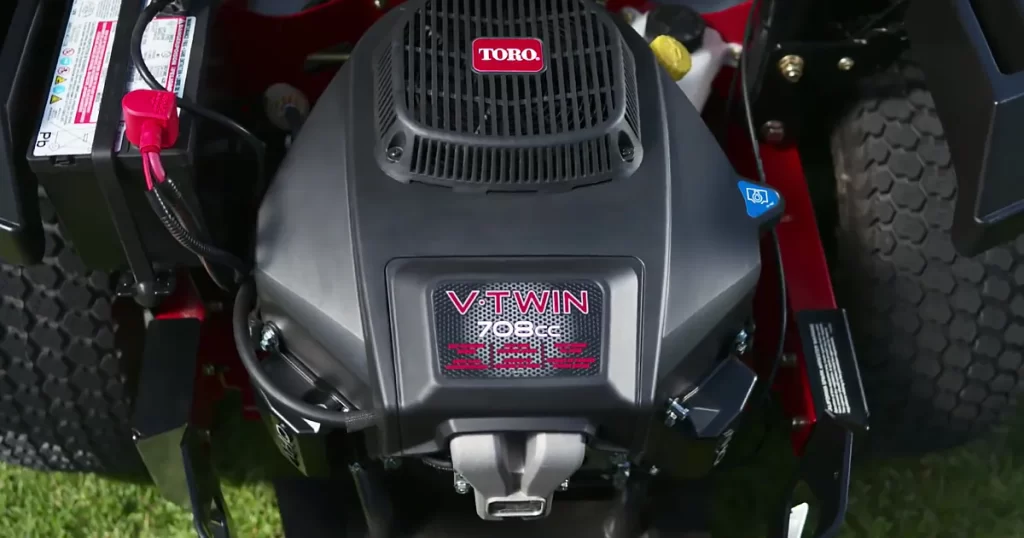
The familiar Toro 24.5HP Commercial V-twin is part of the 708cc engine family used in several zero-turn mowers. This guide concentrates on that family. It explains sensible owner checks, what the results can mean and when a technician needs to measure rather than guess. These are diagnostic possibilities, not evidence that every listed problem is widespread or inevitable.
Start with the mower model and serial number, the engine identification and its service history. Those details determine the correct parts, fluid information and operating procedure. The horsepower sticker alone is not enough to order a carburetor, choose an oil quantity or set the governor.
Identify the Engine Before Following Repair Advice
Toro’s engine literature describes a 708cc V-twin with a two-barrel carburetor and a self-cleaning air-filter housing. A two-barrel carburetor is not the same thing as two separate carburetors. Likewise, a housing designed to shed debris does not make the filter element maintenance-free.
There are meaningful differences between installations. Toro’s TITAN service specifications identify the LC2P77F engine on several 24.5HP models, while nearby models in the same mower range use a Kawasaki engine. TimeCutter and TITAN machines can also have different air-cleaner arrangements and service specifications. Do not transfer instructions from a mower merely because its paint and deck size look familiar.
Use Toro’s parts and manuals lookup with the complete mower identification. If the engine has been replaced, tell the dealer and provide its identification too. The original mower catalogue may no longer identify every engine service part correctly.
Information Worth Recording
- Mower model, serial number and approximate year, plus the engine model and specification labels.
- Hour-meter reading and the date of the last oil, filter and spark-plug service.
- Whether the fault occurs cold, hot, while stationary or only with the cutting deck working.
- Fuel purchase date and whether the problem began after filling, storage or maintenance.
- Recent battery, belt, blade, carburetor, wiring or control changes.
Keep a photograph of each identification label. Serial-number breaks in a parts catalogue can matter even within one model. If a replacement part appears almost identical but has a different connection, linkage or hose arrangement, stop and confirm compatibility rather than modifying it to fit.
Make the Mower Safe Before Inspecting It
Park on firm, level ground, disengage the blades, secure the parking brake, shut off the engine and remove the key. Wait for movement to stop and let hot components cool. Follow the mower’s isolation procedure before maintenance, including disconnecting spark-plug leads or the battery where the procedure requires it.
Never put a hand beneath a running deck, bridge starter terminals, bypass a seat switch or disconnect a safety circuit to keep mowing. A zero-turn mower can move or rotate its blades unexpectedly if its starting and safety circuits are defeated. Support raised equipment using the specified method; a jack alone is not a safe working support.
Run engines only outdoors with adequate clearance from people and buildings. Fuel leaks, a rapidly rising oil level, severe knocking, smoke from wiring or a starter that repeatedly stops abruptly are reasons to stop testing. Continuing through those symptoms can create a fire risk or increase mechanical damage.
Match the Symptom to the First Useful Check
| Symptom | First distinction | Sensible starting point |
|---|---|---|
| Nothing happens at START | Silence versus clicking | Correct starting conditions, battery and connections |
| Starter turns slowly | Weak cranking versus sudden mechanical stop | Battery load test, cable voltage-drop test and mechanical assessment |
| Cranks normally but will not start | Cold, hot or after storage | Fuel history, choke operation and ignition checks |
| Runs only with some choke | Temporary cold operation versus persistent dependence | Fuel delivery or intake-leak diagnosis |
| Speed repeatedly rises and falls | At no load or only while cutting | Air/fuel supply, external load and control linkage assessment |
| Stops after warming up | Abrupt shutdown versus progressive spluttering | Record the hot fault; test ignition, fuel and electrical supply |
| Dies when blades engage | Instant cutoff versus labouring first | Interlock circuit or excessive deck load, depending on the symptom |
| Bangs at shutdown | After stopping versus repeated popping while running | Correct shutdown procedure, then fuel/ignition diagnosis |
| Smokes or uses oil | Exhaust smoke versus an external spill | Correct oil reading, leakage and breather/internal checks |
| Engine sounds normal but mower will not travel | Engine output versus drive-system failure | Mower drive controls, belt and hydrostatic system |
Use the table to narrow the investigation, not to select a replacement part immediately. Several faults can create the same symptom. The sections below explain which observations make a repair decision more reliable.
1. The Starter Does Not Turn the Engine
Check Starting Conditions First
Confirm the blade-control switch is off and the controls are in the positions specified for starting. Brake, seat and motion-control requirements depend on the mower. A lever that appears nearly in its parked position may not be operating its switch correctly, but do not bend or defeat the switch to compensate.
Describe what happens when the key is turned. Silence suggests a different diagnostic route from repeated clicking. A single click shows that something has operated, but it does not prove the starter motor is receiving adequate current. Lights or an hour meter working normally also do not prove the battery can crank the engine.
If moving a control to its correct position consistently changes the result, report that to the repairer. It is useful evidence of a control or circuit relationship. It is not permission to start the mower with the control held in an improvised position or to work around a defective safety function.
Separate a Discharged Battery From a Failed Battery
Inspect accessible connections with the engine off. Corrosion, loose terminals or a damaged cable can prevent the starter receiving sufficient power. A battery can show a plausible resting voltage and still perform poorly under load, so a proper battery test is more informative than judging it only by a charger display.
Battery manufacturer Yuasa recommends professional testing when a battery appears charged but struggles under load or the same fault returns. Use a charger suited to the installed battery type. Do not charge a leaking, swollen or otherwise damaged battery, and keep sparks and flames away from the charging area.
If charging restores normal starting only briefly, investigate why the charge is being lost. Possible categories include a battery unable to retain charge, inadequate charging while running, or an unwanted electrical load while parked. Replacing the battery without separating these possibilities can result in the same complaint a few weeks later.
When the Starter or Circuit Needs Testing
A technician can check voltage drop through the positive and ground paths during a starting attempt, then assess the control circuit and starter. Ask for the measured result before authorising a starter replacement. Resistance at a connection can produce symptoms that resemble a worn starter.
Stop if the starter turns part of a revolution and repeatedly comes to a hard stop. That can require mechanical investigation rather than a larger battery or repeated jump-starting. Do not attempt to force a potentially locked engine through with a wrench; the cause must be identified first.
2. The Engine Cranks but Will Not Start
Begin With Fuel History and the Starting Procedure
Confirm there is fuel and that a fitted fuel-shutoff valve is open. Review the correct choke and throttle positions for the mower. A cold start and a restart after mowing may require different choke use. More choke is not automatically better when the engine has already been cranked repeatedly.
Toro’s fuel guidance recommends fresh fuel, generally less than 30 days old, and prohibits gasoline containing more than 10% ethanol for the equipment covered by that guidance. E15 or E85 is not a substitute for the approved fuel. Adding treatment to badly deteriorated fuel should not be treated as proof that the fuel is now usable.
If the problem appeared after winter storage, tell the repairer how the mower and fuel container were stored. If it began immediately after refilling, preserve the fuel history and receipt where available. Do not keep adding different cleaners and additives, because that makes it harder to establish what was originally in the system.
Observe the starter’s duty limit in the matching manual. Continuous cranking heats the starter and depletes the battery, turning a fuel or ignition complaint into an additional electrical problem. Stop for a strong persistent fuel smell, wet fuel leakage or an unexpected change in cranking sound.
Inspect the Air Cleaner Correctly
With the engine stopped and isolated, inspect the air-cleaner installation according to its instructions. Check that the element is present, correctly seated and undamaged, and that debris has not entered the clean side. A loose cover or damaged seal can be significant even when the visible filter surface looks acceptable.
Paper elements and foam pre-cleaners are not serviced in the same way. Do not wash or oil a paper element, and do not automatically oil every foam component. Use the procedure specified for the fitted assembly. Toro’s instructions for one dual-element installation specifically prohibit cleaning the paper element with liquids or pressurised air.
A badly contaminated or damaged filter needs the appropriate replacement. Running without the filter to see whether the mower will finish the job exposes the engine to dirt and is not a repair. If the intake contains oil or wet fuel, investigate why it got there rather than treating the element as the only fault.
Ignition and Compression Come Next
Check that accessible spark-plug boots are properly seated with the engine off and cool. If a plug inspection is within your skills and the manual provides the procedure, use the correct plug and gap. Do not assume that a visually similar plug has the right reach or heat range.
A workshop can test ignition with suitable equipment and compare both cylinders. Avoid holding a plug against the engine with bare hands or making sparks near an open fuel system. A no-spark result must be interpreted alongside the mower’s stop and safety circuitry; it does not automatically condemn the ignition coil.
If fuel delivery and ignition are verified, mechanical condition becomes relevant. Compression or leak-down testing and valve checks can help locate a problem, but the test method and specification must match the engine. An isolated pressure number from a different engine is not a reliable pass-or-fail standard.
3. The Engine Surges or Needs Choke to Keep Running
Surging, sometimes called hunting, is a repeated rise and fall in engine speed while the operator holds the same setting. Record whether it happens with the blades off, only while cutting or after the engine warms. A speed change as the mower enters heavy grass is different from persistent hunting at a steady load.
If partial choke improves a fully warmed engine, that observation can support investigating fuel delivery or an unwanted intake-air leak. It does not prove that the carburetor must be replaced. Choke changes the mixture, so several underlying conditions can respond to it.
Check Supply Before Buying a Carburetor
Fuel must reach the carburetor reliably. A restriction upstream can create poor running even when the carburetor itself is clean. Tell the technician about collapsed-looking hoses, recent filter replacement or a symptom that develops after several minutes rather than immediately at startup.
A clear fuel filter that is not completely full is not, by itself, a diagnosis. Nor does fitting a new filter prove that flow is adequate through the entire system. A proper test should establish where the supply is restricted and use parts intended for the engine’s fuel system.
The Toro Twin Cylinder Engine Service Manual separates fuel or intake problems from linkage and governor problems when investigating hunting. That is a workshop diagnostic sequence, not an invitation to hold a running throttle linkage by hand. Keep fingers, clothing and tools away from the moving engine and belts.
Avoid Governor and Jet Experiments
Do not stretch a governor spring, change linkage holes or raise maximum speed to disguise poor running. Engine speed affects the mower and blade system as well as the engine. A change that sounds smoother while stationary may create an unsafe operating speed or fail under load.
Similarly, drilling carburetor jets or substituting an almost-matching carburetor can introduce new mixture and control problems. A technician should identify contamination, leakage, wear or a failed component before deciding between cleaning, rebuilding and replacement.
If the problem started after carburetor work, compare the installation with the correct diagram. Gaskets, hoses and linkage routing matter. Returning to a known correct installation is a more useful first step than making another round of unrelated adjustments.
4. It Runs Cold, Then Stops When Hot
Record the elapsed time to failure and how the engine stops. An immediate cutoff, as if the key were turned, suggests a different route from several seconds of spluttering and fading power. Neither description is conclusive, but it helps the technician plan tests while the fault is actually present.
Also record what happens afterward. Does the starter still turn normally? Will the engine restart immediately, or only after cooling? Does the problem occur with the deck disengaged as well? Avoid repeatedly mowing until it fails if there are signs of overheating, fuel leakage or mechanical noise.
Test the Fault in Its Failed State
An ignition component can behave differently when hot, but heat-related shutdown is not proof of a bad coil. Fuel supply, venting and electrical connections can also require investigation. A cold test hours later may miss the condition completely.
Ask the workshop to reproduce the complaint safely and test the relevant systems promptly. A report that identifies spark loss on one cylinder during the hot failure is more useful than a general suggestion that the engine probably needs both coils.
If tank ventilation is suspected, have the cap and vent arrangement checked according to the model’s procedure. Do not mow with the fuel cap loose or absent. A momentary change after opening a tank is not sufficient evidence to ignore other possible restrictions or electrical faults.
Include Cooling and Recent Work in the History
Mention whether the fault began after replacing covers, cleaning the engine, servicing the fuel system or fitting an accessory. A misplaced hose, a connection disturbed during service or a missing cover can be more relevant than the age of the engine.
Keep the conditions consistent when assessing a repair. A mower that runs for five minutes after a part change has not necessarily passed a complaint that previously appeared after half an hour. The repairer should verify operation under an appropriate controlled workload without recreating an unsafe situation.
5. It Loses Power or Dies When the Blades Engage
Instant Cutoff Versus a Labouring Engine
An instant stop when a control changes can involve the safety system or an electrical fault. A motor that slows, struggles and then stalls may be facing excessive mechanical load or failing to produce adequate power. Record the distinction before describing both conditions simply as dying under load.
Check the correct operating sequence from the seat, with guards in place and people clear. If the mower fails its specified safety-system checks, arrange repair. Do not jumper the seat switch or hold it down to determine whether the engine will tolerate the blades; that defeats protection exactly when the cutting system is being activated.
The deck also needs consideration. Packed clippings, damaged blades, a binding spindle or a belt problem can load the engine abnormally. Inspect only after shutting down and isolating the mower. Keep away from spring-loaded belt tensioners unless you understand the manufacturer’s release procedure.
Check the Workload Without Hiding the Fault
Grass height, moisture, ground speed and cutting height affect the demand on the machine. Use the specified mowing throttle setting and reduce travel speed when the grass is heavy. Trying to make a struggling mower quieter by running it at an unsuitable low engine speed can worsen cutting performance.
If it performs normally in light, dry grass but struggles in dense growth, examine cutting conditions and deck condition alongside engine maintenance. If it cannot handle an ordinary workload that it previously managed easily, do not dismiss the change as merely tough grass. Something may have changed in either available power or mechanical resistance.
A V-twin may still run with one cylinder contributing poorly, making it appear reasonably smooth without load and weak during cutting. A technician can compare cylinder contribution and investigate ignition, fuel distribution and mechanical condition. Do not pull off plug leads from a running engine to perform a home cylinder-balance test.
Normal Engine Sound but No Travel
If engine speed remains steady while the mower barely moves or will not move at all, investigate the drive system separately. Drive-release controls left in the towing position, belt issues and hydrostatic faults are examples of mower-side possibilities. The correct check depends on the chassis.
Do not assume more engine speed will overcome a drive fault. Follow the instructions for returning any release controls to their operating position, and arrange service if the machine still behaves incorrectly. Hydraulic fluid recommendations and engine oil recommendations are not interchangeable.
6. Backfiring, Popping and a Bang After Shutdown
Describe when the noise occurs: during cranking, through the intake while running, during deceleration or after the engine has stopped. Those events can have different causes. A single shutdown bang does not establish that the flywheel key has sheared, and repeated running misfire should not be dismissed as a harmless shutdown characteristic.
General small-engine guidance from Briggs & Stratton distinguishes running or shutdown backfire from afterfire following shutdown. It also notes that fuel mixture, temperature and anti-afterfire equipment can matter. These are general principles, not Toro-specific settings or proof that a Briggs part belongs on this engine.
Follow the Actual Shutdown Instructions
Do not adopt a universal rule to idle every mower for a fixed time before switching it off. Shutdown instructions can depend on the engine and its fuel-solenoid arrangement. The Toro TITAN HD manual for models 74447TE and 74451TE, for example, specifies switching off with the throttle in FAST. Use the instructions for your own model.
If the correct procedure does not prevent repeated afterfire, ask for the fuel-solenoid operation and related circuitry to be assessed where fitted. A click is not a complete functional test, and cutting off the solenoid tip is not an acceptable repair. The component must work as designed.
Repeated popping together with loss of power needs a broader ignition, mixture and mechanical investigation. Mention any recent blade impact or engine work. Timing components may need examination when there is supporting evidence, but replacing a flywheel or key based only on the sound is speculative.
Stop if there are flames, a fuel leak, a damaged exhaust or repeated violent bangs. Allow the machine to cool in a safe place. Do not try to clean a hot muffler, pour chemicals into it or continue mowing to burn away the problem.
7. Overheating and Debris Around the Engine
The Toro 708cc V-twin covered here relies on air cooling. Its intake screen, cooling passages, fins and installed shrouds are important. Car-style advice to top up a radiator or replace a coolant thermostat is not the appropriate starting point for this engine.
Hot surfaces alone do not demonstrate a fault: the exhaust becomes very hot in normal operation. More useful evidence includes a new burning smell, repeated power loss as it warms, visible debris scorching or a change from its previous behaviour. Shut down if there are signs of overheating or smoke from accumulated material.
Clean the Right Areas
Once the engine is cool and isolated, remove accessible dry grass and debris using the approved method. Check the intake screen and the area around the exhaust. Debris hidden beneath covers may require the manual’s removal procedure or professional service; cleaning only the visible top grille may leave an obstruction underneath.
Reinstall all cooling covers and guards correctly. Running with a shroud removed to give the engine more air can disrupt the directed airflow the system needs. Do not pressure-wash electrical parts or force debris into the intake while trying to improve cooling.
Oil level and operating load belong in the investigation too. If proper cleaning and a correct service baseline do not resolve the complaint, have the engine assessed. Repeatedly allowing it to cool and restarting is not a lasting solution to an unidentified heat problem.
8. Smoke, Oil Consumption and Fuel in the Oil
Establish Where the Smoke Comes From
Smoke at the exhaust and smoke from oil spilled onto an external hot surface are different observations. Record the location, duration and whether it began directly after servicing. Stop for an active leak or persistent heavy smoke rather than assuming it will disappear with more running.
Blue or pale exhaust smoke can be associated with burning oil. General engine guidance identifies overfilling, breather problems and internal wear among possible causes. The colour alone cannot tell you whether the engine needs rings, a gasket or a simple correction to an overfilled sump.
Start by checking the oil correctly on level ground, with the engine stopped and under the conditions specified in its manual. Compare readings taken the same way. A reading taken on a slope or before oil has settled can lead to an unnecessary top-up and an actual overfill.
Track Consumption Before Ordering Internal Parts
Record the hour-meter reading and the measured quantity added between checks. Look for external leakage around accessible service points after the machine has cooled. A drain fitting or filter area disturbed during service deserves attention before assuming that oil is being burned internally.
Do not tighten covers indiscriminately or spread sealant over a suspected leak. The source may be above the visible drip, and overtightening can damage the component. Ask the technician to locate the leak, confirm the repair and check the level afterward.
If consumption continues without an obvious external leak, mechanical and breather-system tests may be appropriate. A useful estimate should state what was measured and what failure those results support. A claim that every smoking V-twin needs a head gasket is not a diagnosis.
A Rising Level Can Be More Serious Than a Falling One
If the oil level rises unexpectedly, smells strongly of gasoline or appears unusually thin, do not run the engine. Fuel contamination can compromise lubrication. On a carbureted engine, a fuel-control fault is one area for a technician to investigate; simply draining back to the normal mark leaves the source unresolved.
Likewise, repeated flooding is not cured by replacing plugs indefinitely. The fuel system and choke operation need assessment. After the cause of contamination is repaired, the engine needs the appropriate oil and filter service before it returns to work.
Do not attempt to clear a suspected liquid-filled cylinder by repeatedly operating the starter. Stop and have the condition assessed. This is another reason a sudden hard stop during cranking deserves more attention than a routine weak-battery complaint.
9. Spark-Plug Fouling and Uneven Running
Spark plugs provide clues, but their appearance must be interpreted with the symptoms. NGK explains that dark or wet deposits can have several causes, including mixture and oil-control problems. A deposit is not a reliable way to identify one failed part without other checks.
If plugs are removed, keep track of which cylinder each came from. A difference between the two can help the repairer decide where to investigate. Do not swap components around without recording their original positions, because that can destroy useful diagnostic information.
Confirm replacement plugs through the correct parts information. As one specific example, Toro lists NGK BPR6ES and a 0.030-inch gap for TimeCutter model 75760 in the serial range beginning 412563620. That example is not a substitute for checking another installation or a replaced engine.
Repeated fouling after fitting the correct plugs means the underlying cause needs attention. Possible areas include choke operation, air restriction, fuel metering, ignition strength and oil entering the combustion chamber. A more expensive plug is not an automatic fix for any of these.
Do not use abrasive cleaning or aggressive electrode bending as a universal rescue procedure. Follow the engine and plug manufacturers’ instructions. If servicing the plugs requires access work beyond your tools or experience, have it done correctly rather than risking debris entry or damaged threads.
Oil and Filter Maintenance: Check, Add and Change Are Different
Oil checks determine whether the current level is correct. Adding oil corrects a low level. Changing oil and the filter replaces used lubricant and the service component. These are three different tasks, so a change interval must never be interpreted as permission to ignore the level until the next service.
Check the level before use as directed and add only enough approved oil to reach the specified range. Do not pour in a fixed amount every hundred hours regardless of the reading. That can overfill an engine whose level was already correct.
For a model-specific example, the Toro TITAN HD operator’s manual for 74447TE/74451TE specifies an initial oil-and-filter change after five hours and subsequent changes every hundred hours, with more frequent service in dusty or dirty conditions. Confirm the schedule for your machine rather than applying that example universally.
Why One Oil Quantity Does Not Cover Every Search Result
Toro publishes 2.3 litres with a filter change for the referenced TimeCutter 75760 serial range, while other Toro twin-cylinder documentation lists a different capacity. That is a reason to use the matching document and final dipstick reading, not to average the figures or automatically pour in the largest number.
The quantity needed also depends on what was drained and whether the filter was changed. Follow the specified filling and checking procedure. Stop at the correct level, and investigate if the amount or reading seems inconsistent with the work performed.
Choose viscosity and oil specification for the actual engine and ambient conditions. Do not substitute hydrostatic drive fluid because it is another lubricant mentioned in the mower manual. Keep the oil container label and service record so a later running problem can be evaluated against what was used.
A Practical Maintenance and Fault-Prevention Plan
| Task | What to establish | Why it matters |
|---|---|---|
| Pre-use inspection | Correct oil level, no leaks, clear cooling intake and working safety system | Finds conditions that should stop operation before damage or injury occurs |
| Fuel management | Approved fuel, purchase date and appropriate storage treatment | Reduces uncertainty when diagnosing hard starting or poor running |
| Air-cleaner care | Correct element, sound seals and the right cleaning method | Protects against both airflow restriction and dirt entry |
| Oil and filter service | Model-specific initial and recurring intervals | Prevents confusing topping up with scheduled replacement |
| Deck and belt inspection | Clear deck, sound blades and normal belt/spindle condition | Separates excessive mowing load from an engine fault |
| Battery care | Appropriate charging and testing when symptoms recur | Avoids repeated replacement without identifying the cause |
| Storage preparation | Follow the mower’s fuel, battery and cleaning instructions | Makes the next starting problem easier to prevent and diagnose |
A maintenance schedule is a baseline, not a guarantee against failure. Dust, debris and difficult operating conditions may require extra attention. If a fault appears immediately after a service, review that work rather than waiting until the next scheduled interval.
Write down the date, hours, part numbers and oil used. Note any unusual finding, such as a wet air filter, damaged hose or one plug fouled more than the other. A short consistent record is more useful than trying to remember several seasons of repairs.
What to Ask a Repair Shop to Check
Give the technician the symptom and its timing before suggesting a part. A report such as “starts cold, cuts off abruptly after twenty minutes, then cranks normally without firing until cool” provides a workable diagnostic pattern. “Needs a coil” can prematurely narrow the investigation.
- For a no-crank complaint, ask about battery condition, cable voltage drop and starting/interlock circuit results.
- For a hot shutdown, ask which test was performed while the fault was present and whether both cylinders were checked.
- For surging, ask whether fuel delivery, intake leakage and external load were separated from governor or linkage faults.
- For poor cutting power, ask whether deck resistance and cylinder contribution were assessed before major engine work.
- For smoke or oil contamination, ask what evidence identifies the source and what service is needed after repair.
If an expensive assembly is recommended, ask whether a measured failure, visible damage or a verified supply problem supports it. There are situations where replacement is sensible, but the estimate should make the reasoning understandable. A parts list alone does not explain why the fault will be resolved.
After repair, verify the original complaint under suitable operating conditions. Check that guards, air-cleaner parts and safety functions are restored. Keep the invoice and test findings, especially if the problem has been intermittent or previously returned after parts replacement.
Frequently Asked Questions
Is the Toro 24.5HP Engine a Two-Stroke?
No. The 708cc Toro V-twin discussed here is a four-stroke engine with separate engine oil and gasoline. Advice about two-stroke fuel mixtures, reed-valve starting faults or decarbonising two-stroke exhaust ports does not describe its normal troubleshooting process. Identify the fitted engine if the mower has been modified.
Does the Self-Cleaning Housing Mean the Air Filter Never Needs Service?
No. The housing feature does not eliminate filter inspection and replacement. The element and its seals still need the procedure specified for that installation. A foam pre-cleaner and paper element may require different treatment, and a canister assembly should be serviced using its own instructions.
Can I Keep Mowing With the Choke Partly On?
Persistent choke dependence after warm-up warrants diagnosis. It can conceal a mixture or supply problem rather than resolve it. Record when choke changes the behaviour, stop relying on it as a workaround and arrange the appropriate fuel and intake checks.
Should I Replace the Carburetor or Ignition Coils First?
Neither should be the automatic first purchase. Establish whether the complaint is caused by fuel delivery, ignition, an electrical stop signal or mechanical condition. A replacement part cannot correct a restriction elsewhere, a wiring problem or an excessive deck load. Testing protects both time and money.
Is This Engine Unreliable?
The technical documents used here explain construction, maintenance and troubleshooting; they do not provide a representative failure rate for the whole engine population. A list of possible faults is not proof that an engine is unreliable. Judge a particular mower by its condition, service history and verified test results.
For most diagnostic decisions, the useful sequence is straightforward: identify the exact engine, describe the symptom, establish the service baseline and test the relevant system. That approach gives a repair a clear purpose and makes it easier to confirm that the original Toro 24.5HP engine problem has actually been resolved.