
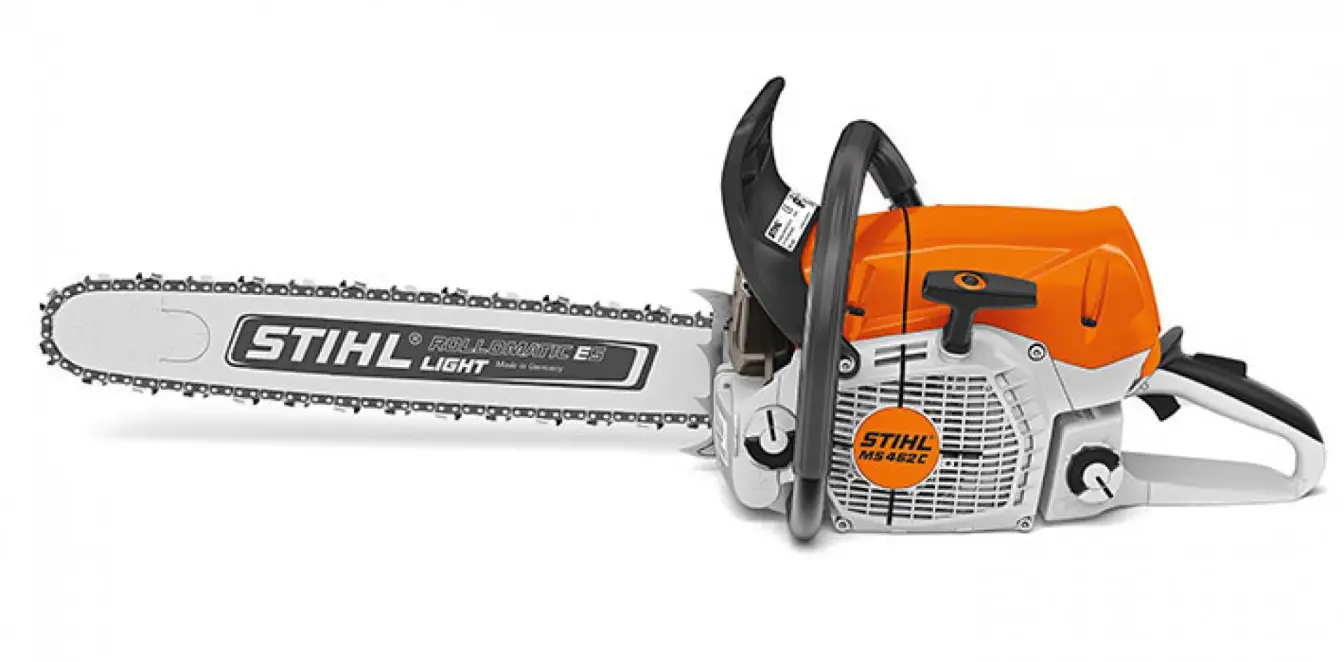
The Stihl MS 462 (formally the MS 462 C-M) is a professional-grade, 72.2cc two-stroke chainsaw that Stihl markets as "the lightest-ever STIHL chainsaw produced in its fuel-powered class," with a powerhead weight of 6.0 kg (approximately 13.2 lbs) and rated engine power of 4.4 kW (6.0 bhp), according to the official Stihl USA specification page (stihlusa.com). It is engineered primarily for forestry professionals, loggers, arborists, and serious firewood cutters who fell, buck, and limb medium to large trees. Despite its strong reputation for power-to-weight performance, the MS 462 is a complex, high-output machine, and owners across forums such as ArboristSite, the Outdoor Power Equipment (OPE) Forum, Arbtalk, and Reddit report a recurring set of problems. This article examines each major problem category in detail, explains the underlying components, and provides practical, actionable troubleshooting and solutions that a United States owner can follow, while noting clearly when professional Stihl dealer service is required.

A note on scope and sourcing: many consumer-facing blog articles about the MS 462 repeat generic chainsaw advice and, in several cases, contain outright errors (for example, several blogs claim that Stihl "recalled certain MS 462 chainsaws"; the 2017 United States Consumer Product Safety Commission recall in fact covered the MS 461, not the MS 462, as detailed below). Where possible, this article relies on the official Stihl instruction manual, Stihl technical guidance, and firsthand accounts from experienced saw builders and professional users on the enthusiast forums.
Technical Overview of the MS 462 and Its Variants
Before diagnosing problems, it is important to understand the machine and its variants, because problem prevalence differs across production revisions and configurations.
The base powerhead is a 72.2cc STIHL 2-MIX (stratified-scavenging) two-stroke engine producing 4.4 kW (6.0 bhp). Rather than a conventional four-position master control lever with manually adjustable high- and low-speed carburetor screws, the MS 462 C-M uses the STIHL M-Tronic engine management system, which electronically controls ignition timing and fuel metering and automatically compensates for altitude, temperature, fuel quality, and a dirtying air filter. The saw also features an HD2 air filter with a pre-separation (centrifugal) system, an ElastoStart starter grip, a decompression valve, a side-access chain tensioner, an adjustable automatic (Ematic) oiler, the STIHL Quickstop chain brake, a winter/summer shutter to prevent carburetor icing, and the STIHL anti-vibration system.
The principal variants are:
- MS 462 C-M: the standard rear-handle model with M-Tronic.
- MS 462 C-M R / MS 462 R: a wrap-handle ("R") version favored by West Coast fallers and climbers, which Stihl lists as "the lightest STIHL gasoline-powered saw in its class, weighing only 13.9 lbs."
- MS 462 C-M VW / VW R: an "Arctic" cold-weather version adding electrically heated handles and a heated carburetor, weighing approximately 6.1 kg (roughly 13.4 lbs) total, intended for winter forestry (stihl.ca).
- MS 462 (non-C-M, standard carbureted): in certain markets and at certain times, Stihl also offered a version with a "simple, proven, non-electronic carburetor" rather than M-Tronic (stihlusa.com). This model retains the HD2 filter and winter/summer shutter but allows limited manual field adjustment.
- Early versus later production: the most important distinction for reliability. Early-production MS 462 units (roughly the 2019–2021 period) are associated with broken piston skirts and cracked crankcases; Stihl subsequently revised the case, cylinder, and piston. This is discussed in detail under Maintenance-Related Failures and Engine Stalling & Performance Problems below.
The approved spark plug is an NGK CMR6H, idle speed is specified at 2,800 ± 50 rpm, and all Stihl gasoline engines run a 50:1 fuel-to-oil ratio.
Starting Problems
Difficulty starting is the single most frequently reported MS 462 complaint, particularly hot-restart difficulty and a higher-than-expected number of cold pulls.
Symptoms
- The engine requires many pulls to start when cold — owners report anywhere from several pulls to more than ten pulls cold, and several pulls even when warm.
- The saw starts on the choke/start position but dies immediately when the operator squeezes the throttle, repeating for several cycles before it stays running.
- After running out of fuel and being refueled on a hot day, the saw refuses to restart and behaves as though flooded.
- The saw appears "flooded" when the decompression valve is pressed on a very hot engine.
Causes
- Operator technique with the Master Control Lever: because M-Tronic saws use a single lever, operators accustomed to conventional four-position switches sometimes inadvertently flip the lever into the start/choke position while the engine is hot, flooding it. One OPE Forum user described repeatedly "thumbing the control lever into the start position while hot and flooding it."
- Flooding after refueling hot: when the saw runs dry and is refueled while extremely hot, excess fuel migrates into a very hot engine as the system tries to re-prime, causing a flood condition (ArboristSite).
- Fuel and oil mixture that is too rich in oil: the M-Tronic system is calibrated for 50:1. Running heavier oil ratios (such as 32:1) with very viscous oils effectively leans the fuel and can make the control unit slower to adapt, contributing to hard starting.
- A worn or contaminated fuel solenoid valve: the electronically controlled solenoid valve that meters fuel can be fouled by contaminants, causing hot-start difficulty. This is a known M-Tronic weak point discussed below.
- Worn or fouled spark plug: a marginal NGK CMR6H can make starting difficult.
- The decompression valve left pressed on a very hot saw: several users report that a hot saw will not start with the deco pressed, and starts once the valve is popped back up.
Troubleshooting Steps
- Confirm correct starting procedure. For a cold start, use the choke/cold-start position, and expect a burble/pop, then move to the fast-idle position and start. For a warm saw, do not choke; start in the run position. Ensure your thumb is not accidentally moving the Master Control Lever into the start position on a hot saw.
- If the saw floods on a hot restart, follow the manual's flooded-engine procedure: engage the chain brake, remove and dry the spark plug, clear the combustion chamber, reinstall the plug, and pull with the lever in the run position (not the choke position).
- Verify fuel is fresh, ethanol content is no greater than 10%, and the mixture is exactly 50:1 with a high-quality two-stroke oil.
- Inspect and, if in doubt, replace the spark plug with an OEM NGK CMR6H, and check the gap.
- On the first start of the day, allow the saw to idle in the run position for a set interval before cutting. This is essentially the M-Tronic self-calibration behavior; several users report that letting the saw idle for a short period rather than immediately revving eliminates their hot-start and stumble complaints.
- If hot-start problems persist despite good fuel, a fresh plug, and correct technique, suspect the fuel solenoid valve and proceed to the M-Tronic section.
Solutions
- Correct operator technique resolves a large share of "hard starting" complaints; letting the saw complete its idle calibration on the first start of the day is the most commonly cited fix on the forums.
- Switch to fresh 50:1 fuel with quality oil; consider Stihl MotoMix ethanol-free premixed fuel, especially for saws used intermittently.
- Replace the spark plug with the correct NGK CMR6H.
- If the solenoid valve is suspected, have it replaced (see M-Tronic section). This frequently requires a Stihl dealer with the MDG1 diagnostic tool to confirm and to perform a reset/calibration afterward, although the MS 462 (M-Tronic version 3) can also be reset without the MDG1 by following the manual's calibration procedure.
M-Tronic™ System Problems
The M-Tronic system is both the MS 462's headline feature and the source of its most discussed intermittent running problems. It replaces manual carburetor screws with an electronically controlled solenoid valve, an ignition/control module (coil), and sensors.
Symptoms
- Intermittent stumbling, bogging, or dying when the throttle is opened, particularly after the saw sits briefly.
- Hard hot-starting, as described above.
- Rich running (excess fuel, four-stroking, black residue) or, less commonly, symptoms that point toward a lean condition.
- Erratic idle or a saw that will not settle to a normal idle.
- In the worst cases, a lean condition that contributes to piston scoring/seizure.
Causes
- Faulty or contaminated fuel solenoid valve: this is by far the most frequently cited cause of M-Tronic running problems. Experienced forum members repeatedly state that "a solenoid swap is the culprit for most of its very sparse running problems" (ArboristSite). Stihl has produced multiple generations of the solenoid: the first-generation black valve (part number 0000 120 5110), the current white valve (part number 0000 120 5104, paired with the orange fuel filter), and a short-lived green valve (0000 120 5111) (OPE Forum). Contaminants in the fuel foul the valve seal and cause metering errors.
- Failed ignition/control module (coil): a defective coil can cause no-spark or erratic behavior; one user reported using the MDG1 tool to "correctly diagnose a faulty ignition module in my 201TC-M."
- Miscalibration: the M-Tronic needs to be allowed to calibrate; a saw that has never been allowed to complete its idle calibration, or that has stored abnormal data after repeated failed starts, may run poorly until reset.
- Altitude and temperature transitions: some users report stumbling when moving between very different elevations until the system re-learns, though the system is designed to compensate automatically.
Troubleshooting Steps
- Perform the M-Tronic reset/calibration per the owner's manual: start the saw and run it in the cold-start position for the specified interval (do not touch the throttle), then run at idle for the specified interval, then make several cuts. The MS 462 is M-Tronic version 3 and can be calibrated by any user without special tools.
- Confirm the fuel filter is the correct current type (orange) and that fuel is clean.
- If problems persist after a reset and clean fuel, suspect the solenoid valve. A dealer can confirm using the MDG1 diagnostic tool, which displays fuel-delivery values on a bar chart; a value pushed to the high/yellow (lean-compensation) side indicates the system is fighting a fuel restriction.
- If there is no spark, have the coil/module and grounds checked. Stihl recommends the ZAT 4 spark tester (part number 5910 850 4503) for this.
Solutions
- Replace the solenoid valve with the current OEM white valve (0000 120 5104) and matching orange fuel filter, then perform a reset. This resolves the majority of intermittent M-Tronic complaints. Parts within the two-year warranty period are typically covered.
- Replace the ignition module if diagnosis points to it.
- For diagnosis beyond a simple reset, professional Stihl dealer service with the MDG1 tool is the appropriate step. The MDG1 is available for purchase (owners report paying roughly $714–$745) and the software can be downloaded, but for most owners the dealer route is more practical. It is worth noting that many experienced technicians consider the MDG1's diagnostic value limited — one described it as chiefly useful for reading engine hours and confirming a reset is needed — so it is not a cure-all.
Engine Stalling & Performance Problems
This category covers the saw dying mid-cut, gradual power loss, over-revving, and — most seriously — catastrophic engine failure on early units.
Symptoms
- The engine dies during a cut or bogs under load.
- Gradual loss of power over time and poorer cut quality.
- The engine over-revs or the chain runs at idle (addressed also under Clutch & Chain Drive Problems).
- Sudden catastrophic failure: loss of compression, a scored or broken piston, and in severe cases a cracked crankcase (predominantly on early-production saws).
Causes
- Clogged air filter: the most common and benign cause of a saw that dies mid-cut or loses power. Even with the HD2 pre-separation system, a heavily loaded filter restricts airflow.
- Clogged spark arrestor screen: combustion residue can block the spark arrestor in the muffler, choking the engine after it warms up.
- Fuel delivery restriction: a clogged fuel filter (pickup body) or dirty carburetor/solenoid starves the engine.
- Lean running leading to seizure: an air leak, a fouled solenoid, or improper fuel can produce a lean condition. Users report scored pistons "mainly exhaust side," which is characteristic of a lean or overheating seizure.
- Early-production piston and case design (the most serious cause): early MS 462 pistons were prone to breaking the skirt. As a worn piston begins to rock in the bore, it can strike a flange cast into the case, and the skirt cracks and breaks out, destroying the engine. Experienced builders attribute a "rash of broken pistons on the 462" to the original piston geometry (ArboristSite). Contributing operator factors cited include excessive "piss revving" (revving out of the cut), running dull chains at high rpm, and neglected air filters.
Troubleshooting Steps
- Clean or replace the HD2 air filter first — this is the single most effective first step for a saw that dies mid-cut or has lost power.
- Remove and clean the spark arrestor screen with a wire brush.
- Inspect and replace the fuel filter/pickup; verify fresh 50:1 fuel.
- If a lean seizure is suspected, perform (or have a dealer perform) a pressure and vacuum test of the crankcase to find air leaks, and inspect the piston through the exhaust port after removing the muffler — a quick check that reveals scoring.
- On any early saw exhibiting worrying noises, loss of compression, or visible scoring, stop using it immediately and have it assessed.
Solutions
- Routine cleaning of the air filter and spark arrestor resolves the majority of mid-cut stalling and gradual power-loss complaints.
- Replace clogged fuel filters and use only fresh, correctly mixed fuel.
- For a scored or broken piston, the engine requires a top-end rebuild (piston and cylinder). On an early saw, the revised (later) top end must be matched to the correct case: the old-style top end will fit the new case, but the new-style top end will not fit the old cases. Given OEM parts cost — reported at roughly $350 for the flywheel-side case, $330 for the PTO-side case, and around $460 for the piston-and-cylinder assembly — a full crankcase failure often makes repair uneconomical relative to a new saw with warranty. This is a decision point best discussed with a dealer.
Chain Oiling Problems
A malfunctioning bar-and-chain oiler is one of the most commonly reported MS 462 problems and is dangerous to ignore because it rapidly destroys bars, chains, and sprockets and can contribute to overheating.
Symptoms
- The bar and chain run dry; the bar smells burnt and discolors, and the chain may rust.
- Little or no oil is thrown onto a sheet of paper or light-colored surface when the saw is revved with the bar tip pointed at it.
- Oil pools inside the sprocket cover/casing but does not reach the bar.
Causes
- Blocked oil passages or bar groove: dried oil, sawdust, and dirt build up in the oil outlet, the bar's oil inlet hole, and the bar groove, blocking flow.
- Oiler set too low: the MS 462 has an adjustable oiler; some owners report it needs to be turned up, especially for longer bars or dry, dusty cutting.
- A loose or detached oil hose: forum users note that "the hose from the pump to the bar channel becoming loose at its fitting points" requires pulling the clutch to access (Hearth.com).
- Air lock/vacuum in the oil tank: a clogged tank vent can create a vacuum that limits oil flow.
- Running with the chain brake engaged or excessive idling: this can damage the automatic oiler over time.
Troubleshooting Steps
- Perform the paper test: hold the running saw's bar tip a few inches from a light surface and rev it; a healthy oiler throws a visible line of oil.
- Remove the bar and chain, and run the saw briefly (carefully) to see whether oil emerges from the outlet port in the saw body. If oil appears at the body but not at the bar, the bar groove/inlet is the problem; if no oil appears at the body, the pump, hose, or tank vent is the problem.
- Clean the bar groove with a thin flat tool, clear the bar oil inlet hole, and blow out passages with compressed air.
- Check the oil tank vent and the oil hose fittings.
- Verify the oiler adjustment screw is not set to minimum.
Solutions
- Clean all oil passages and the bar groove, and increase the oiler setting for longer bars or dusty conditions.
- Some owners enlarge the diameter of the bar's oil holes to improve delivery on longer bars — a user modification, not a factory recommendation.
- If the pump is weak or the hose is detached at the fitting, the clutch must be removed to access and repair or replace the hose; a worn pump should be replaced. Use only good-quality bar-and-chain oil (Stihl offers a winter-grade oil that flows better in cold weather).
- If oiling cannot be restored by cleaning, have the oil pump serviced by a dealer.
Clutch & Chain Drive Problems
This category covers the chain rotating at idle, screeching noises, and power transfer issues.
Symptoms
- The chain continues to turn when the engine is at idle — a safety hazard.
- A screeching or unusual noise while running, often accompanied by inconsistent chain behavior.
- Gradual power loss traced to the drive side.
Causes
- Idle speed set too high: the most common and simplest cause; if idle exceeds the clutch engagement speed, the chain turns.
- Worn or stretched clutch springs: centrifugal clutch return springs weaken or stretch (often from running with the chain brake engaged or "goosing" a pinched saw), so the shoes do not fully retract at idle.
- Debris in the clutch/drum: sawdust and oil build up on the clutch drum and shoes, causing the clutch to drag.
- Worn clutch shoes or drum: high-hour saws develop worn shoes and drums.
Troubleshooting Steps
- Warm the saw fully, then check idle speed with a tachometer against the 2,800 ± 50 rpm specification; adjust the idle (LA) screw counter-clockwise until the chain reliably stops.
- If correct idle does not stop the chain, remove the sprocket cover, clutch, and drum; clean out sawdust and oil, and clean and lightly lubricate the needle bearing.
- Inspect the clutch springs, shoes, and drum for wear, stretching, or damage.
Solutions
- Correct idle-speed adjustment resolves most chain-at-idle complaints.
- Clean the clutch assembly; this ten-minute job frequently cures dragging.
- Replace worn or stretched clutch springs, worn shoes, or a worn drum as needed. Note that the MS 462 uses an electronic idle via M-Tronic; if idle cannot be corrected by the LA screw on the standard-carb version, or if the M-Tronic version idles erratically, suspect an air leak or the solenoid, and consider a reset or dealer diagnosis.
Fuel System Problems
Fuel quality and fuel-system condition underlie many MS 462 complaints, including hard starting, stalling, and lean seizures.
Symptoms
- Hard starting, stalling, hesitation, and power loss.
- Evidence of over-fueling (rich running) or, conversely, lean running.
- Deteriorated fuel lines or a leaking fuel system.
Causes
- Stale or ethanol-laden fuel: Stihl advises that you "do not store or use fuel older than 60 days, and preferably no longer than 30 days, even with a stabilizer," and that ethanol content should not exceed 10%. Degraded fuel attracts moisture, fouling the carburetor and solenoid. Ethanol is hygroscopic and is a leading cause of small-engine fuel-system corrosion.
- Incorrect mixture: not 50:1, or made with poor-quality oil.
- Clogged fuel filter/pickup body: restricts flow and can cause lean running.
- Contaminated solenoid valve (see M-Tronic section).
- "Winter gas" / seasonal fuel volatility: some users tie warm-weather hot-start problems to leftover winter-blend fuel.
Troubleshooting Steps
- Drain stale fuel and refill with fresh 50:1 mixed with a minimum 89-octane (RON 90+) fuel, ethanol content no greater than 10%.
- Replace the fuel filter/pickup body (Stihl specifies replacement every 12 months).
- Inspect fuel lines and the tank vent for cracks, leaks, or blockage.
- For a saw stored with fuel, follow the storage guidance below.
Solutions
- Use fresh, correctly mixed fuel; strongly consider Stihl MotoMix ethanol-free premixed fuel for intermittent users. Per the Stihl USA FAQ, "STIHL MotoMix® contains no ethanol and has a storage life of up to two years… [and] can be left in the machine during seasonal storage."
- Replace the fuel filter annually and clean the tank at service intervals (a dealer task per the manual).
- Store the saw dry (run the fuel system empty) if it will sit longer than 30 days.
Overheating Problems
The MS 462 can overheat, which both degrades performance and risks piston damage.
Symptoms
- The engine runs hot, loses power, or seizes.
- A burning smell, discolored bar, or scored piston.
Causes
- Loss of chain lubrication: a failed oiler makes the engine work harder and overheat (see Chain Oiling).
- Dirty cooling fins and blocked air intake: debris on the cylinder cooling fins and in the fan-housing air intake blocks the airflow that cools the engine.
- Clogged air filter: restricts airflow and disturbs the air-fuel ratio.
- Lean running: from an air leak, fouled solenoid, or improper fuel, producing excessive combustion heat.
- Extended wide-open-throttle running without load: Stihl specifically warns against running the engine at wide-open throttle without a load.
Troubleshooting Steps
- Confirm the oiler is working (paper test).
- Remove the shroud and clean the cylinder cooling fins and the air intake on the fan housing with a soft brush; use Stihl resin solvent for stubborn deposits.
- Clean or replace the air filter.
- If overheating recurs even when clean, have the crankcase pressure/vacuum tested for air leaks and the carburetor/solenoid checked for a lean condition.
Solutions
- Restore chain lubrication and keep the cooling fins and air intake clean; the manual lists cleaning the air intake and cylinder fins as routine maintenance.
- Correct any lean condition promptly, because lean running is the pathway to the piston failures discussed above.
- Avoid sustained no-load, wide-open-throttle operation and avoid running carbide chain at excessive rpm, which generates additional heat.
Excessive Vibration Problems
While the MS 462 is praised for a comparatively smooth anti-vibration (AV) system — many users consider it markedly smoother than the older MS 461 — vibration complaints do arise.
Symptoms
- Increased vibration at the handles.
- A saw that "over-idles" or races after being pulled from a cut.
Causes
- Improper chain tension or a dull/damaged chain: a loose or dull chain vibrates and cuts poorly.
- Loose bar nuts or fasteners: improperly torqued bar-mount hardware and loose screws increase vibration.
- Worn AV buffers/springs: the rubber AV mounts and springs isolate the handles; when worn, vibration increases. Worn AV rubbers can also cause over-idling after the saw is pulled from a cut.
- Worn or damaged bar and chain components.
Troubleshooting Steps
- Check and correct chain tension and sharpen or replace the chain.
- Torque the bar nuts and check all fasteners.
- Inspect the AV buffers and springs for wear or damage.
- Inspect the bar rails and sprocket for wear.
Solutions
- Maintain correct chain tension and a sharp chain; keep fasteners tight (some owners use thread-locker on chronically loosening screws).
- Replace worn AV components and worn bar/chain parts.
- Persistent vibration despite these steps warrants a dealer inspection of the crankshaft and bearings.
Maintenance-Related Failures
Most MS 462 failures brought to dealers trace back to deferred maintenance or, on early saws, to the piston/case design issue. This section consolidates the maintenance-driven failure modes and the early-production concerns, and leads into the preventive schedule.
Symptoms
- Progressive power loss, hard starting, overheating, and eventual engine damage.
- On early saws: broken piston skirts and cracked crankcases.
- Spark plugs that blow out of the cylinder.
Causes
- Neglected air filter: a severely clogged HD2 filter disturbs the air-fuel ratio and contributes to seizures; one rebuild account described a filter "almost totally blocked."
- Neglected fuel system: stale fuel and clogged filters.
- Improper spark plug installation: several reports describe spark plugs blowing out of the cylinder because the crush washer was not properly crushed on installation; the Stihl torque specification is 12 Nm. Blown plugs damage threads and require a thread repair (Helicoil or timesert) (ArboristSite).
- Early-production piston/case design: the original piston had a notched skirt (with a "divertor" feature under the piston) that was prone to cracking at the skirt-radius corners; as the piston wore and rocked, it could strike a flange in the case and break, sometimes cracking the case. The earliest saws also cracked around the bar studs when fitted with longer bars, prompting Stihl to strengthen the case.
- Single-use aluminum crankcase screws: later saws use single-use aluminum case screws (specified torque 3 Nm, then a further 90-degree turn) for weight reduction; these cannot be reused and have drawn criticism, though steel replacements can be substituted (ArboristSite).
Troubleshooting Steps
- Establish and follow the maintenance schedule below.
- On any prospective or owned early saw, check the date of manufacture and, if possible, the serial number, and inspect for the revised design (the revised saws carry a silver sticker on the front).
- When installing a spark plug, always seat the crush washer correctly to 12 Nm.
- If catastrophic failure has occurred, follow the top-end/rebuild guidance in the Engine Stalling section, matching the correct top end to the case.
Solutions
- Preventive maintenance (below) is the primary solution.
- For the early-production design issue: the revised (later) piston, cylinder, and case corrected the failure mode. On saws still under warranty, seek warranty repair; out of warranty, weigh rebuild cost against replacement, matching the correct top-end/case generation.
- Replace blown-plug threads with a thread insert and torque future plugs correctly.
The Early-Production Redesign in Detail
Because this is the defining reliability issue for the MS 462, it merits a fuller account. Early ("Gen 1") MS 462 saws suffered broken piston skirts; experienced builders traced the failure to the original piston geometry, in which the skirt was notched to clear the crank and cracked at the radius corners. Around mid-2021, Stihl introduced a revised case, cylinder, and piston. As the well-known saw builder "Mastermind" described in the OPE Forum "MS462 Design Changes" thread: "The 462 has undergone some serious design changes. The case, cylinder, and piston are are different now." He explained that Stihl "just decided that the divertor under the piston wasn't needed," which simplified and strengthened the slug, and noted "the port is taller now," suggesting a possible performance gain. The change was first observed on European-build saws and reached the United States later, delayed by supply-chain disruptions; externally, the revised saws are identified by a silver front sticker.
The relevant OEM part numbers are the cylinder-and-piston (52mm) assemblies 1142 020 1201 (older) and 1142 020 1202 (revised), and the piston kits 1142 030 2004 and 1142 030 2006 (retailers cross-reference these two piston numbers as equivalent replacements; the old-versus-new designation between them is not clearly documented in public sources). Forum accounts indicate a serial-number crossover in the vicinity of 187803970, above which dealers specify the 1202 assembly and below which they specify the 1201 assembly. Critically, the two generations are a matched set: the old top end will fit the new case, but the new top end will not fit the old case. No published Stihl service bulletin text for this change could be located; the dates, serial ranges, and part designations above derive from experienced forum members and parts retailers (SawAgain, Sawzilla Parts) rather than official Stihl documentation, and should be treated as well-supported but not officially confirmed.
Preventive Maintenance and Recommended Servicing Schedule
The overwhelming consensus across the manual, dealers, and experienced users is that disciplined maintenance prevents the great majority of MS 462 problems. The following schedule consolidates Stihl's published maintenance intervals with practical guidance.
Before each use / daily:
- Check chain tension and sharpness; sharpen with the correct file/gauge (the manual gives depth-gauge and USG sharpener settings). Adjust tension so the chain sits snug but moves freely; expect it to loosen as the saw warms.
- Check the chain brake function and the throttle interlock.
- Confirm the oiler is delivering oil (paper test) and top off bar-and-chain oil; the oil and fuel tanks are sized to empty at roughly the same time.
- Check bar-nut torque and general fasteners.
- On the first start of the day, allow the M-Tronic to complete its idle calibration before cutting.
Weekly:
- Check the chain sprocket for wear.
- Check and deburr the guide bar (a burr builds on the outer rail edge); rotate the bar periodically to even out wear.
- Sharpen the chain as needed.
Monthly:
- Clean the HD2 air filter. Stihl's pre-separation system extends intervals substantially, and the filter does not need cleaning until an appreciable drop in power occurs; spray it with Stihl special cleaner or a cleaning agent with a pH value above 12, or wash gently and dry fully before reinstalling.
- Have the oil tank and fuel tank cleaned by a dealer, and have the fuel pickup body (filter) cleaned.
Every 100 hours of operation:
- Install a new spark plug (OEM NGK CMR6H, torqued to 12 Nm with the crush washer properly seated).
Every 12 months:
- Replace the fuel pickup body (filter).
- Have the chain brake serviced by a Stihl dealer (every 3 months for full-time use, every 6 months for part-time, every 12 months for occasional use).
Periodically / at service:
- Clean the cylinder cooling fins and the air intake on the fan housing.
- Check and clean the spark-arrestor screen in the muffler.
- Stihl offers Service Kit 14 for the MS 462, which bundles the HD2 air filter, fuel filter, and spark plug for owner-performed standard maintenance.
Fuel and oil best practices:
- Use exactly 50:1 with a high-quality TC-classification two-stroke oil; Stihl recommends its HP Ultra synthetic oil for maximum engine life. Do not run heavier oil ratios that can confuse the M-Tronic.
- Use a minimum of 89-octane fuel with no more than 10% ethanol; low-octane fuel raises engine temperature and risks seizure.
- Add oil to the container first, then gasoline, and shake to mix; mix only enough for a few days and never store mixed fuel longer than the 30-to-60-day window Stihl recommends.
- For convenience and shelf life, consider Stihl MotoMix ethanol-free premixed fuel (50:1, up to two-year shelf life).
Off-season storage:
- Empty the fuel tank and run the engine at idle until it stops to dry the fuel system (do not operate the throttle during this).
- Clean the air filter, cylinder fins, spark plug, and cutting attachment; lightly oil metal parts to resist corrosion; clean or replace the spark-arrestor screen.
- Store in a dry, dust-free, frost-free place. MotoMix may be left in the machine during seasonal storage if desired.
Consumer and Forum Feedback: Perspective and Comparisons
Firsthand feedback situates these problems in context. On balance, professional users rate the MS 462 highly for power-to-weight, fuel economy, filtration, and anti-vibration, while acknowledging the M-Tronic quirks and the early-production durability concerns.
- Overall satisfaction: many pros and firewood cutters report trouble-free service; one OPE Forum user reported a year and 40–50 tanks with "no problems" on the original filter. Multiple shop owners report selling many 462s with few warranty returns.
- Hard-start consensus: hard cold-starting and finicky hot-restarts are widely reported but often attributable to technique, fuel, or the solenoid; the "let it idle to calibrate" fix recurs frequently.
- Comparison with the MS 461: the MS 461 (76.5cc, non-M-Tronic, heavier) is repeatedly described as having more torque and displacement but far worse vibration; the MS 462 is lighter, smoother, better filtered, and more fuel-efficient. In one head-to-head cutting video cited by users on the OPE Forum, a ported carbureted 462 recorded 35.1 seconds, the M-Tronic 462 35.5 seconds, and the 461 30.2 seconds in that particular cut — illustrating that the older 461 can still out-cut the 462 in some conditions, especially when ported. Some buyers deliberately choose the 461 for its simplicity and the absence of M-Tronic electronics, while others prefer the 462 specifically to avoid manual tuning.
- Break-in behavior: users report the saw may need several tanks before it settles, and that it starts and runs progressively better as the M-Tronic learns.
- Early versus later production: the community strongly distinguishes early saws (piston/case failures) from later, revised saws, and generally regards the revised version as the durable machine the 462 should have been from the start.
Direct quotations are kept brief and attributed. Representative examples include an ArboristSite user's summary that "the very first 462's were cracking around the bar studs" with longer bars, and an OPE Forum user's observation that the 462 "runs/handles a lot like a 440 in stock form."
Clarifying the Recall Question
Several consumer blogs state that Stihl "recalled certain MS 462 chainsaws" over a chain-brake lever and kickback risk. This is a conflation. The documented United States CPSC recall, dated February 23, 2017 and covering approximately 100,000 units, in fact covered the STIHL MS 461 and MS 461 R (wrap handle), with serial numbers between 173092800 and 181993952, for pinched or leaking fuel lines posing fire and burn hazards. Per the CPSC notice, "STIHL Inc. has received 117 reports of pinched or leaking fuel lines," and the affected saws were sold from July 2012 through December 2016 for about $1,000. It was not the MS 462, and the defect was not a chain-brake lever. Owners concerned about any recall affecting their specific saw should check the serial number against Stihl's official recall page and consult a dealer, rather than relying on secondhand blog claims.
Recommendations
Staged, concrete next steps for an MS 462 owner or prospective buyer:
- If you are buying used, determine the production generation first. Ask for the serial number and date of manufacture, look for the silver front sticker indicating the revised design, and favor a later-production saw or one with a documented top-end update. This single factor is the most important predictor of reliability. Threshold: if the saw predates the mid-2021 redesign and shows any sign of prior overheating or hard use, either negotiate for a compression check and top-end inspection or walk away.
- On any saw, standardize your fuel and oil immediately. Run 50:1 with a quality synthetic two-stroke oil, minimum 89-octane, ethanol no greater than 10%, or use MotoMix. Do not exceed the oil ratio. This prevents lean seizures and M-Tronic confusion. Threshold: if you use the saw less than weekly, switch to premixed ethanol-free fuel.
- For hard starting or intermittent running, work the cheap causes first: correct technique (do not choke a hot saw; let it idle-calibrate each morning), fresh fuel, a new NGK CMR6H plug, and a clean air filter. Threshold: if hot-start or stumbling problems survive all of these, replace the solenoid valve (white 0000 120 5104 with orange filter) and perform a reset; escalate to dealer MDG1 diagnosis if unresolved.
- Adopt the maintenance schedule above and treat the air filter, oiler, and cooling fins as safety-critical. A neglected filter or a dead oiler is a direct path to the expensive failures. Threshold: any burnt-bar smell, discolored bar, or drop in oil throw means stop and fix the oiler before further cutting.
- Know when to stop and go to the dealer. No-spark conditions, suspected air leaks, lean-seizure symptoms, catastrophic noises, and M-Tronic faults that survive a reset all warrant professional diagnosis. M-Tronic calibration on the version-3 462 can be done without the MDG1, but confirming a failed solenoid or coil, and reading stored fuel-demand data, is best done by a dealer with the MDG1 tool.
- Match parts to the generation during any rebuild. Remember that the new-style top end will not fit the old case; order by serial number and confirm 1201 versus 1202 fitment with the dealer.
Caveats
- Much of the granular reliability information — the redesign timeline, serial-number crossover near 187803970, the silver-sticker identifier, and the old-versus-new part relationships — comes from experienced forum members and parts retailers, not from published Stihl service bulletins. No official bulletin text could be located, so these points, while well-corroborated across independent posters and vendors, should be treated as strongly supported rather than officially confirmed. The old-versus-new designation between the two piston-only part numbers (1142 030 2004 and 1142 030 2006) is not clearly established in public sources.
- Several popular consumer blogs about "Stihl 462 problems" contain generic or inaccurate advice (including the recall conflation and instructions to "unplug everything from the electrical socket," which does not apply to a gasoline chainsaw). Their symptom lists are directionally useful, but their technical detail should be verified against the Stihl manual or a qualified technician.
- Problem prevalence varies widely with use. Professional daily users experience and report failures at rates not representative of occasional firewood cutters. Anecdotes of "two blown 462s" coexist with reports of trouble-free saws; both are real, and the redesign plus disciplined maintenance materially change the odds.
- The MS 462 is a professional tool with no user-serviceable engine internals per Stihl; several procedures described here (crankcase pressure/vacuum testing, clutch service, top-end work, M-Tronic diagnosis) assume mechanical competence and appropriate tools, and carry safety risk. When in doubt, use an authorized Stihl servicing dealer.
- Specifications and part numbers cited reflect information available as of the research date and may differ by market and by ongoing Stihl revisions. Always confirm against the current owner's manual for your specific serial number and market.