
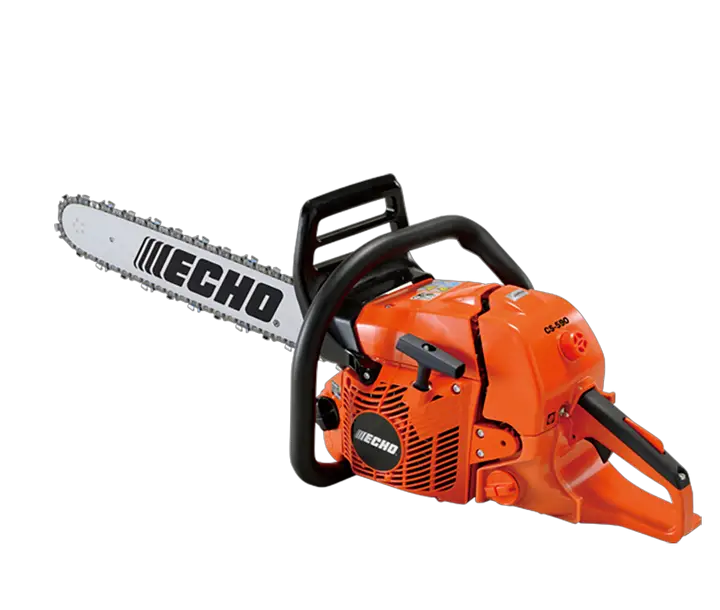
The Echo CS-590 Timber Wolf is one of the most dependable 60-class chainsaws sold in the United States, and the overwhelming majority of the problems owners report are the result of fuel, tuning, and maintenance factors rather than genuine defects in the machine. According to ChainsawsToday, "The ECHO CS-590 started production in 2013, while the ECHO CS-590 Timber Wolf started in 2014," and the saw remains in production today. It has earned a strong reputation among homeowners, ranchers, and light professional users for delivering professional-grade power at a farm-and-ranch price — indeed, the CS-590 Timber Wolf won Power Equipment Trade magazine's Dealers Choice Award, a survey in which over 1,000 lawn-and-garden power-equipment dealers participated. Yet no tool is immune to trouble, and a review of forum threads on ArboristSite, the Outdoor Power Equipment Forum (OPE Forum), the Firewood Hoarders Club, Reddit, and manufacturer documentation reveals a consistent set of recurring complaints: hard hot-starting, flooding, carburetor tuning difficulty, bogging under load, oiler leaks and oiling failures, brake-handle breakage, and chain-tension slippage. This article examines each major problem category in depth, explains the components involved, and provides practical, U.S.-oriented diagnostic and repair guidance based on the official Echo operator's manual and the collective experience of the chainsaw community.

Technical Overview of the CS-590
Before addressing individual problems, it is worthwhile to understand the machine. The Echo CS-590 is powered by an air-cooled, single-cylinder, two-stroke engine displacing 59.8 cubic centimeters (3.65 cubic inches), with a bore of 45.0 millimeters, a stroke of 37.6 millimeters, and a compression ratio of 7.2 to 1. Notably, the CS-590 has a longer stroke than many competitors in its displacement class, which produces strong low-end torque at the expense of peak horsepower. Echo does not publish an official horsepower or kilowatt figure in its operator's manual or support specifications. As chainsawnerds.com notes, "Echo does not explicitly state the horsepower rating … independent tests and user reports suggest it delivers around 3.9 horsepower"; the frequently cited "4.02 horsepower" figure appears only on third-party retailer listings such as SawSuppliers, while Bailey's Online lists "3.89 HP." None of these figures is verified by Echo.
The saw's dry weight, without bar and chain, is 6.0 kilograms (13.2 pounds). The fuel tank holds 645 milliliters (21.8 fluid ounces), and the bar-and-chain oil tank holds 300 milliliters (10.2 fluid ounces). The saw uses a butterfly-valve diaphragm carburetor (a Walbro HDA-series unit) without a primer purge bulb, a digital ignition system, a decompression valve to ease starting, a clutch-driven automatic and adjustable oiler, and a heavy-duty two-piece air filter fed by Echo's G-Force Engine Air Pre-Cleaner. The standard guide bar is 20 inches, with 18-inch and 24-inch options widely sold, and the saw will accept 16-inch and 27-inch bars as well. Per Echo's official model-information page (echo-usa.custhelp.com), the operating speeds are specified as ranges: idle speed of 2,600 to 3,300 revolutions per minute, clutch engagement at 3,750 to 4,250 revolutions per minute, and a wide-open-throttle speed of 12,000 to 13,000 revolutions per minute. The recommended spark plug is an NGK BPMR8Y gapped to 0.65 millimeters (0.026 inch). The fuel mixture is 50 to 1, using a minimum of 89-octane unleaded gasoline containing no more than 10 percent ethanol, mixed with a two-stroke oil meeting ISO-L-EGD and J.A.S.O. M345-FD standards.
Understanding these figures matters because many CS-590 complaints trace directly to deviations from them: stale or low-octane fuel, an incorrect mixture, a fouled or misgapped plug, or a carburetor tuned outside its useful range.
Starting Problems
Starting difficulty is by a wide margin the single most common complaint associated with the CS-590, and it appears in two distinct forms: the saw that will not start when cold or new, and the saw that will not restart when hot. Both are discussed at length in dozens of forum threads.
Symptoms
Owners describe a new saw that "pops" but will not run, a saw that requires many pulls before firing, a saw that starts only when the choke is worked back and forth, and — most frustratingly — a warm saw that refuses to restart after a 10-to-15-minute pause to refuel or move between trees. One ArboristSite member summarized the hot-start pattern precisely: the saw cold-starts in four pulls, runs perfectly, restarts instantly after a brief shutdown, but after a 15-minute refueling stop "it will not start" for five to ten pulls and the decompression button never pops out. Some report that swapping in a spare spark plug allows an immediate first-pull restart, even though the removed plug does not look wet.
Causes
The dominant causes are procedural and fuel-related rather than mechanical. The CS-590 has no primer bulb, so the carburetor must be filled by cranking, and the high-compression engine floods readily if the choke is used incorrectly. Choking a warm engine is the classic error: as multiple experienced users note, "Choking a warm engine will almost certainly flood it." A local Echo dealer, according to one owner, traced repeated hot-start failures specifically to hot-weather operation above 85 degrees Fahrenheit, where restarting with full choke floods the saw; his advice was to pull the choke and push it straight back in to set the fast idle without delivering a rich charge. Vapor lock is a second recognized cause: with the engine hot and the saw sitting, fuel vaporizes and the cylinder must cool before it will fire, which explains why pulling the plug (and thereby venting and cooling the cylinder) restores starting. Other causes include stale fuel, a fouled or incorrectly gapped spark plug, a clogged air filter, a stuck fuel-tank vent, a stuck-open decompression valve, and, in cold weather, carburetor icing or a lean factory tune.
Troubleshooting Steps
Follow a disciplined sequence. First, confirm the fuel is fresh and correctly mixed at 50 to 1. Second, learn and follow the correct cold-start sequence exactly: full choke, pull until the engine "pops" (usually two pulls), then push the choke off and pull again to start — being careful not to miss that first pop, because continued choked pulling floods the engine. Third, for a warm restart, do not use full choke; instead pull the choke lever out and immediately push it back in to set the fast idle, then pull. If the engine is flooded, turn the choke off and pull the cord repeatedly to clear the excess fuel; if that fails, remove the spark plug, dry it, invert the saw to expel raw fuel while cranking, then reinstall the plug and start with the choke off. Fourth, inspect the spark plug for fouling and correct the gap to 0.65 millimeters, replacing it if worn. Fifth, check the air filter and the fuel-tank vent. One owner cured intermittent cold-weather stalling simply by working the stuck tank vent loose with a finger.
Solutions
Most starting complaints resolve with technique alone: use fresh fuel, master the choke sequence, and avoid choking a warm engine. Owners of two or more CS-590 saws consistently report that once the saw is warm, they do not touch the choke for the rest of the day and it "fires right up." For persistent hot-start trouble, a modest enrichment of the high-speed needle (about a quarter turn) compensates for a lean factory tune and reduces vapor-lock tendency, particularly in cold weather. A weak or stuck-open decompression valve should be replaced, though many users simply start the saw without the decompression valve. Where the saw genuinely will not start despite correct procedure and fresh fuel, the fault usually lies in the carburetor (see below) or, less commonly, in worn crankshaft seals allowing an air leak.
Engine Stalling and Bogging Problems
Symptoms
The second great category of complaints involves an engine that starts but will not run cleanly. Owners report the saw bogging and dying the moment the throttle is opened, running only at half throttle or higher and stalling hard below that, refusing to idle, racing and hunting at idle rather than settling, or bogging under cutting load in larger wood. A particularly telling variant, reported by several owners, is a warm saw whose revolutions climb after a cut so that the chain keeps turning at "idle," and whose kill switch then fails to stop the engine until the choke is worked in and out.
Causes
Bogging and stalling stem chiefly from an incorrect air-fuel mixture. A lean low-speed condition — from a clogged low-speed jet, an air leak, or a factory tune set too lean — causes the engine to die when the throttle is opened. The CS-590's carburetor incorporates a governed high-speed jet with an auxiliary check-valve nozzle that feeds extra fuel on the high circuit; this design, intended to prevent owners from leaning the saw to the point of piston damage, is "notorious for causing issues with both idle and H tuning when it fails or when someone blows it out with compressed air while cleaning it." The racing-idle-and-dead-kill-switch symptom is frequently a sign of an air leak (often at the carburetor mounting flange or the intake bellows) or a failing check valve. Other causes include a clogged air filter, stale fuel, a dirty carburetor, and a partially clogged fuel filter.
Troubleshooting Steps
Begin with the simplest causes: replace stale fuel, clean or replace the air filter, and inspect the fuel filter. Snug the carburetor mounting screws, as one owner did on suspicion of an air leak. If the saw races and hunts, suspect an air leak and perform a pressure-and-vacuum test of the crankcase — the definitive diagnostic that forum veterans repeatedly recommend. To adjust the carburetor, first warm the engine, then set the idle-speed screw so the engine idles without the chain turning; if the engine hesitates or bogs coming off idle, richen the low-speed needle slightly (counterclockwise); if it runs rough or four-strokes excessively, lean it slightly (clockwise). Removing or trimming the limiter caps is not officially sanctioned, but experienced users routinely remove them to gain adjustment range, noting that the factory limiters often prevent the low needle from opening far enough.
Solutions
For a saw that bogs off idle, a slight enrichment of the low-speed needle usually restores clean throttle response. For a saw that will not hold tune, the fault is almost always an air leak or a failed carburetor check valve; the fixes are, respectively, replacing the leaking gasket or seal, or replacing the carburetor (a CS-620P carburetor is a documented direct upgrade). Where an owner has confirmed an air leak by pressure test, replacing the intake bellows (Echo part A202000081) or the crankshaft seals will restore stable running. If the check-valve nozzle has failed, replacing it with the correct part restores tunability; owners performing muffler modifications often swap to a non-governed nozzle so the saw responds normally to the high-speed screw.
Fuel System and Carburetor Problems
Symptoms
Related to stalling but broader, fuel-system complaints include hard starting, rough idle, lack of power under load, black smoke (a rich condition), a strong fuel smell after running, fuel leaking from around the fuel pipe or tank, and a saw that ran well when new but deteriorated after sitting with old fuel in the tank.
Causes
The overwhelming cause is fuel-related degradation. Ethanol-blended pump gasoline is hygroscopic — it absorbs moisture — and, left in the tank, it forms gum and varnish that clog the carburetor's fine passages and jets. As one professional saw technician bluntly put it, a saw that "hasn't been used much" for five years or more is a red flag, because "old fuel is just eating away at the carb the whole time." Contaminated fuel, a clogged fuel filter, cracked or brittle fuel lines, a failed carburetor check valve, and a stuck fuel-tank vent all contribute. The CS-590's diaphragm carburetor also depends on an impulse signal delivered through an impulse line and a small diaphragm; a weak or blocked impulse path starves the carburetor of fuel.
Troubleshooting Steps
Inspect the fuel in the tank; drain and replace any that is stale. Inspect the fuel filter (pulled out through the filler port with a hooked wire) and replace it if dirty. Inspect the fuel lines for cracks and the primer path for leaks. If the carburetor is suspected, remove and clean it with carburetor cleaner, taking care not to blow compressed air through the delicate check-valve nozzle. When cleaning does not restore performance, swap in a known-good carburetor to isolate the fault, a technique forum members recommend because "590 carbs are everywhere."
Solutions
The single most effective solution is preventive: run fresh, correctly mixed fuel and do not leave ethanol-blended gasoline in the saw between uses. Many experienced owners drive considerable distances to buy ethanol-free gasoline, and treat stored fuel with stabilizer. For a saw already fouled, a thorough carburetor cleaning or rebuild with a genuine kit usually restores function; where the check valve or nozzle has failed, replacement of the nozzle (or of the whole carburetor) is the reliable fix. Replace cracked fuel lines and clogged filters with an inexpensive tune-up kit (Echo part 90167Y, which bundles air filter, fuel filter, and spark plug, or the fuel-line kits sold by multiple vendors). A clogged fuel filter, the manual warns, "will cause difficulty in starting engine or abnormalities in engine performance."
Chain Oiling Problems
Symptoms
Oiling complaints run in two opposite directions. On one hand, owners report the oiler failing to deliver oil to the bar and chain, with the chain running dry, the bar turning blue from heat, or the chain seizing in the cut. On the other hand, and more commonly, owners report the saw leaking or "throwing" bar oil — draining the oil tank while sitting unused, dripping from the bottom of the saw, or slinging oil without properly wetting the chain.
Causes
A dry chain results from a clogged oil filter or oil line, a plugged bar oil port or bar groove, a painted-over oil hole in a new bar, an oiler set too low, or a failed oil pump. One owner discovered a replacement bar had "one of the oil holes that was painted shut." A leaking oiler that empties the tank while the saw sits is frequently a faulty oil pump or worn pump seal — several owners had this repaired under warranty, with the dealer attributing it to "something to do with the oil pump." Oil emerging from the bottom of the saw, between the crankcase halves rather than at the bar, indicates a cut or dislodged oil pipe; in one documented case the clutch had cut into the oil hose, and in another the brake band overheated and melted the hose.
Troubleshooting Steps
To diagnose an oiling failure, remove the bar, hold the saw so the oil outlet is visible, and run it briefly to see whether oil is pumped. Clean the bar groove with a bar-groove tool and clear the oil holes with a wire. Verify the oiler adjustment screw is open. If no oil is pumped even with the bar removed, the pump or its feed line is at fault. A proven field remedy for a sluggish oiler is to thin the bar oil roughly 50-50 with mixed fuel and run the saw with the bar removed to flush the passages. For a leak, remove the clutch cover and inspect the oil pipe and hose for cuts, and confirm the oil pump and worm gear are intact.
Solutions
Clear clogged ports and grooves, and turn the oiler up for long bars — the 24-inch configuration in particular needs the oiler opened well. Replace a damaged oil hose (Echo part V470000830 in one owner's case) or the oil pump assembly where the pump has failed. Where the oiler drains the tank while sitting, warranty replacement of the oil pump is the documented remedy. Because a factory oiler discharges roughly 4 milliliters per minute at 7,000 revolutions per minute, some weeping when parked is normal; a tank that empties itself is not, and indicates a pump fault.
Chain Brake and Clutch Problems
Symptoms
Two distinct problems dominate here. The first, and remarkably common, is breakage of the plastic chain-brake handle (the front hand guard). The second is a clutch that locks up, drags, smokes, or produces a loud clunking or rattling noise at idle.
Causes
The chain-brake handle on the CS-590 is a known weak point. One ArboristSite thread is devoted to owners who have replaced the handle repeatedly — one member reported being "on my fourth handle" and calling the construction "very poor." Owners theorize a combination of an over-strong brake snap that cracks the plastic tab, and a possible batch of low-quality or counterfeit replacement handles sold through third-party marketplaces. Notably, one owner traced accelerated breakage to a worker's habit of using the chain brake to stop a still-moving chain, which stresses the mechanism. Clutch lockup can result from an engaged brake band (which holds the clutch drum), sawdust and debris packed behind the drum, a broken clutch spring, or a worn needle bearing. Smoke and overheating when the chain is engaged point to a dragging brake band or a failed clutch. A loud clunk at idle can be a loose clutch or a rattling clutch drum bearing.
Troubleshooting Steps
For a locked clutch, first confirm the chain brake is disengaged — a common oversight, since an engaged brake band holds the drum stationary. Remove the sprocket cover, bar, and chain, and try to rotate the drum by hand; it should spin freely. Remove the retainer clip and inspect the clutch shoes, springs, and needle bearing for damage, heat discoloration (blue or purple), or debris. For a smoking saw, clean the clutch area thoroughly and inspect the brake band. For a broken brake handle, the lever within the mechanism can be rotated back with pliers to disengage the brake and free the drum, allowing the saw to be used temporarily while a replacement handle is fitted.
Solutions
Replace a broken brake handle with a genuine Echo part from a reputable dealer rather than an unverified marketplace seller, given the reports of counterfeit or defective aftermarket handles. Some owners have devised reinforcements, such as running a U-bolt through the handle. A clutch that is merely dirty needs only cleaning; a clutch with worn shoes, a broken spring, or a scorched needle bearing needs the clutch assembly replaced. Greasing the clutch-drum bearing eliminates a metallic idle rattle. Never operate the saw if the chain brake does not function correctly, and always confirm brake operation after any clutch or sprocket service.
Chain Tension and Cutting Performance Problems
Symptoms
Owners report the chain loosening after a few minutes of cutting despite being correctly tensioned, the chain cutting crookedly or binding in the cut, poor or slow cutting, and premature bar and chain wear.
Causes
Chain that will not stay tight is most often caused by a failed tensioner adjuster — a recognized weak point on these saws — or by bar nuts that bottom out without actually clamping the bar. A new chain also stretches during break-in. Crooked cutting and binding usually result from a dull chain, uneven sharpening, a worn bar rail, or improper cutting technique that pinches the bar. Chip pack — sawdust wedged between bar and chain, especially in soft wood — can jam the chain and mimic an oiling or tension fault. The laminated factory bar and the factory chain on the CS-590 are both regarded by many users as mediocre; as one owner noted, "the laminated bar on the CS-590 did not last."
Troubleshooting Steps
Adjust chain tension by the book: remove the spark-plug lead, unlock the chain brake, and loosen the two clutch-cover (sprocket-guard) nuts before turning the tension adjuster — the manual explicitly warns that turning the adjuster without loosening the nuts first will damage the cover and tensioner. Hold the bar nose up, turn the adjuster until the chain snugs the underside of the bar, then tighten the nuts to 20 to 23 newton-meters (175 to 200 pound-inches). If the chain still loosens, inspect the adjuster mechanism for slippage and confirm the bar nuts are clamping. For poor cutting, inspect the chain for sharpness and even cutter length, and inspect the bar rails and sprocket for wear.
Solutions
Replace a failed tensioner with the inexpensive adjuster kit that fits the CS-590. Sharpen the chain with the correct 5.5-millimeter round file and a flat file for the depth gauges, maintaining uniform cutter length and correct angles; a well-sharpened chain requires little downward pressure and vibrates less. Replace a worn sprocket once wear exceeds 0.5 millimeter (0.020 inch). Many owners upgrade from the laminated factory bar to a solid professional bar (a GB or Oregon PowerMatch, for example) and from the factory chain to an Oregon chain, reporting markedly better cutting and durability. To avoid chip-pack binding, keep the chain sharp and use wedges to prevent the kerf from pinching the bar.
Excessive Vibration Problems
Symptoms
Some owners report more vibration from the CS-590 than from comparable Stihl or Husqvarna saws, with hand fatigue and numbness after extended use; others report the saw is notably smooth. Sudden onset of new vibration is a distinct and more serious symptom.
Causes
The CS-590 uses a spring-type anti-vibration mount system isolating the engine from the handles. Baseline vibration is a design characteristic — one Echo/Dolmar dealer opined that "the 590 has poor designed filtration and bad vibration" relative to a Dolmar 6100 — but a change in vibration usually signals a mechanical fault. Causes of new or excessive vibration include worn or cracked anti-vibration mounts, loose fasteners, a bent or damaged bar, a worn or unevenly sharpened chain, or an out-of-balance condition. Opinion in the community is genuinely divided on baseline smoothness: other long-time users describe Echo saws as "some of the smoothest saws on the market," so a sharp increase in vibration should not be dismissed as normal.
Troubleshooting Steps
Tighten all nuts and bolts on the saw. Inspect the anti-vibration mounts for cracks or deterioration. Inspect the bar for straightness and the chain for even, sharp cutters, since a dull or unevenly filed chain is a frequent and overlooked source of vibration. Confirm the chain is correctly tensioned.
Solutions
Replace worn or cracked anti-vibration mounts; aftermarket mounts are available and, according to one supplier's testing claim, can reduce vibration meaningfully, though this figure is a vendor claim rather than an independently verified result and should be treated with appropriate caution. Sharpen or replace a dull or damaged chain, replace a bent bar, and keep fasteners tight. In most cases the largest practical reduction in felt vibration comes simply from keeping the chain sharp and correctly tensioned.
Maintenance-Related Failures
Symptoms
A large share of CS-590 "problems" are in fact the downstream consequences of deferred maintenance: hard starting, power loss, overheating, a scored piston, a clogged spark arrestor, and premature wear. The freshhandyman and farmsunseed reviews both conclude that essentially every commonly reported CS-590 fault relates to general upkeep rather than to a construction or quality defect.
Causes
The most damaging maintenance-related failure is a scored piston from running too lean. Multiple forum reports describe pistons scored on the exhaust side after the saw was run in cold weather on a lean factory tune, or run on straight (unmixed) gasoline. The CS-590's factory tune is widely described as lean, and running it hard in cold conditions without enrichment risks a lean seizure. A clogged air filter starves the engine of air and causes hard starting, power loss, and overheating. A clogged spark-arrestor screen — often from excess oil deposits caused by low-quality oil or an over-rich mixture — chokes the exhaust. Clogged cooling fins cause overheating. A neglected fuel system gums the carburetor. Worn crankshaft seals develop air leaks that lean the mixture and can, in turn, score the piston.
Troubleshooting Steps
Diagnose a suspected lean-seizure by removing the muffler and inspecting the piston's exhaust side for scoring and aluminum transfer. Check compression: a healthy CS-590 reads roughly 150 to 165 pounds per square inch. Confirm the decompression valve pops out, as a stuck-open valve produces a false low-compression reading. Inspect and clean the air filter before every use, clean the cooling fins with compressed air or a wooden tool, and clean the spark-arrestor screen with a brush. Where a scored piston is found, a light polish with fine wet sandpaper can salvage a lightly damaged cylinder; the two-ring piston from a CS-620 is a documented direct-fit replacement.
Solutions
Prevention is decisive. Keep the air filter clean, use fresh correctly mixed fuel, and enrich the tune slightly for cold-weather cutting to protect the piston. Where a piston has already scored, rebuild the top end with a new piston and rings (and new crankshaft seals if an air leak is confirmed by pressure test), and correct the underlying lean condition before returning the saw to service — as one parts vendor's warranty notice states, seizures generally result from "ethanol, poor quality fuel or oil, improper fuel/oil mixture, mechanical issues such as air leaks or improperly adjusted air fuel mixtures." Replace a clogged spark-arrestor screen if torn, and switch to a high-quality synthetic two-stroke oil that burns cleanly to reduce deposits.
Preventive Maintenance and Servicing Schedule
The Echo operator's manual sets out a clear maintenance schedule, and adhering to it prevents the large majority of the problems described above. The intervals below are drawn from the official manual (document X7503264710, dated February 2025).
Daily or before each use: Inspect and clean the air filter; inspect and adjust the automatic oiler; inspect the oil filter and fuel system; inspect and clean the guide bar and sprocket nose; inspect, sharpen, and tension the saw chain; inspect the sprocket; inspect and clean the cooling system; inspect the recoil starter rope; and inspect and tighten all screws, nuts, and bolts. The manual directs owners to "check before every use" for the air filter and to check the fuel system for leaks after every refueling.
Every three months: Replace the air filter; inspect or replace the oil filter; inspect the fuel filter and fuel-cap gasket; inspect, clean, or replace the spark plug; inspect and clean the muffler spark arrestor; and de-carbon the cylinder exhaust port.
Yearly: Inspect and replace the fuel filter, and replace the fuel-cap gasket.
Beyond the scheduled tasks, several practices are strongly supported by both the manual and community experience:
- Air filter: Clean before every use with compressed air or light brushing; the CS-590's tool-less two-piece filter takes only seconds to service.
- Fuel filter: Replace when dirty and at least yearly; a clogged filter causes hard starting and poor performance. Many professionals replace it every 50 hours or six months.
- Spark plug: Inspect periodically, clean carbon with a wire brush, and maintain the 0.65-millimeter gap; torque to 15 to 17 newton-meters (130 to 150 pound-inches). Replace with an NGK BPMR8Y.
- Chain tension and sharpening: Check tension before each use and after the first few cuts on a new chain; sharpen with a 5.5-millimeter round file to keep cutting effort and vibration low.
- Cooling fins: Clean periodically; clogged fins cause overheating.
- Chain lubrication: Confirm the oiler is delivering oil to the chain before each cutting session, and keep the oil tank filled with quality bar-and-chain oil.
- Fuel: Use a fresh 50-to-1 mixture of at least 89-octane gasoline (ethanol-free where possible) and a J.A.S.O. FD-rated two-stroke oil; consume ethanol-blended fuel within about 30 days.
- Off-season storage: Drain the fuel tank and run the engine until the carburetor is dry before storing the saw for extended periods, and store it in a dry location to prevent the decompression valve and other parts from seizing. One owner's decompression button seized after the saw spent a summer in a damp shed.
Model Years and Variant Differences
The CS-590 has been in continuous production since 2013 (with the "Timber Wolf" designation beginning in 2014) with relatively few changes, but understanding its relationship to the CS-600P and CS-620P clarifies which problems are inherent to the platform and which are avoidable by choosing a higher variant. All three saws share the same 59.8-cubic-centimeter displacement and the same basic chassis, tanks, handle, and starter. According to knowledgeable forum members, the CS-590 is essentially the first-generation CS-600P fitted with a cheaper laminated bar and a spur (non-replaceable) sprocket, a plastic rear handle, and a limited (rev-limiting) ignition coil. The CS-620P adds meaningfully more power through porting changes — community horsepower data on ArboristSite lists the CS-590 at 3.9 horsepower against 4.5 horsepower for the CS-620P/PW, a gain of roughly 15 percent — along with a larger carburetor without the governed high-speed jet, an unlimited coil, a magnesium clutch cover with captive nuts, a metal handle, a professional (non-laminated) bar with a replaceable-nose sprocket, and double bumper spikes.
The practical consequences for problem prevalence are meaningful. The CS-590's plastic chain-brake handle is the variant's most-reported breakage point. Its laminated factory bar wears faster than the professional bars on the 600P and 620P, contributing to cutting-performance complaints. Its limited coil and governed carburetor make it "run a little rich" stock and complicate high-speed tuning after a muffler modification. And its spur sprocket is not separately replaceable, so a worn sprocket requires replacing the clutch drum. Because the "Timber Wolf" name is simply Echo's marketing designation for the CS-590, there is no functional difference between a saw labeled "CS-590" and one labeled "Timber Wolf."
Guide-bar length also affects problem prevalence. The 18-inch configuration is the most maneuverable and least demanding; the 20-inch is the standard and best-balanced setup; and the 24-inch configuration works the saw harder, demands the oiler be opened further to keep the longer chain wet, and is more prone to bogging in large hardwood. Community consensus holds that the CS-590 pulls a 20-inch bar effortlessly, handles a 24-inch bar adequately in firewood, and can run a 27-inch bar for occasional big wood, though the longer bars expose the saw's torque-over-horsepower character.
Across all variants, forum and buyer sentiment toward the CS-590 remains strongly positive. On SawSuppliers' listing the saw carries 2,208 customer reviews with 93 percent (2,045 buyers) awarding it five stars, and owners in large Stihl and Husqvarna groups concede, in one representative comment, that "the Echo 590 is a beast" that they have "been running hard for years with zero problems." The recurring caveat, echoed across sources, is that the CS-590 rewards correct fuel, correct starting technique, and consistent maintenance — and punishes their absence.
Conclusion
The Echo CS-590 Timber Wolf is a durable, high-value chainsaw whose reputation for reliability is well earned, and the great majority of the problems attributed to it are neither mysterious nor evidence of poor design. Hard starting and hot-restart failures are overwhelmingly matters of technique and fuel; bogging, stalling, and rough idle trace to lean tuning, air leaks, and the saw's governed carburetor; oiling faults divide between clogged passages and failed pumps; the plastic brake handle and the tensioner adjuster are genuine weak points with inexpensive fixes; and scored pistons, overheating, and clogged systems are almost always the fruit of deferred maintenance or lean running. Armed with fresh 50-to-1 fuel, the correct starting sequence, a disciplined maintenance schedule, and a willingness to pressure-test for air leaks and enrich a lean tune, a U.S. homeowner or professional can keep a CS-590 cutting reliably for many years. When a fault does exceed home repair — a failed oil pump, a scored top end, or a carburetor that will not hold tune — Echo's warranty (5 years for consumer use and 1 year for commercial use, with Echo's statement covering "homeowner, or non-income producing use … for five (5) years from date of purchase") and its wide dealer network provide a practical backstop.