
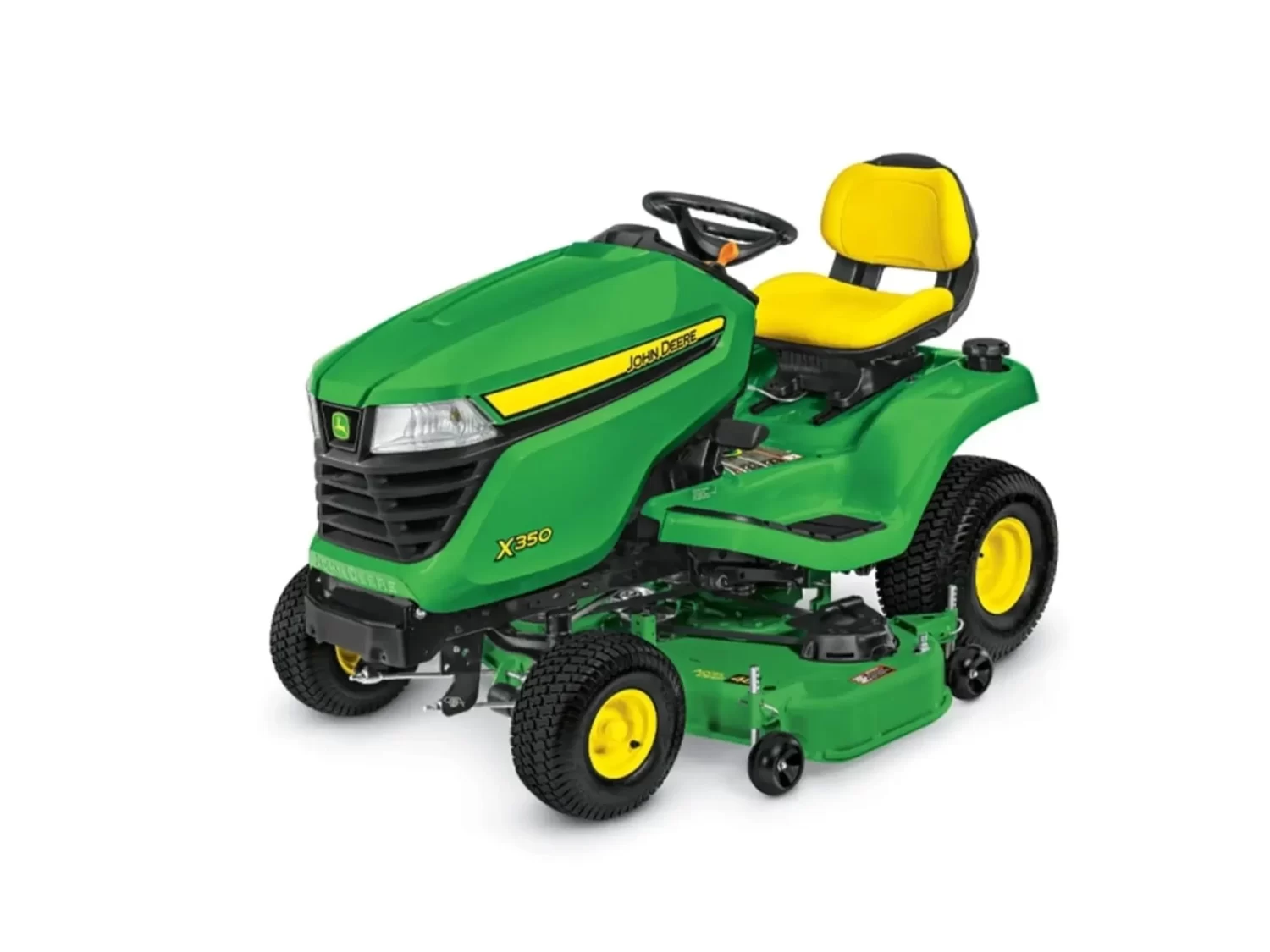
The John Deere X350 is a residential lawn tractor in the X300 Select Series that has been in production since 2016. It occupies a middle position in John Deere's lineup: it is a genuine step above the box-store E100 and D100 series in frame construction, deck quality, and engine choice, yet it remains a homeowner-grade machine that is not engineered for the heavy, sustained loads that the X500 and X700 garden tractors are built to handle. Understanding where the X350 excels and where it is prone to trouble is essential for both current owners who want to maximize the life of their investment and prospective buyers who want to match the machine to the property they intend to maintain.

At the heart of the X350 is a Kawasaki V-twin engine driving a Tuff Torq (Kanzaki) K46 hydrostatic transaxle, with power delivered to a stamped-steel Accel Deep mower deck through an electric power take-off (PTO) clutch. Each of these subsystems has its own characteristic failure modes, and many of the complaints that circulate on owner forums trace back to a mismatch between the machine's design intent and the way it is actually used. This article examines every major problem category for the X350, explains the underlying components and how they fail, and provides troubleshooting steps and solutions drawn from service documentation, technical specifications, and the collective experience of owners on forums such as Green Tractor Talk, My Tractor Forum, TractorByNet, Lawn Mower Forum, and the John Deere dealer network.
Throughout this article, the goal is to be decision-ready. Where the evidence supports a clear conclusion about what is likely wrong and what an owner should do, that conclusion is stated plainly rather than buried in a list of possibilities.
Model Years and Variant Differences
The X350 has been produced continuously since 2016, and the most significant change across its production run is the engine. From model year 2016 through 2020, the X350 was powered by the Kawasaki FS600V, a 603-cc V-twin rated at 18.5 horsepower at 3,600 rpm. Beginning with model year 2021, John Deere transitioned the X350 to the Kawasaki FR651V, a larger 726-cc V-twin rated at 21.5 horsepower. Both are air-cooled, overhead-valve, vertical-shaft V-twins with cast-iron cylinder liners, a float-type carburetor with a fixed main jet, a pulse-type fuel pump, and a dual-element air filter. Prospective buyers of used units should verify which engine a given tractor carries by reading the model and serial number on the engine fan housing, because parts, oil capacity, and some service details differ between the two.
It is worth noting a subtlety in the Kawasaki lineup: within Kawasaki's residential engine hierarchy, the FR series sits a step below the FS series. In other words, the newer 21.5-horsepower FR651V is a higher-displacement engine but comes from a lighter-duty family than the older FS600V it replaced. In practice both engines are well regarded by owners, and the increase in displacement and rated power gives the later units more lugging ability in tall or wet grass.
The X350 is offered with two mower decks: a 42-inch Accel Deep (42A) deck with two blades, and a 48-inch Accel Deep (48A) deck with three blades. Both are stamped-steel, deep, flat-top designs with a shell depth of 4.97 inches that allows cut material room to circulate and exit cleanly. There is also the X350R, a rear-discharge, rear-collection variant built around a dedicated bagging system, and the closely related X354, which is a four-wheel-steer version of the X350. All of these variants share the same K46 transaxle and the same Kawasaki engine family.
The deck choice has real consequences for problem prevalence. The 48-inch deck cuts a wider swath and carries a third spindle, blade, and secondary belt, which means there is simply more rotating hardware that can wear, fall out of balance, or shed a belt. The wider deck also produces more aerodynamic and cutting load, so on the same terrain a 48-inch unit places marginally more demand on the engine and, indirectly, on the drivetrain than a 42-inch unit. Owners who add the Power Flow bagger or the MulchControl kit introduce further belt-driven or baffle hardware that has its own maintenance and clogging behavior, discussed later in this article.
Across the production run, the machine's core weakness has never really changed: the K46 transaxle is a light-duty unit, and it is the single component most often blamed in owner complaints, particularly on properties with slopes or when the tractor is used to tow loads. The engine displacement grew in 2021, but the transaxle did not, so the fundamental advice to match the X350 to relatively flat properties has remained constant across all model years.
In terms of price and warranty, the X350 has consistently been positioned as a premium homeowner tractor. Typical dealer selling prices in the 2025 to 2026 period run in the high 3,000-dollar range for the 42-inch configuration and in the mid to high 4,000-dollar range for the 48-inch configuration. Every X300 Series tractor carries a 4-year or 300-hour bumper-to-bumper warranty, whichever comes first, that covers both the engine and the machine under a single claim process and is transferable to a subsequent owner if the tractor is sold. This warranty is one of the strongest arguments for buying the X350 through a dealer rather than opting for a cheaper box-store tractor.
One recall is relevant to X350 owners. On June 6, 2024, Kawasaki Motors USA, in cooperation with the U.S. Consumer Product Safety Commission (recall 24-256), recalled about 68,500 engines in the United States and 900 in Canada that could overheat and pose fire and burn hazards; according to the CPSC, "Kawasaki has received eight reports of fires… but no reports of injuries." The recalled engines were the model year 2021 to 2023 FJ400D, FS600V, FS651V, FX691V, FX730V, FX801V, FX850V, and FXT00V. For John Deere, the recall covered certain service (replacement) engines supplied for model year 2016 to 2020 lawn tractors including the X350, X350R, X354, and several larger models, as well as the Z760R mower and some Gator utility vehicles. Importantly, the recall applied to specific service engines and specific serial-numbered builds, not to every X350 ever sold. As Consumer Reports noted, "Consumer Reports has tested models from some of these brands… like the John Deere X354 and John Deere X350… But neither of these specific units, nor any riding mower CR has tested, are actually included in the recall, as none came equipped with the specific Kawasaki engines included in the notice." Owners should nonetheless check their engine model and serial number against the CPSC recall notice and contact John Deere if there is any doubt.
Engine Starting and Performance Problems
Symptoms
The most common engine complaints on the X350 are a no-start or hard-start condition, an engine that starts and runs for a few minutes and then stalls, rough running or misfiring under load, loss of power, black smoke, backfiring, and overheating. A particularly characteristic complaint is the engine that runs perfectly when cold but begins to stumble, lose power, and stall after it has warmed up for ten to twenty minutes, sometimes restarting immediately and sometimes requiring a cool-down period before it will run again.
Causes
A no-start or hard-start condition on the X350 usually comes down to fuel, spark, or the safety interlock system. Common fuel-side causes are an empty tank, stale or water-contaminated gasoline, a clogged fuel filter, a gummed carburetor, or a blocked fuel-cap vent that creates a vacuum in the tank and starves the engine. Spark-side causes include a fouled or failed spark plug, a weak or failing ignition coil, and loose or corroded connections. The interlock system will also prevent starting if the operator is not seated, the parking brake is not set, or the PTO switch is engaged.
The warm-stall pattern deserves special attention because it is one of the most frequently discussed X350 problems and one of the most misdiagnosed. There are three classic culprits. The first is fuel delivery: as the engine and its surroundings heat up, fuel in the float bowl can percolate into vapor, producing a mixture too rich to burn, or a marginal fuel pump or partially clogged filter can fail to keep the bowl supplied once demand is sustained. The second is the ignition coil: the fine windings inside a coil can develop a break that separates when hot and touches again when cool, so the coil produces spark when cold and cuts out once it reaches operating temperature. Kawasaki coils have a documented history of heat-related failure, and technicians who work on these engines report selling a high volume of replacement coils. The third is valve clearance that has drifted too tight: as the valvetrain expands with heat, an overly tight clearance can hold a valve slightly open, reducing compression until the engine will no longer run.
Rough running, misfiring, and backfiring most often stem from a dirty or improperly adjusted carburetor, stale fuel, a fouled spark plug, or a failing coil on one cylinder. Black smoke indicates an over-rich condition, typically from a dirty air filter, a stuck choke, or a carburetor needle-and-seat problem. Overheating is usually the result of restricted cooling airflow: a plugged intake screen, grass packed into the cooling fins, or a clogged air filter, compounded by incorrect oil level or by mowing thick, wet grass on a hot day.
Troubleshooting Steps
Begin with the simplest and cheapest checks. Confirm there is fresh fuel in the tank and that the fuel-cap vent is clear by briefly loosening the cap and attempting to start. Verify the interlock conditions: sit on the seat, set the parking brake, and make sure the PTO switch is off. Inspect the spark plug for fouling, damage, or an incorrect gap, and replace it if there is any doubt.
To isolate a warm-stall problem, run the engine until it begins to falter, then apply a targeted test. Spray a small amount of carburetor cleaner or starting fluid into the carburetor throat; if the engine briefly revives, the problem is fuel delivery, pointing toward the carburetor, fuel pump, filter, or fuel lines. If the engine does not respond to added fuel, the problem is more likely ignition, and the coils and spark plugs should be tested hot. Coils can be compared by measuring the primary and secondary resistance with a multimeter and comparing the two sides, or by pulling each spark-plug boot with insulated pliers while the engine runs and comparing the change in engine speed. A weak side will produce little change. Listen also for the click of the fuel shut-off solenoid at the carburetor when the key is turned on, and inspect the anti-backfire solenoid, which if failing can allow idle but choke off high-speed running.
For overheating, shut the engine down and inspect the intake screen, cooling fins, and air filter for debris, and confirm the oil is at the correct level and not overfilled.
Solutions
Replace stale fuel with fresh gasoline, and if the carburetor is gummed, clean it thoroughly, paying attention to the pilot and main jets, the needle and seat, and the float setting, or install a rebuild kit or replacement carburetor if cleaning does not restore smooth running. Replace a clogged fuel filter, observing the flow-direction arrow, and replace the fuel cap if the vent is blocked. Replace fouled or worn spark plugs with the specified NGK BPR4ES type, gapped correctly.
If the diagnosis points to ignition coils, replace the failed coil; Kawasaki recommends replacing both coils when one side fails, and many owners do so to avoid a repeat visit. If valve clearance is out of specification, adjust it to the cold specification (the Kawasaki service data specifies a clearance in the range of 0.10 to 0.15 millimeter). Because valve adjustment on a V-twin requires removing the valve covers and rotating the engine to the correct position, owners who are not comfortable with the procedure should have a dealer perform it. For overheating, clean the intake screen and cooling fins, replace a plugged air filter, and avoid mowing heavy wet grass at full ground speed on hot days. If the charging or ignition diagnosis becomes uncertain, a small-engine technician is the prudent next step, because replacing parts by guesswork on these engines becomes expensive quickly.
Fuel System Problems
Symptoms
Fuel-system problems present as difficulty starting, stalling shortly after startup, surging or hunting at steady throttle, loss of power under load, and an engine that will idle but will not run cleanly at full speed. Many owners report that a machine that ran perfectly at the end of one season will not run properly at the start of the next.
Causes
The overwhelming root cause of X350 fuel-system trouble in the United States is fuel quality, specifically the ethanol in ordinary E10 pump gasoline. Ethanol is hygroscopic, meaning it attracts and holds water, and over a period of weeks it degrades, forming gum and varnish deposits that coat the inside of the carburetor and clog the small passages of the pilot and main jets. Ethanol also attacks rubber components such as the tip of the carburetor needle valve and older fuel lines, and it can loosen sediment in the tank that then travels to the carburetor. The float-type carburetor with its fixed main jet is precise and does not tolerate this contamination well.
Beyond fuel quality, the X350 fuel system can suffer from a clogged in-line fuel filter, a failing pulse-type fuel pump whose diaphragm leaks or weakens, cracked or collapsed fuel lines, a malfunctioning fuel shut-off solenoid on the carburetor, and a blocked fuel-cap vent. Any of these can produce a fuel-starvation pattern that mimics an ignition problem.
Troubleshooting Steps
Start by confirming that the fuel is fresh; if it has been sitting for more than about a month, drain it and refill with fresh gasoline. Inspect the in-line fuel filter for discoloration and debris, and confirm that fuel flows steadily through it by disconnecting the downstream line and observing the flow. Check the fuel lines for cracks, kinks, or softness. Listen for the click of the fuel shut-off solenoid when the key is turned on; a solenoid that does not actuate can block fuel. Remove and inspect the carburetor float bowl for the tell-tale gum, varnish, or a lime-green deposit that ethanol-laden fuel leaves behind. Verify the fuel-cap vent by loosening the cap and testing whether running improves.
Solutions
Replace stale fuel with fresh, and thereafter treat fuel proactively. The single most effective preventive measure is to use fresh fuel and to add a fuel stabilizer at every fill so the stabilizer is present from the start rather than added as an afterthought. Where it is available, ethanol-free gasoline is strongly preferred for small engines and eliminates most of the gumming problem. Owners who store the tractor over winter should either run the carburetor dry using an in-line fuel shut-off valve or treat the fuel with stabilizer and run the engine long enough to circulate it.
If the carburetor is already gummed, clean it thoroughly or rebuild it, and replace the needle and seat if the ethanol has degraded the rubber tip. Replace a clogged fuel filter, a leaking fuel pump, cracked fuel lines, or a failed shut-off solenoid as the diagnosis dictates. It is worth noting that owners have reported the original fuel filter clogging within the first year or two even without visible debris in the bowl, causing surging and stalling, so replacing the fuel filter annually is cheap insurance.
Transmission and Drive Problems
Symptoms
The signature X350 transmission complaint is loss of drive power on hills and slopes: the tractor slows or stops climbing an incline, sometimes accompanied by a whining noise, and in advanced cases loses forward and reverse power entirely after the machine has warmed up for ten to twenty minutes. Owners also report the tractor "skiing" or free-wheeling down a slope with no transmission resistance, jerky engagement, and a general weakening of drive over the machine's life. In severe cases the transaxle fails outright and must be rebuilt or replaced.
Causes
The X350 uses the Tuff Torq K46 hydrostatic transaxle, a sealed unit that Kawasaki's transaxle division builds and that John Deere buys pre-filled with 10W-30 motor oil. The K46 is by a wide margin the most common transaxle in residential riding mowers, and on flat ground with light use it holds up well. It is, however, a light-duty unit, and its Achilles heel is heat. When the tractor is pushed up slopes or asked to tow beyond a light load, the internal hydrostatic pump and motor work harder, the oil heats, its viscosity drops, and the internal leakage past the worn pump and motor increases. This produces the classic pattern of a transaxle that works when cold and loses power once hot, and over time it accelerates wear until the unit is, in owner parlance, "cooked."
Forum consensus, echoed by experienced posters across multiple communities, is that the K46 should not be used to tow more than roughly 200 pounds, should not tow continuously, and will not hold up on hills over time. One owner who reported a failure at only 150 hours acknowledged towing concrete blocks and a loaded trailer up a hill; the response from the community was that the transaxle had been used beyond its design limits. The apparent free-wheeling down a slope is a related but distinct phenomenon: it can be genuine transaxle weakness, but it can also be the rear tires losing traction and sliding, in which case the drivetrain is not actually at fault.
It is important to separate genuine transaxle failure from simpler causes. A drive belt that is worn or has come off, a transaxle freewheeling (bypass) lever that has been left partially engaged, debris clogging the transaxle cooling fan, or a linkage adjustment can all mimic a failing transaxle.
Troubleshooting Steps
Before condemning the transaxle, confirm the freewheeling or bypass lever on the rear hitch plate is fully pushed in to the driving position; a lever left in the tow position releases the transmission. Inspect the traction drive belt for wear, glazing, or displacement from its pulleys. Clean the transaxle housing and its cooling fan of packed grass and debris, because a dirty case runs hotter. Check the shift and control linkage for looseness or misadjustment. If the machine drives normally when cold but fails when hot, and the belt, lever, and fan are all in order, the internal pump and motor are the likely cause.
Solutions
If the loss of power is due to a belt, lever, or cooling issue, correcting that issue restores normal operation. If the internal unit is worn, the realistic options are a rebuild or replacement. A rebuild kit is available from Tuff Torq, and individual internal parts are inexpensive (differential spider gears, for example, run about 25 dollars), but many owners find that by the time the symptoms appear, the pump and motor center section are worn enough that a rebuild may not fully cure the problem. A complete replacement transaxle is a significant expense; owner reports place a new K46 at roughly 700 to 900 dollars depending on source before labor, with the John Deere part at the higher end and surplus or online units sometimes available for less, provided the exact model number on the transaxle decal is matched, because there are dozens of K46 variants that differ in external brackets and drain provisions.
The most consequential decision, however, is preventive and strategic. The K46 is nominally a sealed, maintenance-free unit, and John Deere does not specify a fluid change for it. Nonetheless, a large and vocal contingent of owners changes the fluid as preventive maintenance, and the evidence that this helps is persuasive. Tuff Torq itself now recommends a synthetic oil in place of the factory 10W-30; in the company's words, "after testing… we changed to using a 5W-50 oil. Again, after more testing we finally designed a superior oil in our Tuff Tech oil… it became the standard oil in most of our units," available under part number 187Q0899000 in a 3-liter bottle. The reasoning is that synthetic oil resists the heat that destroys these units far better, and the Tuff Tech formulation is designed to release its protective additives at the lower temperatures a transaxle actually reaches. Owners who have changed the fluid frequently report that a whining, weakening transaxle became quieter, faster, and more responsive afterward, and that the change bought years of additional service. The procedure requires removing the transaxle from the tractor to access the fill cap, and Tuff Torq's guidance is to change the fluid at 50 hours and then approximately every 200 hours. Keeping the case clean with a leaf blower rather than a hose, so that no water enters the vents, further extends life.
The strategic point for buyers is blunt: if the property has meaningful slopes, or if regular towing is anticipated, the X350 is the wrong machine, and a model with the heavier K57, K58, K66, or K72 transaxle, such as the X370, X380, or an X500 series tractor, is the correct choice. Several owners on the forums state plainly that they wished they had bought an X380 with the K58, or that if the K46 is that marginal for a given use they would pass on the X350 entirely. For flat lawns with light carting, by contrast, the K46 gives long and satisfactory service, and many owners report five years or more of trouble-free use.
Mower Deck and Cutting Problems
Symptoms
Deck complaints include vibration when the blades are engaged, an uneven or stepped cut, scalping, uncut strips of grass, a rattling or grinding noise from the deck, belts that wear rapidly or come off the pulleys, the deck failing to engage, and clogging or poor discharge, especially when bagging. Deck vibration is often felt through the seat and steering wheel and can be severe enough to trip the PTO clutch and disengage the blades.
Causes
The Accel Deep deck carries two spindles on the 42-inch version and three on the 48-inch version, each with a blade, and is driven by a primary belt from the engine PTO and, on the 48-inch deck, a secondary belt as well. Vibration almost always traces to the rotating hardware: an unbalanced or bent blade, a blade not fully seated on its spindle register, a worn spindle bearing, a worn or failing idler or tensioner pulley, or debris wrapped around a spindle. A very common and instructive case involves owners who install new blades, including John Deere's own mulching blades, and immediately experience severe vibration; in several documented instances the new blades were either out of balance from the factory or, more often, not seated flush and centered on the spindle register, and correcting the seating or reverting to the original blades eliminated the vibration.
Uneven cut and scalping are usually caused by an unlevel deck, incorrect tire pressures, a bent blade or spindle after striking an object, a deck set too low, or worn gauge wheels and rollers. Belt problems arise from worn or misaligned pulleys (sheaves), incorrect belt tension, debris in the pulley grooves, a belt routed incorrectly, or a belt knocked off its path so that it runs against the tensioner and overheats. A deck that will not engage points to the PTO clutch or a broken or displaced belt.
Troubleshooting Steps
For vibration, first stop the engine, remove the ignition key, and disconnect the spark-plug boots. Inspect each blade for straightness, balance, and damage, and confirm that each is seated flush on its spindle register and torqued correctly with a torque wrench rather than an impact gun. Balance each blade with a blade balancer or a nail; a blade that dips to one side has more weight on that side and must be corrected. Grasp each blade and rock it up and down to feel for spindle-bearing play, and spin each pulley by hand to feel for rough or noisy bearings, paying particular attention to the idler and tensioner pulleys, which are frequent hidden culprits. Inspect the belt for cracks, glazing, and looseness.
For an uneven cut, park on a level surface, set the tires to the correct pressure, and use the onboard Exact Adjust deck-leveling gauge and hex key to level the deck side-to-side and front-to-rear. For a deck that will not engage, turn the key to the run position with the engine off, engage the PTO switch, and listen for the click of the electric clutch; if the clutch clicks, the fault is a broken or displaced belt, and if it does not, the fault is in the clutch or its circuit.
Solutions
Replace bent or unbalanced blades, and when installing new blades take care to seat them fully and centered on the spindle register, because an improperly seated blade both vibrates and cuts low on that spindle. Replace worn spindle bearings or the complete spindle housing assembly as the design requires, and replace a worn or noisy idler or tensioner pulley along with its bushing and spring. Replace a worn deck belt, routing it exactly per the operator's manual, and correct the tension. Level the deck and set tire pressures to cure most uneven-cut complaints. If the PTO clutch is worn or has failed, replace it. As a general rule, keeping the deck underside clean, the blades sharp and balanced, and the spindles greased prevents the majority of deck complaints.
Steering and Control Problems
Symptoms
Steering complaints on the X350 and its X300-series relatives include increasing play or "slop" in the steering wheel, a clicking or popping noise when turning, the front wheels failing to respond to steering input, and in the worst cases complete loss of steering when a gear tooth strips.
Causes
The X350 uses a manual steering system in which a pinion gear on the bottom of the steering shaft meshes with a large half-moon sector gear that turns the steering linkage. This sector-and-pinion arrangement is a well-known weak point across the entire X300 series. Over time the gear teeth wear, and the bushings that support the shaft wear as well, allowing the gears to separate slightly and mesh poorly. The result is progressive play, then a clicking or popping as the teeth begin to skip, and eventually stripped teeth on the sector gear that cause the steering to fail. Owners have reported the sector gear teeth wearing away after several hundred hours, and one documented case describes the steering clicking and then failing after about thirty minutes of use once the teeth had worn away.
Troubleshooting Steps
With the engine off, turn the steering wheel back and forth and observe how far it moves before the front wheels respond; excessive free play indicates gear or bushing wear. Remove the steering-column cover and inspect the sector gear and pinion for worn, chewed, or missing teeth and for excessive slop in the mesh. Inspect the support bushings for wear.
Solutions
If the gears are only lightly worn but the mesh is sloppy, a well-documented and inexpensive fix is to add thin shim washers (John Deere part M41361) to the sector-gear shaft to draw the sector gear downward into tighter mesh with the pinion; owners report that this shimming preserves the sector gear and extends its life well beyond 1,000 hours. If the teeth are already worn or stripped, replace the sector gear and pinion, replace the support bushings at the same time, and consider adding the shims on reassembly for a tighter mesh. Regular lubrication of the steering components slows wear and should be part of routine maintenance. Because the labor to access these parts is significant, it is efficient to replace the bushings, gears, and add shims in a single service rather than returning to the job later. It is worth observing that some owners view the manual sector-gear steering as a reasonable trade-off, since the power steering on higher models can cost roughly a thousand dollars to repair when it fails.
Electrical and Safety Switch Problems
Symptoms
Electrical and interlock complaints include the engine cutting out when the operator shifts or leans in the seat, the mower blades dying when the tractor is put in reverse, the PTO failing to re-engage after reversing, the engine refusing to start, a battery that will not hold a charge, a low-voltage warning and flashing caution indicator on the dash with the voltage reading dropping toward 9 volts, and blown fuses.
Causes
The X350 is equipped with a network of safety interlock switches: a seat switch, a brake switch, a PTO switch, and a reverse implement option (RIO) switch. These are designed to shut off the engine or the blades under unsafe conditions, and many complaints are the interlocks working as designed rather than a fault. By design, backing up with the mower engaged shuts off the blades unless the operator deliberately activates the RIO; John Deere's own guidance is that mowing in reverse is discouraged and that the RIO must be used only when necessary. However, the switches themselves also fail or fall out of adjustment. A seat switch that is too sensitive will cut the engine or clutch when the operator leans on a slope or crosses a bump. A reverse-pedal switch that is misadjusted or stuck partly depressed will keep the blades from re-engaging when the tractor returns to forward travel. Switches also fail outright, and their connectors fill with grass, dirt, and water.
Charging-system complaints are among the most frequently reported X350 electrical problems. The classic pattern is that the machine runs normally for a minute or two, then the dash voltage drops to about 9 volts and the caution indicator flashes, and if the blades or headlights are switched on the drop happens immediately. The battery slowly discharges as it runs the machine without support from the charging system. The usual culprits are the stator under the flywheel, the voltage regulator, a blown fuse or a poor connection in the charging circuit, or, less obviously, a bad ground on the regulator. One instructive forum case documented an owner replacing the stator, voltage regulator, PTO switch, PTO clutch, and solenoid before resolving the problem, illustrating how easily money is wasted by replacing parts without systematic testing. A weak or aging battery is also a common cause and, at three years of age, is often the answer.
Troubleshooting Steps
For interlock behavior, first confirm the behavior is not simply the safety system working correctly; consult the decal in front of the seat for the correct RIO procedure. If the seat switch is cutting out on bumps, inspect its connector and wiring. If the blades will not re-engage after reverse, inspect and adjust the reverse-pedal switch so it fully releases when the pedal returns to neutral; the switch is typically located under the fender deck or foot area and may require removing the fender to reach. The X350 also has a diagnostic mode, entered through a specific key and control sequence with the operator off the seat, that can help identify which interlock is unsatisfied.
For charging problems, use a multimeter. With the engine off, a healthy battery reads about 12.6 volts. With the engine running at full throttle, the battery should read roughly 13.6 to 14 volts; a reading below about 12.5 volts means the charging system is not working. Test the stator output by disconnecting its two-wire connector at the regulator and measuring the alternating-current voltage across the two leads with the engine running; a healthy stator produces roughly 28 to 30 volts alternating current or more. If the stator output is good but the battery is not charging, the fault is in the regulator, the charging wire, a fuse, or a ground. Confirm the regulator case is properly grounded, because a poor ground will prevent charging even with a good stator and regulator.
Solutions
For an overly sensitive seat switch, the switch and its wiring should be inspected and the connector cleaned; some owners bypass the seat switch or the RIO switch, but doing so defeats a safety feature, may void warranty coverage, and is not recommended, particularly on a machine that others, including children, may operate. Adjust or replace a misadjusted or failed reverse-pedal or PTO switch. For charging faults, replace the failed stator or voltage regulator once testing has identified it, using original-equipment parts, and repair any poor ground, blown fuse, or corroded connection. Replace an aging battery that no longer holds a charge; keeping the terminals clean and tight and maintaining the battery over winter with a proper charger prevents many no-start complaints. As with the engine diagnosis, the guiding principle is to test before replacing, because the charging circuit offers several ways to waste money on parts that were never the problem.
Maintenance-Related Failures
Symptoms
Maintenance-related failures are the problems that appear not because of a design weakness but because routine service was neglected or performed incorrectly. They present as premature engine wear, valvetrain problems and compression-release failures, hard starting and stalling from clogged filters, transaxle failure from never-changed and overheated fluid, deck vibration and noise from ungreased spindles and worn belts, rapid belt wear, steering wear from dry linkages, and battery failure from neglect.
Causes
Air-cooled Kawasaki V-twins depend on clean oil, clean air, and correct valve clearance. Owners who stretch oil-change intervals, who never adjust the valves, or who allow the cooling fins and intake screen to pack with debris shorten engine life and invite overheating. The condensation that collects in an engine that is used only a few hours between long idle periods contaminates the oil, which is why annual oil changes matter even when the hour count is low. On the drive side, the single most consequential maintenance-related failure is allowing the K46 transaxle to run for hundreds of hours on its original factory oil while working it on slopes or under tow, so that the oil overheats and the unit wears out. On the deck, failing to grease the spindles, running worn belts, and leaving caked grass on the deck underside cause vibration, noise, poor cut, and belt failure. Using stale, ethanol-laden fuel without stabilizer causes the fuel-system failures described earlier.
Troubleshooting Steps
Review the machine's service history against the maintenance schedule below. Check the engine oil level and condition before every use, and check the air filter, cooling fins, and intake screen regularly. Inspect belts, spindles, and the deck underside at each blade sharpening. Track engine hours so that valve adjustment and other interval-based services are not missed.
Solutions
The solution to maintenance-related failures is, straightforwardly, to follow a disciplined preventive-maintenance program, which the next section sets out in detail. Where neglect has already caused damage, the affected component must be repaired or replaced, but the more valuable action is to reset the maintenance clock and adhere to it thereafter.
Preventive Maintenance and Recommended Service Schedule
Preventive maintenance is the single most important determinant of how long an X350 will last and how few of the problems above an owner will experience. John Deere provides a maintenance reminder sheet and offers the LG265 home maintenance kit for the X350, which bundles the oil, oil filter, fuel filter, air filter elements, and spark plugs needed for service.
An important clarification is warranted regarding oil changes. The John Deere Easy Change 30-second oil-change system, which uses an all-in-one filter canister, is a feature of the 100 Series tractors and is not used on the X350. The X350 uses a conventional spin-on oil filter, John Deere part AM125424, together with a quick oil-drain provision, so servicing it means draining the oil and spinning off and replacing a conventional filter. This is a routine job that any owner comfortable with basic maintenance can perform, though owners note that it is a messy job and recommend placing cardboard under the machine to catch drips.
The recommended engine service intervals are as follows. Change the engine oil and filter after the first 8 hours as a break-in service, and thereafter at 100 hours or annually, whichever comes first. The engine holds approximately 2.1 liters, or 2.2 quarts, of oil; John Deere supplies Turf-Gard 10W-30, while many owners prefer a synthetic such as 5W-40 or a heavier 10W-40 or 15W-40 in hot weather for an air-cooled engine that can consume some oil. Many owners sensibly change the oil more often than the 100-hour interval, commonly at 50 hours or once per season, because more frequent changes are cheap insurance against condensation and contamination. Replace the air filter foam and paper elements, the in-line fuel filter, and the two spark plugs at 100 to 200 hours or as needed, and clean the foam pre-cleaner regularly during the season. Critically, check and adjust the valve clearance every 300 hours; this is a service many owners overlook, and neglecting it contributes to hard starting, power loss, and warm-running problems. Because valve adjustment requires removing the valve covers on the V-twin, owners who are not confident performing it should have a dealer do it.
Transmission maintenance is the most debated item. John Deere treats the K46 as sealed and specifies no fluid change, and for a genuinely light-duty, flat-lawn machine that position is defensible. However, as discussed in the transmission section, the weight of owner experience and Tuff Torq's own recommendation favor changing the fluid as preventive maintenance, especially for any machine that sees slopes or towing. The practical program that emerges from the forums is to change the K46 fluid at approximately 50 hours and then every 200 hours, using a synthetic 5W-50 motor oil or Tuff Torq's Tuff Tech fluid (part number 187Q0899000), and to keep the transaxle case clean and free of packed debris so it runs cooler. This is optional in John Deere's eyes but is, on the evidence, one of the most effective life-extending measures an owner can take.
Deck and chassis maintenance rounds out the program. Inspect the deck belt and, on the 48-inch deck, the secondary belt, for wear, cracking, and glazing at least once per season and replace as needed. Sharpen and balance the blades regularly, taking care to remove equal metal from each side so the blade remains balanced, and inspect them for bending or wear. Grease the deck spindles, the front axle pivot, and the axle spindles with John Deere multi-purpose lithium-complex grease every 50 hours or annually. Keep the deck underside clean by using the washout port after mowing rather than a high-pressure hose directed at bearings, and blow debris off the machine with a leaf blower rather than washing the transaxle. Lubricate the steering linkage and, if play is developing, address the sector-gear mesh early with shims before the teeth are damaged. Maintain the battery by keeping the terminals clean and tight and by using a maintenance charger during the off-season. Finally, manage fuel proactively: use fresh gasoline, add stabilizer at every fill, favor ethanol-free fuel where available, and either run the carburetor dry or fully stabilize the fuel before winter storage.
What Owners Say: Forum and Review Feedback
The consensus of owner and expert feedback on the X350 is favorable but pointed. Consumer Reports rates the X350-42 highly. As summarized by MotorBiscuit citing Consumer Reports, "Consumer Reports gave it an 88 overall score, along with an Excellent predicted reliability rating," with an expected price of approximately 3,200 dollars; Consumer Reports' more recent 2026 ratings list the X350-42 at an overall score of 83, so the exact figure has drifted slightly over time, but the machine has consistently earned Excellent marks for predicted reliability, owner satisfaction, mulching, and handling. Consumer Reports also notes that it is a noisy machine and that its acceleration and deceleration can be jerky, as is typical of hydrostatic tractors. Owners across the forums repeatedly praise the machine's cut quality, the comfort of the seat and controls, the tight 16-inch turning radius, the Kawasaki engine, and the strong Accel Deep deck, and John Deere tractors of this class are widely observed to hold their resale value well.
The criticism is remarkably consistent and centers on the drivetrain. The recurring refrain is that the K46 transaxle is the machine's limiting factor: it is fine on flat ground and with light loads but struggles and can fail on hills or under tow. One owner, describing the machine on a slope, summarized it as the transaxle simply not being up to the job. Another, weighing the X350 against the K58-equipped X380, concluded that if the transaxle is that marginal for hilly ground one should pass on the X350. Experienced posters advise limiting towing to about 200 pounds and limiting hard pulls to short bursts of 30 to 60 seconds so heat can dissipate. Many long-term owners report the opposite experience on suitable ground, describing five or more years of trouble-free mowing and towing about 250 pounds on flat property.
Owners of bagger-equipped units voice a specific and repeated complaint: the Power Flow and standard baggers clog easily, especially in wet grass or leaves, and the chute on the 42-inch Accel deck is criticized for leaving a gap where clippings escape. The practical wisdom that emerges is to bag only dry material, to use high-lift blades, to run the engine at full throttle, and to stop and empty the bag the moment the full indicator sounds rather than mowing a few extra feet and packing the chute solid. Owners who follow this discipline, particularly on the X350R, report excellent leaf and grass collection.
Two further themes appear consistently. First, the fuel system is sensitive to ethanol, and the owners who have the fewest problems are those who use fresh, stabilized, or ethanol-free fuel and store the machine properly. Second, the safety interlocks, while occasionally annoying, are usually working as designed, and the most common "problems" with reversing and seat cut-out are resolved by understanding the RIO procedure and by keeping switches clean and adjusted rather than by defeating them.
Conclusion
The John Deere X350 is a well-built, comfortable, and capable residential lawn tractor that earns high marks for cut quality, reliability, and resale value when it is matched to the right property and maintained conscientiously. Its problems are, for the most part, predictable and manageable. The engine's warm-stall and hard-start issues almost always trace to fuel quality, ignition coils, or valve clearance, and they respond to fresh stabilized fuel, coil replacement, and periodic valve adjustment. The fuel system's vulnerability to ethanol is real but is largely preventable through fuel discipline. The deck's vibration and cut problems come down to blade balance and seating, spindle and pulley condition, belts, and leveling. The steering's sector-gear wear is a known weak point that is inexpensively managed with shims and addressed by replacing gears and bushings when necessary. The electrical complaints are dominated by charging-system faults that require systematic testing rather than parts-swapping, and by interlocks that are frequently misunderstood.
The one issue that rises above the rest is the K46 transaxle. It is the defining limitation of the X350, and the clearest, most actionable conclusion of this article is a matter of fit: buy the X350 for flat to gently sloped lawns and light carting, maintain it well, and it will serve reliably for many years; but if the property is hilly or regular towing is planned, step up to a model with a heavier transaxle rather than expecting the K46 to do work it was never designed to do. For the owner who already has an X350, the most valuable single maintenance action beyond routine engine and deck service is to change the K46 fluid to a synthetic and to keep the transaxle cool and clean, which on the evidence of many owners meaningfully extends its life. Matched to the right yard and cared for religiously, the X350 lives up to its reputation.