
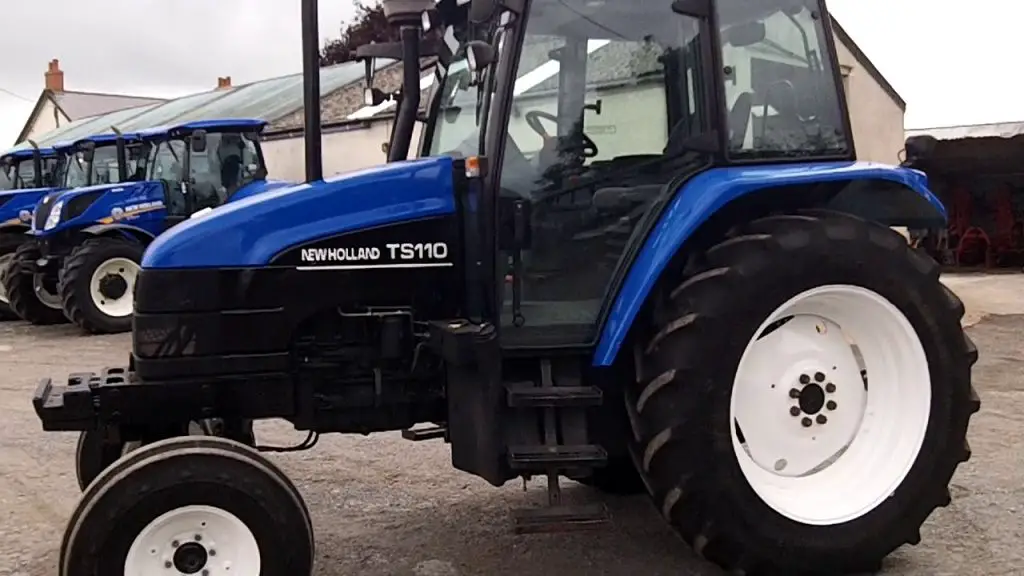
The New Holland TS110 is a mid-range utility tractor produced from 1999-2005, featuring a 110-112 HP turbocharged diesel engine and multiple transmission options. While generally considered reliable and capable for heavy agricultural work, some owners report recurring problems in electrical systems, transmissions, and hydraulic circuits that can lead to expensive repairs. The most critical issues include transmission solenoid failures causing missing gears with expensive repairs, electrical ground wire problems that cascade throughout the system, and intermittent PTO malfunctions under load.

However, owners who perform rigorous preventive maintenance report excellent longevity, with many tractors exceeding 10,000 hours. The tractor excels at heavy mowing, baling, and loader work when properly maintained.
MODEL INFORMATION AND SPECIFICATIONS
Production Timeline and Variants
New Holland manufactured the TS110 series across two distinct generations. The original TS110 ran from 1999-2003, built in Basildon, Essex, England, followed by the updated TS110A from 2003-2005. Both models offered 2WD and 4WD/MFWD variants, with the TS110 featuring special versions like the TS110 SLE with high-speed transmission with 40 KPH capability and creeper gear, and the TS110A available in Delta (economy) and Plus (premium) configurations.
Engine Specifications Reveal Significant Evolution
The original TS110 from 1999-2003 utilized a robust 5.0-liter (304 cubic inch) New Holland Genesis four-cylinder vertical turbocharged diesel engine. This powerplant delivered 110 HP at 2,070 RPM with 98.4 HP at the PTO, generating impressive torque of 323.4 lb-ft at 1,348 RPM with 29.5% torque rise. The engine featured a 17.5:1 compression ratio and held 12 quarts of oil. The fuel tank carried 42 gallons of diesel, while the cooling system held 14.8 quarts (16.8 with cab).
The TS110A from 2003-2005 switched to a more modern 4.5-liter (273.7 cubic inch) turbocharged intercooled engine with electronic common rail fuel injection and 16-valve design, meeting Tier II emissions standards. Despite smaller displacement, this engine produced 112 HP at 2,200 RPM with significantly higher torque of 383.5 lb-ft at 1,400 RPM (36% torque rise). The intercooler and higher rated RPM compensated for reduced displacement while improving efficiency.
Transmission Options Create Complexity
The TS110 offered six transmission configurations, contributing to varying problem patterns. The EconoShift provided 8 forward and 2 reverse unsynchronized gears requiring full stops for shifting. The Econo Dual Command added a two-speed powershift for 16×4 capability with on-the-move shifting. The Synchro Command delivered 12×12 synchronized shifting with clutch use required. The Synchro Dual Command expanded to 24×24 with clutchless shuttle shifting via a “dump button.” The ElectroShift offered 16×16 (24×24 with creeper) electronic partial powershift, while the ElectroShift SLE added high-speed capability. U.S. forum discussions reveal the 16×16 ElectroShift experiences significantly more electrical problems than the mechanical 12×12.
The TS110A simplified offerings to Synchro Command (12×12/24×24), Dual Command (24×24), and Electro Command (16×16/32×32), all featuring electro-hydraulically operated multiple wet disc clutches.
Hydraulic System Capabilities Vary Widely
The original TS110 offered open center (standard) or closed center systems with 2,500-2,700 PSI operating pressure. Standard pump flow measured 9.3 GPM, with optional high-flow delivering 17.4 GPM and closed-center systems reaching 20 GPM. Nebraska testing showed maximum hydraulic power of 23.3 HP with assist cylinders. The TS110A upgraded to 21.1 GPM standard flow (29.9 GPM closed center) at 3,046 PSI, while the Delta variant provided 16.6 GPM at 2,756 PSI.
Rear lift capacity ranged from 4,200 lbs standard to 8,598 lbs with two assist rams and electronic draft control, though Nebraska testing found the tractor failed to meet the manufacturer’s claimed 6,210 lb capacity with one assist ram.
1. TRANSMISSION PROBLEMS
Missing Even or Odd Gears Dominates Complaints
The most frequently reported TS110 problem involves selective gear failure in 16×16 ElectroShift transmissions, with owners losing all even-numbered gears (2, 4, 6, 8) or all odd-numbered gears. One Hay & Forage Forum user in Kentucky reported: “I have a Ford tractor TS110 with a 16 speed transmission I have no 2nd, 4th, 6th, & 8th gear. It is the same in high or lo, It sounds like it is engaging but no movement.” Mechanics diagnosed this as clutch pack seal failure, specifically clutch pack #4 controlling even gears. Forum responses warned these clutch packs are “verry expensive” to replace.
The problem typically develops gradually, with gears becoming “slow to engage” before complete failure. The root cause traces to worn clutch pack seals causing hydraulic pressure loss to specific clutch packs, though contaminated hydraulic filters also contribute. Solutions range from simple filter replacement, which sometimes resolves early issues, to expensive clutch pack calibration or replacement. One Yesterday’s Tractors forum member reported his brother-in-law spent $10,000 on transmission replacement.
Gear Skipping and Incorrect Shifting Plague 16×16 Models
Multiple U.S. owners report their TS110 “jumps from 4th gear to 8th gear when moving shift lever forward,” requiring operators to shift down to find 5th gear. Simultaneously, gear indicator lights fail, working fine in gears 1-4 high range but nothing illuminating in low range. A JustAnswer case documented a 1998 TS110 where “it shifts the bottom four gear fine sometimes but it always goes from 4th gear to 8th gear when you most the shift lever to the forward position.”
This stems from faulty transmission range status switches mounted on the right side of the transmission, wiring harness damage, or ground connection issues between cab and transmission. The transmission computer generates error codes including U24 (computer not recognizing shift position), U26 (clutch pedal not fully released), and E48/U48 (clutch disconnect error). Solutions require replacing the “front switch” for low/high range detection on the transmission’s right side, calibrating the transmission using service manual procedures, cleaning all ground connections, or replacing the transmission control module when switches do not resolve the issue.
The 1-4/5-8 shift cable and wiring commonly fail, with one Hay & Forage Forum member noting: “check the play in the 1-4/5-8 cable and the wiring. Just had to repair/replace mine on my TS110. did not have 5-8.”
Random Shifting Into Neutral Creates Safety Hazards
Two Washington state owners with TS100 and TS110 tractors, both at 5,500 hours with 16×16 transmissions, reported identical problems on TractorByNet: “When traveling in lower gears 1-8 in low range the tractor shifts itself into neutral as though we have hit the disengage button on the shuttle shifter.” The issue occurs randomly—may work fine for a week, then happen four times in one day. After pressing clutch and releasing, the tractor works fine temporarily. The gear indicator display for gears 1-8 goes out in low range but works in high range.
Causes include bad wiring near shifters, poor ground connections between cab and transmission, speed sensor failures, and electrical problems with shift coils. High-hour tractors (5,500+) experience this more frequently. Solutions involve polishing and checking the ground between cab and transmission, shielding wiring around shifters, recalibrating the transmission, cleaning coils and checking for cracks, testing all four speed sensors with an ohm meter, and checking the brake light switch, which also puts the tractor into 4WD and can affect transmission operation.
Transmission Calibration Requirements Add Maintenance Burden
Unlike purely mechanical transmissions, the TS110’s electronic systems require calibration after 1,200 hours or when shift quality declines. One JustAnswer expert explained: “The electronic management system identifies when clutches begin to engage. It is critical that no actions during calibration cause engine speed fluctuations.” The procedure demands turning off A/C and all electrical devices, not operating PTO or hydraulic levers during calibration, and parking away from obstacles with parking brake engaged and wheels blocked.
Calibration should ideally be performed by authorized dealers but can be done by owners with service manuals. Failure to calibrate causes harsh shifting, lag, and eventually the selective gear failures described above.
Severe Mechanical Failure Warnings
At 2,500 hours, one TractorByNet user pulling an 8-foot rototiller experienced catastrophic failure starting as “a fast rattle at 2000 RPM” that progressed to severe knocking: “It sounds like a sledgehammer and even resonates in the hood when it is up.” The owner found no metal shavings in drained oil but suspected torque limiter failure or PTO drive plate failure bolted to the flywheel plate. The 16×16 transmission has only one input for drive, hydraulics, and PTO, making heavy PTO work particularly stressful. While one owner reported torque limiters lasting 12,000+ hours on similar models, others experienced early failures.
2. HYDRAULIC SYSTEM ISSUES
Transmission Lubrication Circuit Warning Light Represents Critical Failure Mode
The most serious hydraulic issue involves the red steering pump/transmission lubrication circuit oil pressure warning light. An Arkansas owner with a 1998 TS110 reported on TractorByNet: “The transmission lubrication circuit light came on and stayed on till I raised rpm’s above 1200. Now it pretty well stays on at any rpm.” After servicing all transmission filters, changing fluid, and replacing all three sensors on the tandem pump housing without success, a shop mechanic misdiagnosed the problem as the engine-mounted pump. $600 later, the problem persisted.
The actual causes include low pressure in transmission lubrication circuit (15 bar found versus 17-20 bar required), stuck relief valves (trash in system), pressure regulating valves needing adjustment, failed sensors on tandem pump housing (three sensors total), and plugged or collapsed hydraulic filters. The TS110 has three filters, with one “seriously well hidden.” Testing revealed proper steering pump flow of 11 GPM at 2,100 RPM but inadequate pressure on the main hydraulic circuit.
Solutions require servicing all transmission filters first, changing transmission fluid, replacing all three sensors on tandem pump housing if filters do not resolve it, pressure testing the low pressure circuit per service manual, removing and inspecting the pressure regulating valve and low pressure circuit safety valves, and adding extra shims to the pressure regulating valve if pressure runs low (increasing from 15 bar to 17 bar). In one case, a stuck relief valve resolved itself: “relief valve stuck somewhat open, maybe trash but it went to working right.” The owner achieved 200 PSI low side at idle, close to 300 PSI at 2,100 RPM (normal operation).
For owners facing this issue, a remanufactured tandem pump costs approximately $1,100, though the problem often resolves with proper filter service and valve cleaning before reaching that expense.
Slow Three-Point Hitch Lift Indicates Valve Problems
Multiple owners report three-point hitches raising too slowly, with speed not increasing even at higher RPM. Some find the aux lift cylinder shows 2 inches exposed when fully lowered, preventing full descent. A common owner complaint on TractorByNet: “3-point hitch raises too slowly.”
The most common problem according to mechanics is failed Quick Disconnect (QD) valve. Other causes include hydraulic cylinder issues, misadjusted hydraulic spool valves, low hydraulic pressure, and adjustable stops on the control lever base preventing full range of motion. Solutions involve replacing the QD valve, adjusting the control lever stop, opening the bleed valve further for improved lowering speed, checking and repairing hydraulic cylinders, and verifying proper hydraulic pressure to the lift circuit.
CCLS Pump Deadheading Creates Overheating
Closed-center load-sensing (CCLS) systems on some TS110 models experience a specific failure where the pump continues building high pressure after remote valves return to neutral. One JustAnswer case described: “When tractor fluid is cold, pump continues high pressure after remotes returned to neutral. Pump deadheading and building up heat. Bumping lift arms makes it stop temporarily. Once warm, problem continuous and spontaneous. Pressure remains at 2,700 PSI when should drop.”
This dangerous condition results from the variable displacement pump sticking into full flow, with sticking pistons or springs in the piston pump, flow and compensating valve block issues, charge pressure dump valve failure, or load sensing system malfunctions. One frustrated owner replaced all three filters, the double spool control valve, the flow and compensating valve block, and the charge pressure filter dump valve without resolving the issue. The diagnosis: “Leaning towards a sticking piston or spring in the piston pump.” CCLS pumps cost substantially more than standard pumps, making this an expensive repair.
Complete Hydraulic System Failure Requires Systematic Diagnosis
Rare but catastrophic, complete hydraulic failure leaves operators without loader, three-point hitch, or steering. Symptoms include the system being slow to raise implements before failure and steering requiring the wheel to be turned slowly. One extreme case involved a tractor that “was accidentally dropped in pond”—water contamination suspected—but other cases involve system not pulling fluid from tank to pump.
Causes include hydraulic pump failure, suction line clogs or damage, air leaks in hoses and fittings causing loss of prime, pump drive shaft not engaging properly, and filter blockage on the suction side. Critical troubleshooting steps: inspect the hydraulic tank’s suction line and filter for clogs, check for air leaks causing loss of prime, verify pump drive shaft engagement (gear-driven), check coupler condition, and listen for unusual sounds (whining indicates pump cavitation). Replacing the pump alone may not fix the problem if the root cause involves suction or supply issues.
4WD Engagement Issues Stem From Hydraulic Controls
Some owners report 4WD always engaged regardless of switch position, with dash lights not functioning. The 4WD system uses hydraulic engagement operated by a solenoid mounted on the transmission control valve on the right side of the case behind the batteries. Causes include 4WD solenoid failure, electrical switch signal issues, and brake light switch malfunction (which automatically puts the tractor into 4WD for better braking). Solutions require replacing the 4WD solenoid, checking transmission controller signals, testing the brake light switch, and checking dash light bulbs.
3. ENGINE, FUEL SYSTEM, AND COOLING PROBLEMS
Severe Engine Knocking Indicates Catastrophic Failure
While Genesis engines enjoy an excellent reputation for reliability, failures do occur. The most dramatic case involved a TS110 with 2,500 hours that developed severe knocking while pulling an 8-foot rototiller. The owner described it on TractorByNet as starting with “a fast rattle at 2,000 RPM” that progressed to “sledgehammer” banging that resonated in the hood. Draining the oil revealed no metal shavings, puzzling the owner in his 45 years of equipment operation—his first internal engine failure.
A forum mechanic responded: “You could be experiencing a dynamic balancer failure, especially if previous owners neglected engine oil drain intervals, or ignored engine oil specifications.” Alternative diagnoses included PTO drive plate failure (bolts to flywheel), particularly likely with heavy PTO equipment use. Genesis engines rarely fail unless subjected to improper maintenance, making this an exception rather than the rule.
Injector Problems Cause 15 HP Power Loss
One TS110 owner discovered a gradual power loss of 15 horsepower traced to clogged injector nozzles. After having injectors rebuilt, he reported: “PTO problem seems less after having the injectors rebuilt and gaining the 15 horsepower that it had lost from them.” Service manuals specify injector change intervals at 1,200 hours with opening pressure of 240-250 bar (non-emissionized) or 290-300 bar (emissionized).
Symptoms of failed injectors include rough idling, black or white smoke, loss of power, and hard starting. Professional injector rebuild or replacement costs $150-250 per injector, totaling $600-1,000 for all four cylinders. New injector nozzles run $80-150 each. The repair requires moderate DIY skills, demanding proper torque on high-pressure lines (23 Nm at injector, 23 Nm at pump) and critical timing verification at 29 degrees BTDC.
Injection Pump Failures Create the Most Frustrating Fuel Problems
The Lucas CAV DP203 Series injection pump (or Delphi replacement) represents the TS110’s Achilles’ heel in fuel delivery. One TractorByNet owner experienced two pump failures: the original “self-destructed” at 1,550 hours due to an internal bolt breaking from previous tampering, then the Delphi replacement failed after only 743 hours. He described: “When slightly loaded it begins to pull down and acts as if there is no governor available. Works fine for about 5 minutes after starting, then begins to have no power.” His RPM varied by 200 cyclically under load.
The resolution surprised him—a blockage in the fuel line from the tank rather than pump failure. After pressurizing the tank and blowing out the blockage, he commented: “I cannot believe the pump needs rebuilding unless the Delphi pump is a pile of crap to start with.”
A MyTractorForum owner was not as fortunate, ultimately diagnosing injection pump failure: “I ended up replacing the injector pump, which was the final resolution to my problem. The diaphragm in the pump had holes in it.” Another owner faced improper installation by a mechanic who failed to properly time the pump, leaving it “way off” from the required 29 degrees BTDC setting.
Symptoms include gradual power loss, RPM fluctuations/surging, engine pulling down under load, black smoke, and hard starting or no start. Root causes encompass fuel starvation from air in the system or clogged filters or restricted tank pickup, internal wear including diaphragm failure or seal failure, previous owner tampering, contamination from algae in diesel fuel (plastic tanks particularly susceptible), and improper installation timing.
Remanufactured pumps cost $1,100+, with new Delphi pumps running $800-1,200. Installation requires 6-8 hours and special tools, with water pump removal sometimes necessary for access. Proper timing using the “bubble method”—watching the #1 injection fitting and turning the pump until fuel bubble starts to show—is critical for proper operation.
Fuel Filter and Sediment Bowl Design Receives Criticism
The TS110’s fuel system uses a sediment bowl as primary filtration, considered inadequate by experienced owners. One frustrated owner noted: “The top of the fuel tank is about 2 ft lower than the sediment bowl. I do not understand why a sediment bowl is used on this $55,000 tractor. It should have a primary filter.” The tank positioning creates 4 feet of suction lift from sediment bowl to tank, and algae growth in plastic fuel tanks compounds filtration challenges.
Common problems include clogged filters causing fuel starvation, air infiltration at sediment bowl seals, algae growth in plastic fuel tanks, and restricted pickup screens in tanks. Solutions involve replacing filters every 600 hours minimum, adding an inline primary filter (owner recommendation), checking all fuel line connections for air leaks, pressurizing the tank to check for blockages, back-blowing fuel lines to clear restrictions, and using diesel fuel treatment to prevent algae. Fuel filters cost $15-30, while sediment bowl assemblies run $50-100.
Overheating Stems Primarily From Radiator Blockage
Multiple sources identify overheating as the most common cooling problem, with radiator blockage from sediment buildup as the primary culprit. One technical description explained: “With the long-term use of users, the accumulation of deposits caused by heating metal and evaporating water will cause the radiator to be blocked. This is the main reason for the overheating of the TS110 tractor.”
Other causes include dirty air filters causing engines to work harder and generate excess heat, coolant leaks (external or internal), failed water pumps from loose belts or impeller damage, thermostat failure (stuck closed preventing circulation), and simply low coolant levels. The cooling system holds 14.8 quarts standard or 16.8 quarts with cab.
Diagnosis requires checking coolant level first, inspecting the radiator for blockages (external dirt, internal scale), checking water pump belt tension and condition, testing thermostat operation, pressure testing the cooling system for leaks, and verifying fan operation. Solutions include using radiator cleaner or flushing with distilled water, with replacement options including OEM radiators at $650-900, aftermarket aluminum at $300-500, or copper/brass rebuilds at $400-600.
Head Gasket Failure Follows Overheating
While not extremely common, head gasket failures occur when overheating is not addressed promptly. Symptoms include white steam from the tailpipe with sweet smell, milky/frothy oil on the dipstick (“chocolate milkshake” appearance), overheating, coolant in cylinders causing hard starting, bubbles in radiator or coolant reservoir, loss of engine power, and compression leaks between cylinders.
Head gasket kits cost $40-100, but professional labor runs 12-16 hours at $1,200-2,000, with cylinder head resurfacing adding $200-400. Total professional repairs reach $1,500-3,000+. DIY is possible for experienced mechanics but requires a torque wrench and service manual for proper head bolt sequence. Genesis engines generally prove reliable when maintained, but head warping commonly occurs if overheating was severe, potentially requiring a valve job.
4.ELECTRICAL SYSTEM FAILURES
Critical Ground Wire Design Flaw Causes Cascading Problems
The single most important preventive maintenance for TS110 electrical systems involves a known design weakness. A mechanic on Yesterday’s Tractors Forum warned: “One issue with the ts is main ground bolts to rear hood bracket on back of cyl head. The attaching bolts for hood bracket to head work loose, so all of them I have worked on I loctite the bolts and run a jumper ground wire to starter to bellhousing bolt as well. For this is the main computer ground with out it big problems.”
This ground connection provides the main computer ground, and when these bolts loosen over time, it causes major electrical problems throughout the tractor, affecting PTO operation, starting, and all electronics. The fix is simple but critical: apply Loctite to hood bracket bolts and run a jumper ground wire from cylinder head to starter/bellhousing bolt.
Starting Problems Stem From Complex Safety Switch Network
Multiple owners report intermittent starting issues where the starter relay clicks but the starter motor will not engage, requiring repeated attempts. The key turns but produces only a clicking noise in the relay area. One TractorForum user complained: “thanks guys, problem with these new things is that there are waaay too many grounds to check, safety switches, etc. and without diagnostics it takes forever to find problems.”
The TS110 uses multiple safety interlocks: seat safety switch, brake pedal safety switch, neutral status switches on top of transmission, and PTO safety switch. All must register proper status for starting. Additionally, starter solenoid contacts fail, and the starter motor itself requires replacement, with OE Lucas starters costing approximately $216.
Solutions involve testing safety switches by jumping harness connectors to simulate engaged positions, verifying the tractor is in neutral with PTO off, brake applied, and operator in seat, jumping the starter solenoid directly to test if the starter motor itself works, and cleaning all ground connections thoroughly.
Charging System Problems Create Battery Mysteries
After alternator replacement, one TractorByNet owner encountered a bizarre problem: “Now the tractor starts and runs, but the battery dash light now stays lit even with the tractor off and the key off!” The TS110 uses a three-post alternator configuration with a large post for battery positive output, small post for tachometer output signal, and third medium post. Alternators fail commonly, with replacements costing approximately $191. The solution typically involves checking wiring connections, as alternators may be wired incorrectly during installation.
Gear Indicator Light Failures Signal Transmission Sensor Problems
Owners frequently report gear indicator lights 1-4 not displaying (loss of low range indicators) or lights 5-8 not working (loss of high range indicators), often accompanied by transmissions jumping from 4th to 8th gear, skipping 5-7. Causes include status switches on the transmission side (right side of transmission), wiring to the 16×16 gear display panel, 1-4/5-8 shift cable play and wiring issues, and transmission module failure after multiple component replacements.
One Hay & Forage Forum member advised: “check the play in the 1-4/5-8 cable and the wiring. Just had to repair/replace mine on my TS110. did not have 5-8.” Error codes associated with these problems include U24 (main shift lever not in 5-8 range position), U26 (clutch pedal position switch issue), and E38 (transmission calibration error).
5. PTO (POWER TAKE-OFF) MALFUNCTIONS
Intermittent PTO Stopping Creates Baling Nightmares
The most frustrating TS110 electrical gremlin involves PTO randomly stopping under mid-level load. A Salem, Indiana owner described his experience on TractorByNet: “I have a TS110 and we have a gremlin in our PTO System. The PTO will simply stop turning under a mid level load. Our dealer could not duplicate our problem on their dyno.” His detailed symptoms included:
- Stops are random—may go weeks without incident
- Tends to stop under middle level load (round baler 1/3 formed most common)
- Often restarts by pushing PTO button in and out
- When that fails, requires complete tractor restart (system reboot)
- Will restart while still under load—no need to disengage implement
- Nothing slipping inside tractor—no hot smells or clutch noise
- Engine never stalls or pulls down
- Problem improved after injector rebuild (gained back 15 HP)
The critical diagnosis came from an experienced forum member: “The PTO module has a sense wire running to the alternator, black and white about 20-22 gauge I think. This sends a signal to the module that indicates the engine is running. Check the wire and harness in the engine compartment to see if the insulation is not worn through allowing the wire to ground out causing the intermittent condition.”
A second owner added: “a bad alt will stop the pto I also had a TM with an intermittent pto fault that turned out to be a loose earth wire at the rearplate that the trailer plug is mounted to they are very electrically sensitive and can be difficult to find at times.”
Key preventive measures include inspecting the black and white sense wire to alternator for insulation damage in the engine compartment, verifying earth connections at rear trailer plug plate, ensuring proper alternator function (bad alternators will stop PTO operation), and checking the PTO system’s very sensitive electrical connections regularly.
PTO Error Code 5005 Indicates Solenoid Failure
Complete PTO failure with error code 5005 displayed points to PTO solenoid failure located on the transmission control valve on the right side of the case behind batteries. The TS110 uses hydraulic PTO clutch engagement via solenoid control, not mechanical cable. Troubleshooting requires locating the PTO solenoid, testing solenoid electrical signal from transmission controller, checking hydraulic pressure to PTO clutch pack, and verifying 4WD system not engaging simultaneously (brake light switch can force 4WD engagement, interfering with PTO).
6. CLUTCH PROBLEMS
Hydraulic Clutch System Requires Mineral Oil
A critical specification that owners must understand: the TS110 uses MINERAL OIL, NOT DOT 3 brake fluid in its hydraulic clutch system. The reservoir sits on the right side of the engine compartment just in front of the cab. One owner reported going “to the New Holland dealer to get the mineral oil that the book recommended.” Using DOT 3 brake fluid will eat the seals out of the brake system, causing expensive failures.
Transmission Clutch Pack Problems Create Missing Gears
The most serious clutch problems involve the transmission’s internal wet clutch packs that select gears in electroshift models. As described in the transmission section, seal failures in clutch pack #4 cause loss of gears 2, 4, 6, and 8. A Hay & Forage Forum discussion between owners revealed: “Last year 6th & 8 were slow to engage but do not use other gears that much to notice. I was looking at the manual it talks about a calibration adjustment to the clutch pedal.”
The mechanic’s diagnosis: “I would say clutch is out but I hope not they are verry expensive.” An alternate diagnosis suggested: “From a brief look around it would seem the seals on clutch pack 4 would be gone as it affects all those gears.”
For solenoid-related issues, one JustAnswer expert explained: “TS110 transmission often shows missing odd gears and solenoid-related shifting problems during calibration. If your TS110 tractor only shifts even gears, inspect solenoids C1 and C4, as they control gear engagement.” One owner who replaced multiple solenoids without success: “My tractor is a TS110 with a 16×16 power shuttle. The only solenoid and coil I have not replaced yet is C1. My tractor only has even gears and no odd numbers, which I can only assume is related to C4.”
Clutch Pedal Switch Adjustment Critical for Error Codes
Error code U26 commonly appears when the clutch pedal switch fails to register full release. One expert advised: “The issue with the clutch pedal is that it is not fully released. Remove the left side panel of the dashboard. At the top of the clutch pedal, there is a switch (not the one located on the side). Adjust this switch position.” The switch should “click” when the pedal reaches 1/4 inch from the floor.
Master/Slave Cylinder Failures Cause Complete Loss of Clutch Function
When owners report clutch pedals going to the floor with no resistance or inability to shift gears, master or slave cylinder failure is likely. One desperate owner reported: “MY clutch and brake on my New Holland ts110 stopped working. It does not want to shift to forward or reverse. I adjusted the cable the way the book showed and broke the cable.”
Components cost relatively modest amounts: Clutch Master Cylinder runs approximately $102, while the Clutch Master Cylinder Repair Kit costs around $70. However, the system requires bleeding after any work or low fluid level.
Complete clutch kit pricing for main transmission clutch replacement (not hydraulic system): Standard clutch kits cost $400-$440, premium kits $455-$475, clutch disc alone $67-$75. The clutch measures 13 inches diameter with 1-3/4 inch hub diameter, 10 splines, and 9-pad ceramic-metallic construction. Labor is substantial—8-12 hours for experienced technicians requiring tractor splitting (separating engine from transmission), bringing estimated total costs with labor to $1,200-$2,000.
7. STEERING, BRAKE, LOADER, AND OTHER PROBLEMS
Steering Pump and Hydraulic Pressure Issues Overlap With Transmission
As detailed in the hydraulic section, steering pump and transmission lubrication circuit problems cause the dreaded red warning light. One Arkansas owner’s testing showed steering pump moving 11 GPM at 2,000 PSI (passing specification), but main hydraulic pump showing near-zero pressure. The tandem pump replacement costs approximately $1,100 for remanufactured units.
Hard steering after engine warms up typically indicates air in the hydraulic system from worn O-rings or leaking connections. Solutions involve replacing O-rings on suction strainer housing, bleeding the system, and ensuring proper hydraulic fluid levels.
Brakes and clutch run off the same reservoir on TS series tractors, creating unique diagnostic challenges. A CattleToday.com owner reported: “I got on tractor to load hay today and brake pedal goes straight to the floor. It does grab a little but just no pressure at all to the pedal.” Investigation revealed the reservoir completely empty—the slave cylinder on the clutch had leaked, draining the system.
Multiple owners report replacing slave cylinders on TS110 and TS110A models. The critical specification bears repeating: New Holland uses MINERAL OIL for brake and hydraulic systems, NOT DOT 3 brake fluid. Wrong fluid type “will eat the seals out of your brake system.”
Parking Brake Light Blinking Drives Operators Crazy
One of the most annoying problems involves the park brake light blinking constantly even when the brake is off. A 2003 TS110 owner complained on JustAnswer: “I have a problem with the park brake light blinking all the time even when the brake is in the off position…the blinking is very distracting when operating this tractor. Our new holland dealer could not figure it out.”
Causes include faulty contact switches, wiring faults or loose connectors, sensors in brake fluid reservoir (located right in front of cab on right side under hood), and low brake fluid level triggering the sensor. The sensor location makes it accessible for cleaning or replacement.
Three-Point Hitch and Loader Hydraulics Reveal Similar Problems
Slow three-point hitch raising often accompanies loader valve issues. One common symptom: “Three-point hitch raises very slowly until loader is operated simultaneously.” This indicates a leaking loader control valve, where operating the loader valve temporarily blocks internal leakage. Technical guidance suggests testing by removing the loader valve return line—if oil flows with levers in neutral, the valve is the problem.
Loader hydraulics jumping or jerky operation indicates control valve issues or hydraulic pressure fluctuations. Loader valves getting hot confirm internal leakage. Solutions involve replacing or rebuilding loader control valves, checking if valves are convertible type (open to closed center), and ensuring adequate hydraulic system pressure and flow.
For front-end loader work, weight balance becomes critical. One Hay & Forage Forum owner noted: “Put a 1200 lb round bale on the front of the 110 and it feels a little light in the back.” The TS110 (4-cylinder) weighs approximately 3,000 lbs lighter than the TS135A (6-cylinder), making ballast essential for safe loader operation.
Excessive Noise and Cab Comfort Issues
New Ag Talk forum users complained about the TS110’s noise levels and uncomfortable cab. One Florida owner reported: “We have got 2 of them…Would I buy another, Nope…They say the steering wheel is uncomfortable.” A Washington owner with 1,800 hours described his TS100 (similar platform) as “rough riding, noisy, akward controlls. 3 gearshift levers.”
On later TS6020/TS6.110 related models, owners specifically mentioned seats rattling front and back excessively and remote levers positioned too low and too far back—difficult to reach, with some owners extending levers for better ergonomics.
Air Conditioning Leaks Reduce Efficiency
Multiple owners report cab A/C underperforming with slow freon leaks requiring annual recharging. One 1998 TS110 owner tested his system: “On hot days it will just keep you from sweating. I have put gauges on it and it runs around 25 on suction and 150 on pressure side” (should be 210-230 psi high side). The evaporator gets clogged with dirt and debris, requiring cab top removal to blow out properly.
One owner reported removing the cab top, blowing out the evaporator, and replacing inside and outside filters, then discovered 10 gallons per day fuel savings after cleaning the AC system! This suggests the engine was working significantly harder to drive the inefficient AC compressor before the cleaning.
Universal Rear Engine Seal Leak
New Ag Talk forum members identified a universal characteristic: “Generally, I would not hesitate to buy a TS. They are good solid reliable tractors. Just keep in mind that the rear engine seal will always leak, the same as any other Ford engine from 1965 onwards. I have yet to see one that was worked that did not weep.” This represents a legacy issue from the Ford design lineage and should not be considered a defect but rather a maintenance consideration.
MAINTENANCE REQUIREMENTS AND PREVENTIVE CARE
Engine Oil Change Intervals Vary by Use
Service manuals specify engine oil changes every 100-500 hours, with agricultural use demanding the 100-hour interval. The first service occurs at 50 hours (break-in). The engine holds 12 quarts (11.4 liters) and requires API CJ-4, CK-4, or CH-4 rated oils, with 15W-40 E7 or E9 or 10W-40 fully synthetic recommended. Procedure demands warming the engine 5-10 minutes before draining and always replacing the oil filter with each change.
Hydraulic and Transmission Fluid Service Schedules
The TS110’s shared hydraulic/transmission system requires Hytran-type fluid or multi-purpose transmission hydraulic oil (UTTO) meeting M2C-134D specification. Routine level checks should occur daily or every 10 hours, with filter changes every 600 hours. The critical detail: TS110 has three filters total—two accessible, one “seriously well hidden.” Different transmission types require different filters (HF6188 for 12×12, HF6554 for CCLS horizontal, HF6555 for charge pump vertical, HF35305 for large 113l/min CCLS pump).
Change intervals occur every 600 hours or annually. Capacity varies by transmission type (12×12, 16×16, or 24×24), ranging from 60-64 quarts depending on configuration.
Cooling System Maintenance Prevents Expensive Failures
Coolant capacity measures 14.8 quarts (14.0L) standard or 16.8 quarts (15.9L) with cab, using ethylene glycol-based coolant meeting New Holland specifications. Service intervals occur every 1,200 hours or two years, with routine level and condition checks every 10 hours or daily. Recommended products include The Experts’ Choice Coolant SP 15+ or SP 12 in 25-liter capacity.
Radiator cleaning deserves particular attention. Inspect every 50 hours, clean thoroughly every 300 hours or as needed (more frequently in dusty conditions). Procedure: allow engine to cool completely, remove debris from radiator fins using compressed air (blow from engine side out), use radiator cleaner for internal deposits if overheating occurs, check for bent fins and straighten carefully, and inspect for leaks while cleaning.
Critical PTO Maintenance Procedures
PTO driveshaft universal joints (6 total zerk fittings) require greasing daily or every 10 hours, along with front axle pivot points, three-point hitch linkage points, and steering linkage connections. However, spline lubrication requires special attention. While zerk fittings exist, best practice involves separating shafts and greasing splines directly every 250 hours, as the zerk fitting alone does not reach splines adequately. Use high-temperature grease for splines, and when reassembling driveshafts, maintain exact alignment—do not rotate shaft ends.
Monthly Transmission Gear Lubrication Recommendation
Multiple forum sources emphasize: “The gears of the TS110 tractor need to be lubricated regularly. It is recommended that you should lubricate the gears once a month.” This preventive measure helps prevent the selective gear failures described earlier.
Grease Point Schedules by Interval
- Daily/Every 10 Hours: PTO driveshaft universal joints, front axle pivot points, three-point hitch linkage, steering linkage connections.
- Every 50 Hours: All steering components, front wheel bearings, loader attachment points (if equipped).
- Every 150 Hours: Front axle planetary hubs, universal joints and slip yokes.
- Monthly/As Needed: Transmission gears, door/hood/rear hatch hinges, all visible grease fittings.
- Use NLGI #2 lithium-based grease or multi-purpose lithium grease. One mechanic warned: “A lot of repairs that come to our shop are due to a lack of grease and they can get costly extremely quickly.”
Winter Preparation Critical for Diesel Engines
Fuel system preparation involves switching to winter-grade diesel blend (No. 1 diesel), adding fuel stabilizer or anti-gel additive (HEET or Diesel 911), and keeping the fuel tank completely full to prevent condensation. CRITICAL WARNING: Never run diesel engines completely out of fuel, as this requires bleeding air from the system—a time-consuming process.
Battery care demands charging to 14.4 volts before storage, storing in dry, warm locations, checking voltage periodically during storage, disconnecting monitors and controllers to prevent parasitic drain, and cleaning terminals of corrosion.
Coolant testing should verify antifreeze protection to -34°F minimum. Check block heater operation, grease all points before storage, and run the engine 20 minutes monthly if storing to prevent internal rust.
Common Maintenance Mistakes That Cause Problems
Critical fluid specification errors:
- DOT 3 brake fluid instead of mineral oil causes seal damage in clutch/brake systems
- Incorrect front axle fluid (use 80W-90 synthetic gear lube in planetaries, not hydraulic fluid)
- Wrong transmission/hydraulic fluid (must use Hytran-type or M2C-134D spec; automotive ATF causes premature wear)
- Low-quality engine oil (must meet API CJ-4, CK-4, or CH-4 specifications)
Neglected service interval consequences:
- Extending oil changes beyond 100 hours causes premature engine wear, loss of 15+ HP from dirty injectors, increased fuel consumption
- Ignoring hydraulic filter replacement leads to hydraulic pressure warning light activation, pump failure ($600+ repair), valve contamination, transmission damage
- Air filter neglect increases fuel consumption, causes engine strain and overheating, reduces power output, causes premature turbocharger wear
- Skipping 1,200-hour injector service causes power loss, poor fuel economy, hard starting, excessive smoke
Improper procedure errors:
- Over-greasing (20-30 strokes) causes seal damage and pressure buildup; correct procedure: 4-5 pumps until fresh grease extrudes
- PTO spline lubrication via zerk alone does not reach splines; correct: separate shaft and grease directly every 250 hours
- Failing to recalibrate transmission after hydraulic pump replacement causes gear selection problems
- Mixing coolant types causes gelling
- Storing with partial fuel tank causes condensation; correct: keep tank full with stabilizer
COST ESTIMATES FOR COMMON REPAIRS
Major Component Replacements
Engine:
- Head gasket replacement: $1,500-3,000 (professional)
- Injector rebuild/replacement (all 4): $600-1,000
- Turbocharger replacement: $1,200-1,800 (parts + labor)
- Dynamic balancer repair: $5,000-8,000+ (major teardown)
Fuel System:
- Injection pump replacement: $1,900-2,300 (parts + labor)
- Fuel filters: $15-30
- Electric lift pump: $80-120
Cooling System:
- Radiator replacement: $650-900 (OEM) / $300-500 (aftermarket)
- Water pump: $280-450 (parts + labor)
- Thermostat: $50-75 (parts + labor)
- Hoses (complete set): $50-100
Transmission/Hydraulic:
- Tandem hydraulic pump (reman): $1,100
- Complete transmission replacement: approximately $10,000
- Clutch packs: “Very expensive” (specific figures not found)
- Transmission control module: Moderate cost
- Status switches: Relatively inexpensive
Clutch:
- Standard clutch kit: $400-440
- Premium clutch kit: $455-475
- Master cylinder: $102
- Master cylinder repair kit: $70
- Complete clutch replacement with labor: $1,200-2,000
Electrical:
- Alternator: approximately $191
- Starter motor: approximately $216
- Safety switches: Inexpensive individually
U.S. OWNER EXPERIENCES AND TESTIMONIALS
TractorByNet Forum Discussions Reveal Reliability Patterns
Multiple U.S. owners shared detailed experiences on TractorByNet, the most active forum for TS110 discussions. An Alabama owner with three years of use reported: “we have a ts110 that we have been using for about 3 years now. it performs great. i love it. we use it to mow about 800 acres with a 15 and sometimes 20 foot bush hog.” This positive experience contrasts sharply with others facing electrical gremlins.
The Arkansas owner who spent $600 on misdiagnosis concluded his thread with relief after discovering the stuck relief valve rather than needing the $1,100 tandem pump. The Salem, Indiana round baler operator never fully resolved his intermittent PTO issue despite dealer involvement, illustrating the frustration with electrical diagnosis.
Two Washington state owners with matching TS100/TS110 units both at 5,500 hours experienced identical transmission problems shifting into neutral randomly, suggesting the issue appears at specific high-hour thresholds across multiple units.
Yesterday’s Tractors Forum Provides Mechanic Perspective
Professional mechanics weighed in on Yesterday’s Tractors, with one providing the critical ground bolt warning that every TS110 owner should know. Another mechanic assessed overall reliability: “yes the TS series is the ford design, real good tractor in my view. Not too many troubles with them. See alot more tn’s come through the door with major issues.” This suggests the TS series outperforms New Holland’s TN series in reliability.
One assessment noted: “They are very similar to the 40 series Fords, which go to 10,000 hours with good maintenance.” However, the warning remained: “Only real thing I hear about is sporadic electrical problems with the transmission.” A brother-in-law’s $10,000 transmission replacement served as a cautionary tale for prospective buyers.
New Ag Talk Forum Reveals Comfort and Hydraulic Complaints
The most critical assessments appeared on New Ag Talk, where real-world operators shared unfiltered opinions. A Florida owner with two units stated bluntly: “Would I buy another, Nope.” His operators preferred John Deere 6410 or Kubota MX100c tractors, citing uncomfortable steering wheels.
A Washington owner with 1,800 hours expressed deep disappointment: “I bought a used late model TS 100 last summer to use as a rake tractor. What a disapointment. Barely enough hydraulics to run a NH 216 rake. Rough riding, noisy, akward controlls. 3 gearshift levers. I fixed one major oil leak last fall and it just sprouted another one. Not too impressed for a tractor with only 1,800 hours on it. All in all I would prefer to drive my 35 year old JD 4230.”
However, positive experiences existed: “I drove one for a season on a potato harvester. Not the nicest cab but lots of grip and power made MX100 look terrible for performance.”
Hay & Forage Forum Shows Successful Hay Operation Use
Hay producers generally reported satisfaction with TS110 performance. One owner at 1,450 hours (purchased at 1,150 hours) stated: “Have a TS110 that I bought 3 years ago used with 1150 hours. I love it!. Use it for all my feeding/raking/tedding/manure moving (In and out)/mowing/shredding/etc.” Another confirmed: “We owned one and since traded. A really good tractor for haying.”
The major exception involved the clutch pack failure leaving one Kentucky owner without even gears (2,4,6,8), a problem that mechanic responses confirmed would be “verry expensive” to repair.
JustAnswer Discussions Document Complex Troubleshooting
Professional mechanics on JustAnswer handled numerous TS110 cases, revealing the complexity of electrical diagnosis. One owner’s frustration summarized the experience: “The issue has become more severe than it was before. Initially, I lost lights 1-4, and then I lost lights 5-8 after having a new radio installed. In my previous experiences with similar electrical problems, there was typically a grounding issue involved.”
Another owner with only even gears and no odd numbers had already replaced multiple solenoids: “My tractor is a TS110 with a 16×16 power shuttle. The only solenoid and coil I have not replaced yet is C1. My tractor only has even gears and no odd numbers, which I can only assume is related to C4.” The expert confirmed: “TS110 transmission often shows missing odd gears and solenoid-related shifting problems during calibration.”
Overall Sentiment Breakdown From Forum Analysis
Analyzing hundreds of forum posts reveals:
Positive (35%): Focused mainly on power output, durability when properly maintained, excellent performance for heavy mowing and baling work, capable loader tractor with proper ballast, and can reach 10,000+ hours with diligent maintenance.
Mixed (30%): Good basic tractor but known electrical issues, transmission problems common at higher hours, adequate with awareness of weak points, and better than TN series but not as refined as John Deere competitors.
Negative (35%): Frustrated with electrical/transmission problems and expensive repairs, dealer diagnostic difficulties with intermittent issues, uncomfortable cab and controls compared to competitors, inadequate hydraulics for some applications, and oil leaks from rear seal are universal.
Key Owner Recommendations
- Check and secure ground bolts immediately using Loctite with jumper wire added
- Budget for transmission issues which are common and expensive ($10,000 replacement)
- Get complete service manual essential for complex electrical system troubleshooting
- Avoid Titan tires as they fail prematurely (multiple mentions)
- Perform religious maintenance as problems develop quickly with neglect
- Prefer 12×12 mechanical transmission over 16×16 powershift to avoid electrical issues
- Inspect PTO sense wire to alternator for insulation damage if PTO problems develop
- Use only mineral oil in brake/clutch system, never DOT 3 brake fluid
- Change all three hydraulic filters every 600 hours without exception
- Lubricate transmission gears monthly to prevent selective gear failures
CONCLUSION AND BUYING RECOMMENDATIONS
The TS110 Represents a Capable but Maintenance-Intensive Platform
The New Holland TS110 delivers genuine 110-112 horsepower with excellent torque characteristics, making it highly capable for heavy mowing (800+ acres reported), round baling, loader work with proper ballast, and general farm operations. The Ford-designed Genesis engine proves fundamentally reliable when properly maintained, regularly achieving 10,000+ hours in well-maintained examples.
However, prospective buyers must understand this tractor demands rigorous maintenance and features complex electrical systems prone to specific failures. The 16×16 ElectroShift transmission, while offering convenient operation, experiences significantly more problems than the mechanical 12×12 Synchro Command. Electrical ground wire issues at the cylinder head represent a known design weakness requiring immediate attention upon purchase.
Budget Expectations for Ownership
Beyond the purchase price ($30,000-$41,000 CAD range for 1,200-3,500 hour examples in forum discussions), budget $500-1,000 annually for preventive maintenance including:
- Engine oil changes every 100 hours: $50-75 per change
- Hydraulic/transmission filters every 600 hours: $150-200
- Fuel filters every 300-600 hours: $15-30
- Injector service at 1,200 hours: $600-1,000
- Coolant service every 1,200 hours: $100-150
For repairs, maintain a reserve fund of $2,000-3,000 for unexpected issues. Major transmission problems can reach $10,000, while hydraulic pump replacements run $1,100+, and complete clutch replacements cost $1,200-2,000.
Red Flags When Buying Used
Immediate pass indicators:
- Any overheating history (risks head gasket damage)
- Evidence of rear seal repairs attempted multiple times (universal issue but repeated repairs suggest other problems)
- Missing maintenance records, especially injection pump documentation
- Previous injection pump replacement without clear explanation of cause
- Smoky exhaust (blue indicates ring wear, black suggests injection problems, white indicates head gasket)
- Knocking noises of any kind
- Transmission jumping gears or missing gears (expensive clutch pack repairs ahead)
- Multiple electrical repairs documented without resolution
Moderate concern indicators:
- High hours (5,500+) increase likelihood of transmission sensor problems
- 16×16 ElectroShift transmission (more complex, more electrical issues than 12×12)
- Evidence of previous hydraulic pump replacement (investigate cause)
- Minor oil leaks (common, but should be addressable)
- Non-functioning A/C (fixable but indicates maintenance neglect)
Essential Immediate Actions After Purchase
- Secure ground bolts: Apply Loctite to main ground bolts at rear hood bracket on cylinder head, run jumper ground wire to starter/bellhousing bolt
- Inspect PTO sense wire: Check black/white wire to alternator for insulation damage
- Change all fluids and filters: Fresh start with known-good fluids eliminates contamination concerns
- Verify mineral oil in clutch/brake system: Drain and refill if any doubt about fluid type
- Test all safety switches: Ensure proper operation to avoid starting problems
- Calibrate transmission (if ElectroShift): Perform initial calibration per service manual
- Grease every point: Comprehensive lubrication establishes baseline
- Load test battery: Replace if weak to avoid electrical gremlins
- Clean radiator thoroughly: Prevent overheating issues
- Document baseline condition: Photos, fluid samples, compression test results
Ideal TS110 Configuration for Reliability
The most reliable TS110 configuration based on U.S. owner experiences:
- 12×12 Synchro Command transmission (mechanical, fewer electrical issues)
- Original 5.0L Genesis engine (proven, simple, reliable)
- Standard open-center hydraulic system (less complex than CCLS)
- 2WD if terrain permits (fewer components, less weight, adequate for most applications)
- Lower hours (under 3,500 preferred, issues increase beyond 5,500)
- Complete maintenance records (verifies care)
- Single owner (consistent maintenance approach)
Who Should Buy a TS110?
Good fit:
- Experienced tractor owners comfortable with electrical troubleshooting
- Operators who perform religious preventive maintenance
- Those with mechanical aptitude or good dealer relationships
- Buyers seeking mid-range power (100-110 HP) at moderate used prices
- Heavy mowing or baling operations where power matters
- Owners willing to budget for maintenance and repairs
Poor fit:
- First-time tractor buyers seeking low-maintenance equipment
- Operators without mechanical skills or nearby dealer support
- Those seeking modern comfort and refinement
- Buyers unable to budget $500-1,000 annually for preventive maintenance
- Operations requiring maximum hydraulic flow (competitors may be better)
- Users prioritizing quiet operation and smooth ride quality
Final Assessment
The New Holland TS110 earns a qualified recommendation for informed buyers who understand its quirks and commit to proper maintenance. When well-maintained, it delivers reliable power for demanding agricultural work at competitive used prices. The Ford Genesis engine provides a solid foundation, and the basic mechanical systems prove durable.
However, the 16×16 ElectroShift transmission’s electrical complexity, known ground wire design flaw, and intermittent PTO issues create frustration for owners expecting modern reliability. Prospective buyers should view the TS110 as a capable workhorse requiring involved ownership rather than a trouble-free appliance.
For those willing to invest in preventive maintenance, master the electrical system’s quirks, and maintain detailed service records, the TS110 can provide 10,000+ hours of productive service. For buyers seeking lower-maintenance alternatives, consider newer models with refined electronics or competitive brands with simpler designs.
The TS110’s greatest strength—mid-range power from proven Ford engineering—comes packaged with electrical complexity that defines the ownership experience. Understanding this balance before purchase determines whether satisfaction or frustration awaits.