
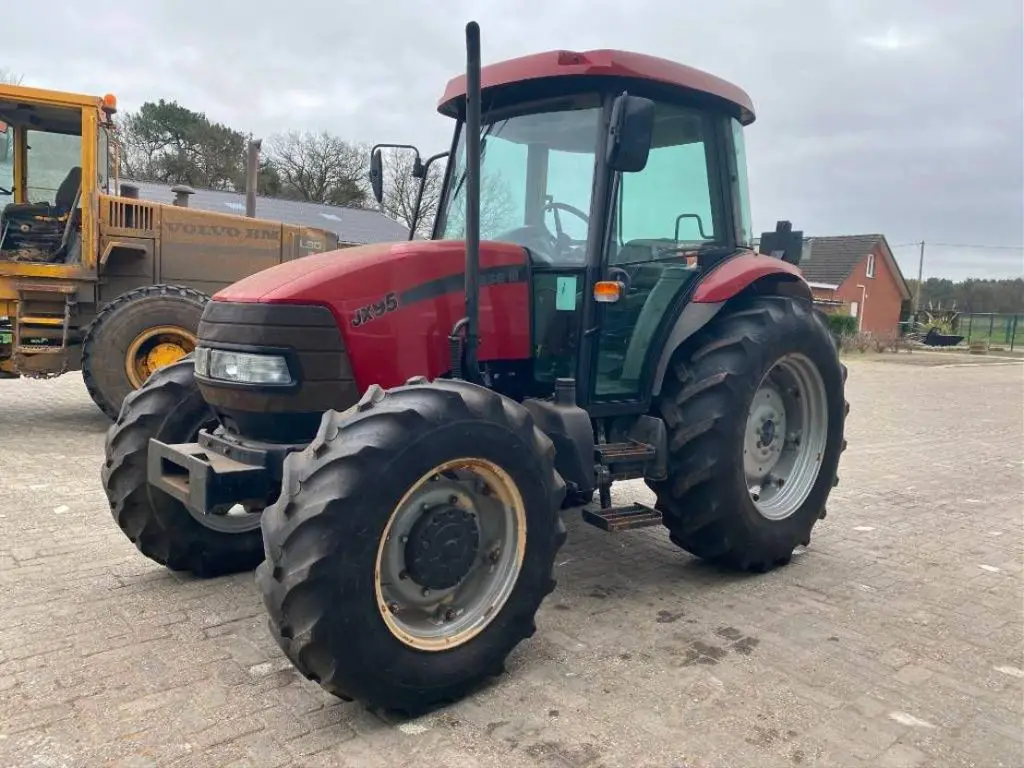
The Case IH JX95 is a dependable, no-frills utility tractor whose most common problems are not deep engineering flaws but a cluster of predictable, largely serviceable issues: a poorly accessed clutch cable that leads to premature clutch wear, stiff and easily damaged shuttle-shift linkage, hydraulic and selective-control-valve leaks, fuel-delivery and cold-start faults, load-related overheating, and cheap ancillary parts such as heater hoses and cable ends. This article explains, category by category, how those failures manifest, how to diagnose them, and what an owner or technician in the United States can do to fix and prevent them.

TL;DR
- The JX95's signature problems are maintenance- and access-related, not fundamental: the dry clutch fails prematurely mainly because its adjustment cable is almost impossible to reach, the shuttle linkage is stiff and breakage-prone, and the shared transmission-hydraulic-PTO oil system punishes neglected filters. Nearly all of these are diagnosable and fixable by a competent owner-technician.
- Match the machine to the work and stay ahead of service. The JX95 is well suited to light and moderate utility duty (feeding, mowing, loader chores, light tillage); owners who work it hard at its full rated output or who defer the awkward clutch adjustment are the ones who report expensive clutch and cooling failures.
- Three priorities prevent most failures: keep the shared transmission-hydraulic oil clean and full, keep the fuel system filtered, and keep clutch free play correctly adjusted. Proactively replacing the known-weak heater hoses and cracked cable ends eliminates most of the remaining common complaints.
Key Findings
- The JX95 was built for Case IH by Türk Traktör in Turkey; Tractor-Specs.net states the JX95 Maxxima "was manufactured by Turk Tractor for distributor Case IH in Turkey from 2002 to 2009." It is closely related to the New Holland TD95D and is the direct precursor to the later Case IH Farmall 95 / JXU line.
- The engine is a 3.9-liter (3,908 cm³, 238.5 cubic inch) Iveco/CNH four-cylinder turbocharged diesel with a 104.0 mm (4.09 inch) bore, 115.0 mm (4.53 inch) stroke, and 18.0:1 compression. Per Tractor-Specs.net, "this engine produced 94.4 PS (69.4 kW; 93.0 HP) at 2,500 rpm of output power," and its independent PTO is rated 80.0 hp (59.7 kW) per TractorGearbox technical data.
- The clutch complaint is the most-discussed issue. A 2007 JX95 cab owner on Yesterday's Tractors reported the pedal "is very stiff and I measured that it takes 180 pounds of pressure to fully depress it. That is with a bathroom scale between the pedal and foot." Multiple owners also found the clutch linkage was installed backwards at the factory.
- Owner sentiment is genuinely split. One long-term TractorByNet owner called the machine "no frills, comfortable, reliable and no computer," while a Kansas owner of a used 2008 unit reported "a new Hydraulic pump and a new clutch. Plus a few other minor items. Total repair costs so far in excess of $7,000," concluding that "repairs have been frequent and expensive."
- The transmission, hydraulics, and PTO share a single 46-liter (12.15 US gallon) oil sump, so clean oil and filters are the highest-leverage preventive measure on the whole tractor.
Background: What the JX95 Is and Where It Came From
The Case IH JX95 belongs to the JX "Maxxima" series of utility tractors and was built for Case IH by Türk Traktör (a CNH joint venture) in Turkey from 2002 to 2009, per Tractor-Specs.net. The tractor is closely related to the New Holland TD95D of the same era, and the JX series is the direct precursor to the later Case IH Farmall 95 / JXU line, all of them sharing CNH platforms derived from Fiat and New Holland designs.
The JX95 is powered by an Iveco/CNH four-cylinder turbocharged diesel engine. The unit is commonly identified on machine plates as an Iveco 8045-series engine (dealer listings cite, for example, "Iveco 8045.25L.939 4 cylinder turbo diesel"); its displacement is listed by Tractor-Specs.net as 3.9 liters (3,908 cm³, 238.5 cubic inches), with a 104.0 mm (4.09 inch) bore and a 115.0 mm (4.53 inch) stroke, an 18.0:1 compression ratio, and, per the same source, 94.4 PS (69.4 kW; 93.0 HP) at 2,500 rpm. (Some specification aggregators, such as TractorGearbox, list a larger 4.49-liter / 274-cubic-inch figure under a "JX95" heading; that displacement actually belongs to the later, different Case IH JXU95 utility model and should not be applied to the 2004-2009 JX95.) The engine drives the rear wheels through a dry-disc clutch and, on most units, a 12-forward/12-reverse mechanical (synchronized) shuttle transmission; a 20-forward/12-reverse creeper arrangement was optional. The tractor was offered in 2WD and mechanical front-wheel-drive (MFWD/MFD) configurations, with a two-post ROPS open station or an optional cab, and was frequently sold with a front loader.
The JX95 uses an open-center hydraulic system, a shared rear-transmission/hydraulic/PTO oil sump, hydrostatic power steering, an independent (mechanically clutched) PTO rated at 80.0 hp with 540/540E or 540/1000 speeds, and a Category II three-point hitch. Understanding these systems is central to diagnosing the problems below, because the JX95 shares one oil supply among the transmission, hydraulics, and PTO, and relies heavily on cables and linkages rather than electronics.
Owner sentiment, gathered from forums such as TractorByNet, AgTalk (New Ag Talk), Red Power Magazine, Yesterday's Tractors, The Combine Forum, and Hay & Forage Forum, is genuinely mixed. Many owners describe the JX95 as a comfortable, simple, computer-free machine that does light-to-moderate work well; others report frustrating early-life failures and poor factory quality control. One long-term owner on TractorByNet summarized the machine as "no frills, comfortable, reliable and no computer," while a Kansas owner of a used 2008 JX95 warned that "repairs have been frequent and expensive." Both perspectives are represented fairly throughout this article.
Engine Starting and Performance Problems
Symptoms
- Engine cranks but will not start, or starts then dies after a few seconds.
- Hard starting when cold that improves once the engine is warm.
- White smoke on cranking, rough idle for the first several minutes, then smoothing out.
- Loss of power under load; black smoke under heavy pull.
- Engine that runs, then stalls intermittently and restarts after the fuel system is bled.
- A fuel shut-off solenoid that audibly clicks at the injection pump when the key is turned, yet no fuel reaches the injectors.
Causes
The JX95's Iveco diesel is mechanically injected, without an engine computer, so most starting and running faults trace to the fuel-delivery system, the cold-start aids, or basic electrical supply. Common causes include a clogged fuel filter or water-contaminated fuel; air entering the suction side of the fuel system through a loose fitting, a seeping fuel-tank pickup, or a failed O-ring; a weak or failed fuel lift (transfer) pump; a fuel shut-off solenoid on the injection pump that clicks but does not actually open or deliver fuel; worn or poorly adjusted injectors; and, for cold-start complaints, failed glow plugs, a failed glow-plug relay or timer, or fuel drainback while the tractor sits. Power loss under load usually points to a restricted air filter, a clogged fuel filter, tired injectors, an injection-pump timing or calibration problem, or a failing turbocharger.
Troubleshooting Steps
- Establish when the problem occurs. Cold-only difficulty points to glow plugs, battery, or oil viscosity; difficulty only after the machine has sat points to fuel drainback; difficulty in all conditions points to injectors, compression, or timing.
- Check the cheap items first. Confirm the fuel filter age and condition and replace it if in doubt; a restricted filter is the most common and least expensive cause of hard starting and power loss. Drain any water from the filter/separator.
- Bleed the fuel system and watch whether the engine starts and then dies. If bleeding restores running temporarily but the fault returns, suspect air being drawn in on the suction side or a failing lift pump.
- Verify the fuel shut-off solenoid actually opens. As one heavy-equipment technician advised a JX95 owner on JustAnswer, hearing the solenoid click "does not guarantee that it is functioning properly." Confirm 12 volts at the solenoid and confirm fuel flow; a stuck solenoid can be temporarily removed and reinstalled as a "dummy" to test (with the understanding that the engine must then be stopped by shutting off fuel).
- Confirm fuel reaches the injectors by cracking an injector line during cranking.
- Test the cold-start system. Check for battery voltage at the glow-plug bus bar during the preheat cycle; test individual glow plugs for resistance (a good plug typically reads a low resistance, and an open circuit indicates a burned-out plug).
- Check the air filter and intake before condemning fuel components for a power-loss complaint.
- If fuel, air, and cold-start systems are sound, have the injectors tested and, if necessary, matched to the pump, and check injection-pump timing.
Solutions
Replace the primary and secondary fuel filters on schedule and use clean fuel; on this platform a clean filter frequently resolves both hard starting and power loss. Repair air leaks on the suction side and replace failed O-rings or a seeping tank pickup. Replace a weak fuel lift pump (the same CNH pump is shared with New Holland TD/TL models, so parts are widely available). Replace a defective fuel shut-off solenoid. For cold-start faults, replace failed glow plugs and, if the plugs are good but not energizing, replace the glow-plug relay/timer. For chronic drainback, address leaking injectors or a failed check valve in the injection pump. Have injectors rebuilt or replaced and pump timing reset by a diesel injection shop where atomization is poor. Because this is a mechanically injected engine, most of these repairs are within reach of a competent owner-technician, and there is no electronic control module to fault.
Clutch and Shuttle Shift Problems
This is the single most frequently discussed problem area for the JX95, and it has two distinct dimensions: a genuine design/access weakness in the clutch cable, and damage-prone shuttle-shift linkage.
Symptoms
- Clutch pedal extremely stiff and tiring to operate; a 2007 JX95 cab owner on Yesterday's Tractors reported it "is very stiff and I measured that it takes 180 pounds of pressure to fully depress it. That is with a bathroom scale between the pedal and foot."
- Clutch that engages only near the very top of pedal travel, or that will not fully disengage, making shifting difficult.
- Clutch slip: as one used-JX95 owner described on TractorByNet, "at 600 hrs I am now having trouble with no power to wheels after tractor warms up. It will barely untrack in third range 1st gear… the tranny does not get hot and there is no smell."
- Shuttle (forward/reverse) lever that is stiff, notchy, or that has physically broken off at its base.
- Transmission oil found on the clutch disc after a bell-housing seal failure.
Causes
Several causes recur across owner reports. First, the clutch cable and its adjustment yoke are located high up between the transmission and fuel tank and are extremely difficult to reach; as the dry clutch wears, free play is lost, and because the adjustment is nearly inaccessible, owners let it go until the clutch slips, glazes, and fails prematurely. Several TractorByNet owners reported that the clutch linkage was actually installed backwards at the factory — one wrote, "The other problem we had was that the clutch linkage adjustment was installed backwards!!" Second, the mechanical shuttle uses a cone clutch / synchronizer to match forward and reverse; shifting direction without coming to a full stop (a temptation during loader work) wears the synchronizers and can also stress the clutch. Third, the shuttle-shift linkage is a long, complicated path that arrives from the factory lightly lubricated and sometimes corroded, so it becomes stiff and the lever can snap off at the base. Fourth, a failed seal between the transmission and clutch can leak oil onto the dry clutch disc, causing grabbing or slip. Fifth, the stiff-pedal complaint can arise from a binding throw-out bearing or dry linkage pivots.
Troubleshooting Steps
- Measure clutch free play at the pedal and compare to specification. As a general tractor guideline, look for roughly 1 to 1.5 inches of free travel before resistance; loss of free play signals a needed adjustment or a worn clutch.
- Lubricate every pivot in the clutch and shuttle linkage and re-check operation; multiple owners found that dry or corroded pivots, not internal damage, caused stiffness. One JX95 owner was advised simply to "check all the pivots on the linkage for lubrication."
- Inspect the clutch cable routing and yoke to confirm it was assembled correctly and is not installed backwards.
- For slip under load, confirm whether the transmission runs hot or smells burnt (clutch slip typically does not overheat the gearbox). Attempt to restore free play; if adjustment cannot be reached or restored, plan for clutch replacement.
- For a broken shuttle lever, inspect the lever base and the cone-clutch/synchronizer action.
- For oil on the clutch, confirm the source is the bell-housing/transmission seal.
Solutions
Adjust clutch free play promptly and regularly; the practical difficulty is access. Some owners have resorted to cutting a small access hole in the cab floor to reach the clutch-cable yoke — an indication of how poor the factory access is, and something to weigh before buying a cab model. Lubricate the shuttle and clutch linkage thoroughly and periodically; owners suggested that the linkage "could use bearing type connectors" to resist the corrosion and stickiness that appears after shipping. A broken shuttle lever can be welded and reinstalled. A glazed or oil-contaminated clutch, or one worn past adjustment, requires splitting the tractor to replace the clutch disc, pressure plate, throw-out bearing, and pilot bearing as a set; because the independent PTO clutch is integrated into the same main clutch assembly, a PTO-clutch repair also requires a split, so it is prudent to service both at once. Replace the leaking transmission-to-clutch seal during any split. To prevent synchronizer and clutch wear, come to a full stop before reversing direction, especially during loader work.
Hydraulic System Problems
Symptoms
- Weak or absent hydraulic pressure; three-point hitch or loader lifts slowly, will not lift rated loads, or drifts down.
- Loader that "gets air" and will not hold position on the bucket curl, requiring the operator to recycle the function.
- Loader bucket with hydraulic "slop" that must be taken up.
- "Low transmission pressure" warning when running a PTO-driven implement such as a trailer pump.
- Complete loss of hydraulic performance in severe cases.
Causes
The JX95 uses an open-center hydraulic system that shares its oil with the transmission and PTO in one rear sump. The most common causes of weak hydraulics are a clogged hydraulic/suction filter or screen, low or contaminated oil, and worn pumps. A minority of owners reported severe, repeated hydraulic-pump failures — in one extreme case, a TractorByNet poster helping on a grandfather's ranch said two new JX95 tractors had each had hydraulic pumps replaced roughly three times in two years — but the more experienced consensus on the forums is that most JX hydraulic trouble is "user inflicted or maintenance related," typically neglected filters and oil. The loader "air" and drift complaints stem partly from valve/coupler leakage and from the absence of a regeneration circuit in the loader valve. Low-pressure warnings when driving an external pump usually reflect the shared-sump pressure being drawn down and a marginal filter or oil condition.
Troubleshooting Steps
- Check hydraulic/transmission oil level and condition first, using the correct fill point (owners note the fill hole is awkwardly placed). Look for milky oil (water contamination) or metal.
- Inspect and replace the hydraulic filter and clean the suction screen; a clogged filter is the first suspect for low pressure.
- Attach a pressure gauge at the appropriate test port and compare readings to the service-manual specification to distinguish a pump problem from a filter/oil problem.
- For drift or a bucket that will not hold, isolate whether the leak is at the SCV spool, the quick-couplers, or the cylinder seals (see the SCV section below).
- For the low-pressure warning on PTO pump duty, verify oil level, filter condition, and that engine rpm is adequate; confirm the warning clears as rpm rises.
Solutions
Restore the correct oil level with the specified Case IH transmission-hydraulic fluid (Akcela/Hy-Tran type), replace the hydraulic filter, and clean the screen. If pressure remains low after clean oil and a new filter, test and, if necessary, rebuild or replace the hydraulic pump. Address loader valve leakage and couplers as described below. Because the transmission, hydraulics, and PTO share one oil supply, disciplined oil and filter service is the most cost-effective way to prevent hydraulic failures on this tractor.
Hydraulic Remote (SCV) Problems
Symptoms
- Selective control valve (SCV) remotes leaking oil externally at the couplers.
- Implements that lower or drift on their own (valve leaking internally past the spool).
- An auxiliary-hydraulic button on the loader joystick that intermittently fails to work.
- Slow or weak remote functions.
Causes
External leaks on the JX95's remotes most often occur at the quick-connect couplers, which weep and lose oil; several owners simply replaced the couplers. Internal leakage (self-lowering or self-raising implements) indicates worn spool seals or valve seats inside the SCV. Intermittent auxiliary function on the loader joystick suggests an electrical switch or connector fault in the loader control circuit.
Troubleshooting Steps
- Locate the leak precisely — coupler face versus valve body versus spool. Wipe clean, operate the function, and observe.
- Distinguish external from internal leakage. External leaks show as visible oil; internal leaks show as an implement that drifts or lowers on its own even with no external oil loss.
- Inspect the couplers for face damage, worn O-rings, and trapped debris.
- For intermittent joystick auxiliary function, check the switch, wiring, and connectors.
Solutions
For leaking couplers, replace them; one JX95 owner replaced all of his remotes' couplers with Stucchi "push-pull, connect-under-pressure" couplers to cure both the leaks and the difficulty of connecting under residual pressure. (Choosing flat-face couplers would have required changing the mating male fittings on every implement, which is why matching the existing style is often the practical choice.) TractorByNet For internal valve leakage, rebuild the SCV with the available seal kit or replace the valve; this work is easier with the valve removed from the tractor. Repair or replace the loader-joystick auxiliary switch or its wiring for intermittent operation.
PTO and 3-Point Hitch Problems
Symptoms
- PTO that will not engage, or a floor engagement arm that will not move.
- PTO that turns for a few seconds, stops, then starts again while working (intermittent engagement) under load, for example while baling.
- PTO shaft that freewheels under load — it turns by hand with the lever engaged, but will not carry even a light load.
- Broken plastic end on the PTO control cable, allowing the PTO clutch to slip.
- Three-point hitch that lifts slowly or will not hold heavy implements (overlaps with the hydraulic section).
Causes
The JX95's PTO is an independent, mechanically clutched unit whose clutch is integrated into the main clutch assembly, with a separate plate for the PTO operating against the flywheel. The PTO is controlled by a cable that must retain enough free play to keep pressure on the PTO clutch. The recurring causes are: a PTO control cable with the wrong free play (or a broken plastic cable end) that lets the clutch slip; worn PTO clutch friction plates or weakened springs, causing freewheeling or intermittent drive under load; and binding or misaligned engagement linkage that jams the floor lever. Because the PTO clutch is part of the main clutch pack, a worn PTO clutch cannot be reached without splitting the tractor.
Troubleshooting Steps
- Check the PTO control cable and its free play first. As one technician asked a JX95 owner, does the cable "have slack, preventing it from keeping the fingers off the pressure plate?" Verify the cable is intact (no broken plastic end) and correctly adjusted.
- Inspect the engagement linkage for binding, corrosion, or misalignment if the floor arm will not move; do not force it.
- Test engagement behavior: freewheeling under load with the lever engaged, after confirming correct cable adjustment, points to the internal PTO clutch. As the JustAnswer technician concluded with one owner whose shaft freewheeled, once the cable and adjustment were ruled out, "the tractor needs to be split."
- For intermittent PTO drive, confirm oil/filter condition (a common first step is to change the hydraulic filter), then suspect the PTO clutch friction plates and springs.
- For the three-point hitch, follow the hydraulic-system troubleshooting.
Solutions
Adjust or replace the PTO control cable and set the correct free play; this cures many slip and engagement complaints cheaply. Free up and realign binding linkage. If the PTO clutch itself is worn — freewheeling under load despite a correct cable, or intermittent engagement traced to the clutch — the tractor must be split to replace the PTO clutch friction plates, and it is efficient to service the main drive clutch at the same time. Multiple owners noted that a factory-known weakness in the plastic PTO cable end can, if it fails unnoticed, let the PTO clutch slip and cause further wear, so replacing a cracked cable end promptly is important. For hitch lift capacity, maintain correct hydraulic oil and filter condition.
Electrical and Safety Switch Problems
Symptoms
- Complete loss of cab electrical functions: no lights, no gauges, no horn, no radio, even with fuses apparently intact.
- Temperature gauge (or other gauge) that does not read even though power is present at the sender and the gauge.
- A loud buzzer/horn that sounds intermittently — at start-up, shutdown, or while driving — related to the parking-brake circuit. Hay & Forage Forum
- Battery drain when parked.
- Engine that will not crank (starter does not engage).
- Headliner/roof electrical connectors that will not stay connected.
- A steering-fluid reservoir that repeatedly melts and loses fluid.
Causes
The JX95's electrical faults are overwhelmingly wiring, connection, and switch problems rather than module failures, because the tractor has no engine computer. A total loss of cab accessories typically comes down to a single small fuse (a 10-amp fuse feeds those functions) or corrosion/damage in the fuse panel or a harness connector feeding it. Non-cranking faults trace to the battery, cables, ground connections, starter, or a safety interlock. Like most modern tractors, the JX95 uses safety switches (seat, clutch/neutral) that must be satisfied to crank and to operate the PTO; a faulty switch or its wiring can prevent starting or cause nuisance behavior. The intermittent buzzer is the parking-brake/key-off alarm behaving abnormally. Hay & Forage Forum Loose headliner connectors are a noted quality issue. The melting steering reservoir is an unusual reported fault most plausibly caused by heat from a nearby component or a routing problem.
Troubleshooting Steps
- For total accessory loss, start at the battery terminals and grounds, checking for corrosion and looseness, then test the specific accessory fuse for power on both sides with the key on. Power on one side only indicates a blown fuse; no power at all indicates an upstream fuse-panel or harness fault.
- Inspect harness connector pins for corrosion and spread/damaged terminals, especially the connector feeding the accessory fuse.
- For a dead gauge, if power is present at both sender and gauge, suspect the gauge/cluster ground or the cluster itself (one owner found a replacement cluster still did not read, pointing to a circuit/ground issue).
- For no-crank, load-test the battery, clean grounds, and check the safety interlocks (seat and clutch/neutral switches) and their wiring.
- For the buzzer, confirm parking-brake switch operation and its wiring.
- For battery drain, perform a parasitic-draw test with a multimeter on the disconnected negative cable.
Solutions
Replace blown fuses and, more importantly, repair the underlying corroded or damaged harness connectors and grounds that cause them; clean and protect terminals to prevent recurrence. Replace faulty safety switches and repair interlock wiring rather than bypassing them — bypassing a clutch/neutral or seat switch removes a protection designed to prevent the tractor from starting or moving unexpectedly and is dangerous. Replace failed gauges or repair cluster grounds. Secure or replace loose headliner connectors with tighter units. For the melting steering reservoir, identify and eliminate the heat source or re-route/insulate the reservoir, and use the correct reservoir part. Address the parking-brake alarm switch rather than disconnecting the battery ground as a workaround (a habit one seller had adopted, which itself caused inconvenience and did not fix the fault).
Cooling System Problems
Symptoms
- Engine that runs cool during light work (loader, mowing) but overheats within roughly 15 minutes when pulling a heavy draft load such as a disc harrow.
- Coolant loss and overheating traced to failed heater hoses.
- Overheating on a machine delivered or operated without a thermostat installed.
- Gradual coolant loss with no obvious external leak.
Causes
Load-dependent overheating (cool at light work, hot under draft) most often reflects reduced cooling capacity that only shows up when heat load is high: an internally clogged or scaled radiator, a slipping fan belt at high engine speed, a worn water pump, or a marginal thermostat. Several JX95 owners reported that the factory heater hoses are poor quality and leak early; a JX95/JX80 owner on TractorByNet's "CaseIH JX Series Durability" thread wrote that the heater hoses "leak like a screen door on a submarine … kinda sorry material and pitiful quality. CaseIH should be ashamed." Replacing them on a cab tractor is awkward because a rubber plug at the cab pillar base can bind against the fuel tank, sometimes requiring partial fuel-tank removal. A tractor operated without a thermostat (as one buyer discovered on a used unit) can actually run hotter under load, because coolant can move through the radiator too quickly to be cooled properly and flow distribution suffers.
Troubleshooting Steps
- Confirm coolant level and check for a thermostat actually being installed and functioning.
- Check the fan belt tension at high engine speed; a belt that grips at low rpm can slip under full load. Inspect the crankshaft pulley groove for a worn, shiny flat that lets a narrow belt bottom out and slip.
- Assess radiator airflow and internal condition. Blow out external chaff first. To gauge internal circulation, feel the heat of the air coming through the radiator at part throttle on a hot engine — strong, hand-burning heat suggests good internal flow, while only mild warmth suggests an internal circulation problem (a clogged/scaled radiator or weak water pump). An infrared thermometer comparing inlet and outlet temperatures can confirm.
- Inspect heater hoses and all connections for leaks, especially as the engine warms and hoses expand.
- Rule out combustion-gas intrusion or an internal leak if coolant disappears with no external evidence.
Solutions
Install a correct thermostat if one is missing. Replace or properly tension the fan belt, and replace a worn crankshaft pulley if the belt bottoms out. Have the radiator professionally cleaned (rodded) internally or replace it if it is scaled or clogged; radiators for this machine are relatively expensive and ship poorly, so a local radiator shop cleaning is often the first move. Replace a worn water pump if flow is inadequate after the radiator and belt are addressed. Replace the poor-quality heater hoses with better material, accepting that partial fuel-tank removal may be needed on a cab unit, and check clamps carefully after refilling. Maintain a proper 50/50 coolant mix.
Steering and Front Axle Problems
Symptoms
- Loss or weakness of power steering.
- Steering wheel that does not turn the wheels properly.
- Chronic cracking/knocking noise from the MFWD front axle while driving.
- Repeatedly failing (melting) steering-fluid reservoir with fluid loss (also noted under electrical).
Causes
The JX95 uses a hydrostatic power-steering circuit. Weak steering points to low steering-circuit fluid, a worn steering pump, or a defective steering unit. A steering wheel that turns without steering the tractor points to the steering gear/orbital unit or linkage. Front-axle cracking noises on MFWD units point to worn bearings or a failed gear in the front drive, consistent with the general reports of variable factory quality control.
Troubleshooting Steps
- Check steering-circuit fluid level and condition.
- Assess steering effort and response to separate a pump problem from a steering-unit problem.
- For front-axle noise, inspect front-axle oil level and listen to localize the noise to bearings or gears.
Solutions
Top up or replace steering-circuit fluid with the specified fluid. Replace a worn steering pump or repair the steering unit as indicated. For front-axle noise, replace worn bearings or damaged gears; maintain correct front-axle oil levels. Address the steering-reservoir melting fault by eliminating the heat source and fitting the correct part.
Oil Leaks and Minor Quality Issues
Symptoms
- Several small engine and driveline oil leaks, often visible early in the tractor's life.
- Fuel-tank seepage.
- Cheap hood latch that does not work well; hood gelcoat dulling quickly.
- Air-conditioning that loses charge over a few months; a non-working radio speaker.
Causes
These are largely fit-and-finish and quality-control issues reported repeatedly by owners of Turkish-built JX units, consistent with the tractor's economy positioning. As one AgTalk owner put it, there seemed to be "more little things going wrong for that new a tractor." The engines themselves are generally regarded as reliable even when the tractor "has some leaks."
Troubleshooting Steps
- Locate each leak and determine whether it is a seal, gasket, or fitting.
- Prioritize leaks that lose fluid quickly or contaminate the clutch, brakes, or belts.
Solutions
Address seeping fittings and seals as they appear; re-torque fasteners early in the tractor's life (owners recommend going over the whole machine with a wrench at about 50 hours, as the operator's manual itself advises checking and retightening bolts). Repair fuel-tank seepage, replace the hood latch, and recharge the A/C after finding the leak. Most of these are inexpensive individually but collectively shape the ownership experience.
Model-Year and Variant Differences
Several differences across JX95 configurations affect which problems an owner is likely to encounter:
- Transmission choice (shuttle versus none). The JX95 was sold with a 12×12 mechanical synchro shuttle and, optionally, a 20×12 creeper. Some economy units were configured without a convenient shuttle, and owners repeatedly said that if they bought again they "would look for one with a shuttle shift." The shuttle units bring the synchronizer-wear and broken-lever risks discussed above, while non-shuttle units avoid those but are less convenient for loader work. A closed-center hydraulic and power-shift package cost more; the base JX is described by owners as having "clumsy" actions compared with up-optioned models.
- 2WD versus MFWD. MFWD units add the front-drive axle, which introduces the front-axle bearing/gear noise complaints; 2WD units avoid that failure mode but are less capable with a loader. Owners widely regard 4WD as "a must" if a loader is fitted.
- Cab versus open station (ROPS). Cab units are praised for comfort and a large, well-lit interior, but the cab dramatically worsens access to the clutch cable (leading some owners to cut the cab floor to adjust it) and complicates heater-hose replacement. Open-station units are easier to service in those respects.
- Loader-equipped units. Loader tractors concentrate several of the JX95's problems: synchronizer and clutch wear from shuttle shifting without full stops, loader-valve "air"/drift and coupler leaks, and hydraulic-pump load. They also benefit most from MFWD and rear ballast.
- Early versus later build; pedal design. Owners note that Case IH revised the JX line over its run, including a change from through-the-floor pedals on earlier units to hung pedals on later ones, and that the later Farmall/JXU tractors that replaced the JX are generally considered improved. Build quality reportedly varied unit to unit regardless of year, so individual inspection matters more than model year alone.
Across all variants, forum consensus is that the JX95 is well suited to light and moderate utility work — feeding, mowing, loader chores, light tillage — but is stressed by sustained heavy field work at its full rated horsepower, where clutch and cooling complaints concentrate.
Preventive Maintenance and Recommended Servicing
The JX95's problems are disproportionately maintenance- and access-related, so disciplined preventive care is the highest-value thing an owner can do. The following intervals and capacities are drawn from the Case IH JX-series service and operator documentation and reputable lubricant guides; always confirm against the operator's manual for your specific serial number, and note that intervals should be shortened for severe-duty, dusty, or heavy-load operation.
First 50-hour break-in service. The operator's manual (publication 6-62660) includes a dedicated "First 50-hour Service." At break-in, change the engine oil and filter, change the transmission/hydraulic oil and filter and clean the suction screen, check front-axle oil, and — as owners strongly recommend and the manual notes — go over the entire machine and re-torque bolts, several of which are commonly found loose when new.
Engine oil and filter. Capacity is 11.2 liters (about 2.96 US gallons) with the filter on the JX80/JX90/JX95 engine, confirmed in the OEM service-manual consumables table, using an Akcela No. 1-type API CH-4 engine oil. Change engine oil and filter at approximately 300-hour intervals (and at least annually), shortening the interval for dusty or heavy work. (Note that the later JXU generation moved to a 600-hour engine-oil-filter interval; for the 2004-2009 JX95 the model-specific 300-hour figure is the more appropriate guide.)
Transmission / hydraulic / PTO oil and filter. This is the tractor's most important shared system. The combined rear transmission, gearbox, hydraulic lift, and PTO sump Slideshare holds 46 liters (12.15 US gallons), per the OEM service manual, using the specified Akcela transmission-hydraulic fluid (Hy-Tran-type, API GL-4, ISO 32/46, SAE 10W-30). Service the hydraulic/transmission filter and screen at roughly 300-hour intervals and change the oil at approximately 1,200 hours or 24 months. Because hydraulics, transmission, and PTO all draw from this sump, keeping this oil clean and full directly prevents hydraulic-pressure, SCV, and PTO complaints.
Fuel filters. Replace the fuel filter(s) at approximately 600-hour intervals, and sooner if starting or power problems appear; drain water from the separator regularly. Given how many JX95 starting and power complaints trace to fuel filtration, err toward more frequent changes.
Air filter. The tractor uses a dual dry-cartridge air cleaner with a restriction indicator. Service the outer element when the indicator shows or at roughly annual/1,200-hour intervals, and replace the inner (safety) element on a similar schedule; do not neglect it, since a restricted filter causes power loss and black smoke.
Cooling system. Cooling-system capacity is 14 liters (about 3.7 US gallons) without a cab or 16 liters (about 4.2 US gallons) with a cab, per the OEM service manual, using a 50/50 Akcela Premium anti-freeze mix. Inspect the radiator, hoses, fan belt, and coolant condition regularly; proactively replace the known-weak heater hoses before they fail; keep the radiator core clean externally and have it cleaned internally if load-related overheating appears.
Clutch linkage adjustment. Check and adjust clutch free play on a regular schedule — this is the preventive step most directly tied to the JX95's signature clutch failures. Lubricate all clutch and shuttle linkage pivots frequently. If access to the clutch-cable yoke is impractical on a cab unit, arrange a means of reaching it (rather than deferring adjustment until the clutch slips and fails).
Steering, loader, and grease points. Grease all fittings on the schedule in the lubrication chart, paying particular attention to steering linkage, front-axle pivots and spindles, loader pins, three-point hitch pivots, and PTO/driveline bearings, which carry high loads. Use an NLGI 2 multipurpose grease.
Electrical connections. Periodically clean and protect battery terminals and grounds, and inspect harness connectors — especially the fuse-panel feeds and headliner connectors — for corrosion and looseness, since these cause the tractor's common no-power and nuisance-alarm faults. Batteries typically last three to five years; replace a battery that cranks slowly or will not hold a charge.
Following this schedule, and above all keeping the shared transmission-hydraulic oil clean, the fuel system filtered, and the clutch properly adjusted, addresses the large majority of the problems that owners actually report.
Recommendations
The JX95 is best understood as an honest economy utility tractor: mechanically simple, comfortable, and repairable, but built to a price with variable quality control and a few genuinely poor design choices around clutch access and cheap ancillary parts. Owners who match it to light-to-moderate duty and who stay ahead of maintenance are generally satisfied; owners who work it hard at full horsepower or who defer the awkward clutch adjustment are the ones who report expensive failures.
Staged recommendations:
- Before buying a used JX95, budget an inspection focused on the known weak points: clutch free play and engagement, evidence the clutch has been or needs to be replaced, shuttle-lever integrity, hydraulic lift performance and SCV/coupler leaks, PTO engagement under load, cooling behavior under draft load, and the condition of harness connectors and heater hoses. Be especially skeptical of a unit priced far below comparable machines; as one experienced buyer cautioned, an unusually low price usually means "something isn't right with this tractor." Hay & Forage Forum Verify whether it is a cab unit (harder clutch access) and whether it has a shuttle.
- In the first 50 hours of ownership (or immediately on a used purchase), perform the full break-in service, re-torque fasteners, confirm the clutch linkage is correctly installed and adjusted, lubricate all clutch and shuttle linkage, and change all fluids and filters if history is unknown.
- Ongoing, hold the shared transmission-hydraulic oil, the fuel filtration, and the clutch adjustment as your top three priorities, and proactively replace the heater hoses and any cracked PTO/clutch cable ends before they fail.
- When a clutch or PTO clutch repair becomes necessary, service the entire clutch pack (drive clutch, PTO clutch, throw-out and pilot bearings, and the transmission-to-clutch seal) in one split, because the PTO clutch is integral to the main clutch and re-splitting is costly.
Thresholds that should change your plan: repeated hydraulic-pump failure after you have confirmed clean oil and filters, low measured hydraulic pressure at the test port with a new filter and correct oil, front-axle gear noise, or main-bearing/engine noise are signals to escalate from routine maintenance to major repair or to reconsider keeping the machine. Conversely, if the common complaints (stiff/dry linkage, dirty filters, missing thermostat, leaking couplers, corroded connectors) are addressed, the JX95 typically returns to dependable light-and-moderate-duty service.
Caveats
- Much of the problem-frequency information in this article is drawn from owner forums (TractorByNet, AgTalk/New Ag Talk, Red Power Magazine, Yesterday's Tractors, The Combine Forum, Hay & Forage Forum) and from technician question-and-answer threads (JustAnswer). These are illustrative of real-world experience but are not a statistically representative survey; individual results vary, and some reports reflect abused or poorly maintained machines.
- Specification figures were cross-checked against TractorData-type aggregators, the Nebraska Tractor Test Laboratory summary (S463), and Case IH JX-series service/operator documentation. Where aggregator sites conflicted (notably a 4.49-liter/274-cubic-inch engine figure that actually belongs to the later, different Case IH JXU95 model), this article follows the JX95-specific service-manual data of a 3.9-liter Iveco/CNH four-cylinder engine.
- Maintenance intervals are best-available figures from service/operator documentation and reputable lubricant guides; capacities are OEM-confirmed, but a few interval numbers are corroborated from the closely related JXU generation and should be confirmed against the operator's manual for your exact serial number before use.
- Any repair that requires splitting the tractor, working on the hydraulic system under pressure, or servicing the fuel injection system should be undertaken with appropriate training and safety precautions, including relieving hydraulic pressure and disconnecting the battery as the service manual directs.