
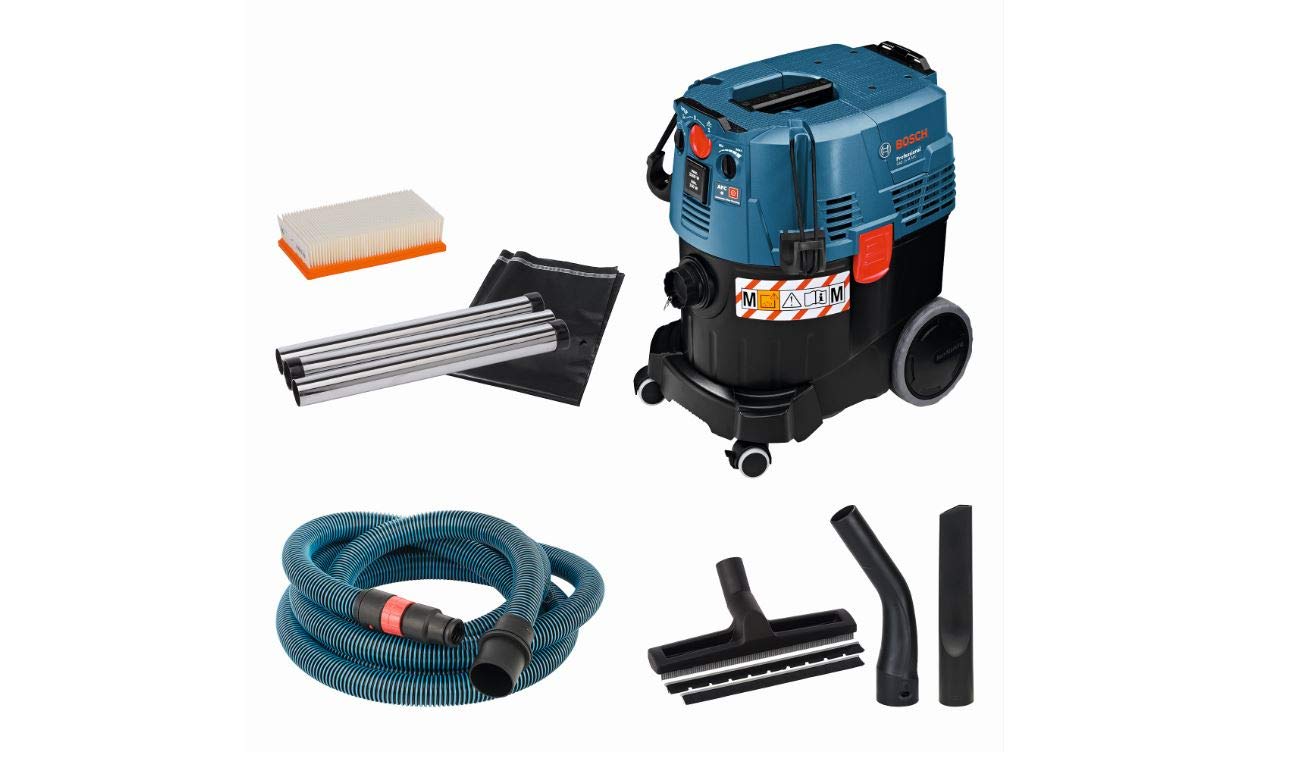
The Bosch GAS 35 M AFC Professional dust extractor represents the pinnacle of professional-grade dust extraction technology. This powerful M-class vacuum with automatic filter cleaning (AFC) is designed to meet the demanding needs of contractors, woodworkers, and construction professionals who require superior dust control and OSHA-compliant filtration. With its impressive 1200W motor delivering 254 mbar vacuum pressure and approximately 1110 CFM airflow, combined with HEPA-grade filtration that captures 99.9% of particles as small as 1 micron, the GAS 35 M AFC is built to handle everything from fine silica dust to coarse construction debris.

The standout feature of this dust extractor is its automatic filter cleaning system, which pulses the flat pleated filter every 15 seconds to knock off accumulated dust and maintain consistent suction power throughout extended work sessions. This innovative AFC technology, combined with the 35-liter capacity tank, tool-activated auto-start outlet, and M-class certification, makes it an attractive choice for professionals who demand reliability and performance on the jobsite.
However, like any sophisticated piece of equipment, the Bosch GAS 35 M AFC has its share of known quirks and issues that users have reported. From suction loss and filter seal problems to the sometimes-annoying automatic cleaning noise and compatibility challenges with various tool brands, understanding these common problems is essential for getting the most out of your investment.
This comprehensive troubleshooting guide addresses the most frequently reported issues with the Bosch GAS 35 M AFC dust extractor, drawing from real-world user experiences across forums like Reddit, Contractor Talk, and Sawmill Creek, as well as official Bosch support materials. We break down common problems into three categories – technical malfunctions, user complaints, and maintenance issues – and provide effective troubleshooting steps and solutions for each. We also compare the AFC model to its non-AFC variants and discuss compatibility with other tool brands and adapters, helping you make informed decisions about setup, usage, and long-term maintenance.
Table of Contents
1. Suction Loss and Poor Performance
The vacuum runs but suction is weak – for example, “more air coming out the exhaust than it is sucking in”. Users have noted that a cheap household vacuum had stronger suction than their GAS 35 M AFC in this state.
Causes
The most common causes are airflow leaks or clogs. Notably, if the flat filter is missing or not sealing, the vacuum will not develop proper suction. An air leak between the motor housing and filter can drastically reduce suction. (One user discovered the top cover of the filter housing and the AFC shaker mechanism were not sealing against the filter, creating a bypass leak.) A clogged hose or inlet, full dust bag, or clogged filter can also starve suction.
Solutions
Start with basic checks: ensure the dust bag is not overfilled, and inspect the hose and inlet for blockages, clearing any debris. Verify the power dial (Power Broker) is turned up for maximum suction. Next, check the filter installation – a filter must be present and seated correctly, as the AFC plunger requires the filter to form an airtight seal. If you suspect an air leak around the filter, a proven fix is to improve the gasket seal: for example, add a few layers of electrical tape or foam around the filter frame or on the mating surface to eliminate gaps. Multiple owners have reported this tape-seal trick immediately restored full suction by closing the air gap in the filter compartment. Always use the correct Bosch filter (or quality equivalent) – some aftermarket filters may be slightly undersized in thickness, causing a poor seal. Finally, if suction is still low, inspect the motor fan for built-up dust and ensure the automatic filter cleaning is functioning (see below).
2. Automatic Filter Cleaning (AFC) Malfunctions
The AFC system, which normally thumps the filter to clean it every 15 seconds, can misbehave. Two opposite issues are reported: (a) The filter-cleaning “thump” is overly frequent or will not stop, even with AFC turned off, or (b) the AFC does not seem to work at all (filter clogging too quickly). In case (a), users describe a constant rattling or banging noise “like it is trying to clean the filter… even while the AFC is turned off”, which is very frustrating. In normal operation, the AFC makes a loud “thump-thump” noise at intervals (Bosch spec is a pulse every approximately 15 seconds). Many find this startling or annoying – one owner said the vac “loudly smashes the filter clean every 15s”, and some were concerned it was a defect when it is actually by design.
Causes
If AFC is constantly triggering or making noise even in the “off” position, it points to a control fault – possibly a stuck solenoid valve or a sensor/electronic glitch in the AFC circuit. If AFC never seems to activate, ensure it has not been manually turned off (the red AFC disable button on the unit). Also note, very fine dust (for example, drywall or concrete) can overwhelm the filter such that the automatic pulses cannot fully keep up, leading to gradual clogging.
Solutions
For an overactive AFC (constant thumping): First try a power-cycle reset – turn the unit off, unplug, and clean the filter manually. Then re-engage AFC (press the button so the AFC LED is lit). If the thumping continues nonstop even with a clean filter and empty bag, the AFC mechanism may be faulty. Some users in this scenario had to get the unit serviced under warranty, as the control board or shutter valve could be malfunctioning. There is no user-accessible adjustment for the timing. As a workaround, you can run the vacuum with AFC turned off (use the manual filter-clean button periodically). In fact, many owners choose to disable AFC during use because of the noise – the GAS 35 M AFC has a front button to switch off auto-clean; you will just need to press it each time you power on, since it defaults to AFC on. When disabled, you can occasionally pulse the filter manually (if your model has a manual push-clean function, or by briefly covering the hose end to flex the filter). This avoids the constant banging at the expense of more frequent manual intervention.
For AFC not cleaning well enough: Ensure the AFC is actually activated (LED on). If it is on but the filter still clogs quickly, you might be generating an extreme volume of fine dust – consider using a fleece bag or a pre-separator (cyclone) to take load off the filter. The Bosch fleece bags (or a compatible reusable bag) will capture most dust before it hits the filter, greatly extending filter life and maintaining suction. Also verify the filter is not caked with hardened dust (if you ran a lot of gypsum or concrete dust without a bag, the pleats may have a coating that even AFC cannot shake off). In that case, remove the filter and clean it thoroughly: tap out the dust or use compressed air gently from the clean side (with PPE on), or wash it if it is a washable filter (PES filters are washable). Replace the filter if it is damaged or too clogged to recover. When functioning properly, the AFC is very effective at keeping suction high – it pulses the flat filter aggressively and can maintain near-maximum airflow even in heavy dust applications. Just remember that the thumping noise is normal during operation – a few owners have described it as startling but something you get used to. If you prefer a quieter experience, you might compare the non-AFC variant (more on that below).
3. Power Tool Auto-Start Outlet Issues
The onboard power outlet (for auto-starting the vacuum when a tool is plugged in) can be a source of confusion or problems. Complaints include: the vacuum trips the circuit breaker when a high-draw tool is used, the auto-start does not trigger reliably, or the outlet is not providing power. Users have noted that if you plug a very large tool (like a big miter saw) into the vac, the combined load can trip household breakers. In other cases, plugging certain tools in may start the vac even when the tool is off (this is reported on some other vac brands due to leakage current from tool electronics) – although this issue is more rare.
Causes
The GAS 35 series has two versions: models with Auto Clean (“A”) include a Power Broker dial that lets you allocate power between the vac and the tool, up to a combined 15A circuit. Models with Semi Clean (“S”) or certain 240V versions often have a fixed lower amperage limit (around 5.5A for the tool outlet). If that limit is exceeded, the outlet may not power the tool or may trip the breaker. A tool that draws too many amps can overload the vac’s internal circuit or your wall circuit. Another potential cause of auto-start failure is simply user error: the selector switch must be in the Auto position (not “On” or “Off”) for the tool-trigger to work, and the tool must be plugged into the correct socket. Also, check that the outlet’s fuse (if any) is not blown – Bosch dust extractors typically do not have a user-replaceable fuse for the tool outlet, but a severe overload could damage the electronics.
Solutions
Match the tool’s amperage to the vac’s settings. Before using the auto-on feature, confirm your tool’s amp rating. Bosch provides a Power Broker dial (on VAC090/140 series, equivalent to GAS 35) to adjust suction power and keep total draw under 15A (for 120V models). For example, if your saw draws 10A, you set the dial so the vac draws at most approximately 5A, keeping the total approximately 15A. If you do not have such a dial (some EU versions or “SFC” models), note that the tool outlet is limited (about 5.5A max tool load). Do not plug in a tool that exceeds that – it will trip the vac or wall breaker. In those cases, run the tool on a separate circuit and have a helper or remote switch to start the vac manually. If the vac and tool together still trip your breaker (for example, on a 16A or 20A household circuit) despite being within specs, you may need to plug them into separate circuits (one in a different outlet) as Bosch also advises, or lower the vac’s suction power during tool startup.
If the auto-start is not triggering at all, verify the basics: the vac is plugged in and switched to Auto (symbol showing plug+vac), and that the tool’s switch is actually “On” when testing. Some tools with very low current draw (like a small sander) might not generate enough load to trigger the sensor – but this is uncommon as even 1-2 amps should trigger it. If it still fails, this points to a defect in the outlet or control unit. In such case, professional repair is needed (Bosch service can replace the PCB or outlet module).
Tip: When using the auto-start, be aware the vacuum has a built-in run-on delay – when you turn your tool off, the vac will continue for approximately 5-15 seconds to clear residual dust in the hose. This is normal. Also, the tool outlet is only powered when the vac is turned to Auto (in “On” mode the outlet may be dead or live constantly depending on model). The outlet is intended for corded tools only – do not plug another vacuum or a daisy-chain of power strips into it. Keep the tool’s amps within the limits to avoid nuisance tripping.
4. Hose Blockages and Clogs
A blockage in the hose or vac inlet usually manifests as low suction and might even trigger the M-class vacuum’s alarm (a loud beeping) indicating a flow drop. The GAS 35 M AFC, being an M-class extractor, includes a flow sensor that beeps if airflow falls below a safe threshold. This alarm can sound if the hose is clogged or even if you block the nozzle fully for a moment. Users sometimes report the alarm going off frequently during ordinary vacuuming, which can be an annoyance (more on the alarm in Usability section).
Causes
Common culprits are large debris (chunks of wood, concrete pieces, packing material) stuck in the hose or at the inlet port, or a buildup of fine dust lining the hose walls. Long hoses or those with bends are more prone to clog with things like planer shavings or drywall mud chunks. If using the smaller 35mm OD hose for general shop cleanup, it will not swallow very large debris without the risk of clogging – these extractors prioritize filtration and portability over big hose diameter. Static charge can also make dust stick to the hose interior.
Solutions
Clear the obstruction: Detach the hose from both the vac and the tool. Inspect the ends – many blockages occur at the cuff or where the hose connects to the tank. Use a flashlight to locate any jam. You can try to dislodge a clog by gently flexing the hose or tapping it along its length. For stubborn plugs, use a long rod (for example, a broom handle) to push out the debris. Another method is to reverse the airflow: if your vacuum has a blower function, connect the hose to the exhaust and blow the clog out (just ensure the other end is not pointed at anyone!). If not, use compressed air or another vacuum to suck/blow from the opposite end.
After removing the blockage, consider preventative measures: Avoid vacuuming chunks or long fibrous debris without a pre-filter or separator; such materials are better swept up or picked up with a larger-diameter shop vac. If static cling is causing fine dust buildup inside the hose, you might upgrade to an anti-static hose. Bosch offers anti-static hoses in 5m lengths which help prevent clogs of fine powder by reducing static attraction. Some users specifically sought out the 5m anti-static Bosch hose for this reason. Also, using the fleece bag will keep most fine dust out of the hose and in the bag where it belongs, rather than accumulating along the hose walls.
Lastly, if you are getting the M-class alarm beeping frequently during normal use with no real clog, you can use the airflow relief valve (if you have one) to mitigate it. The GAS 35 M often includes a clip-on air valve attachment that you twist open to let a bit of air in. Opening this ¼ to ¾ of the way maintains a small airflow even if your nozzle seals against a surface, which can prevent the alarm from triggering during tasks like floor vacuuming. The trade-off is a slight loss of suction strength, but many find it worthwhile to stop the incessant beeping.
5. Electronic or Motor Failures
In rare cases, the vacuum may stop working entirely (motor will not start, no noise) or exhibit erratic behavior (for example, power cutting in and out). One Amazon reviewer reported their unit failed just after two years of light use – the vacuum would not run at all. After diagnosis, it turned out the electronic control board had failed (“carte électronique”) and replacing that board was extremely costly. Other users have mentioned high-pitched motor noises or sparking, which usually indicate worn motor brushes or bearings (more a maintenance issue than a design flaw).
Causes
A total failure can be caused by a burned-out motor (especially if the unit was used without adequate airflow or with very fine dust ingress), a fried control PCB, or something simple like a damaged power cord or switch. Overloading the unit or frequent stall conditions (for example, sustained heavy clog with the alarm ignored) can stress the motor and electronics. Note that Bosch vacs often have thermal protection – if the motor overheats, it may shut off until cooled. In such cases, the vacuum might refuse to start for a while but then works again later.
Solutions
First, rule out external issues: ensure the wall outlet has power, try a different outlet, and check the vac’s power switch is firmly in the “On” position (it is easy but embarrassing to overlook). Inspect the power cord for cuts or loose connections at the plug – a bad cord can cut power intermittently. If the unit has a reset or overload button, press it (many vacs do not have a manual reset, but refer to the manual for any circuit breaker feature). Let the unit cool for 30 minutes and try again, in case a thermal cutoff tripped.
If none of these revive it, the issue is internal. A handy user could open the top cover (after unplugging!) to check if leads to the switch or motor came loose. However, for most, the next step is to contact Bosch service – especially if under the 1-year or extended warranty. Outline the symptoms; they might advise on known issues or part replacements. For instance, if the motor brushes are worn out (after many hours of use, the motor stops running), a service center can replace the carbon brushes relatively inexpensively. This can cure a motor that only hums or intermittently starts. A failing PCB (electronic controller), on the other hand, is an expensive repair – if just out of warranty, it is worth appealing to Bosch or the retailer. In some cases, it might be more economical to replace the entire unit if the motor or board is shot and not covered by warranty. Keep the filters clean and do not let the motor ingest water or fine dust without proper filtration to maximize its lifespan. There have not been widely circulated “service bulletins” on recurring electronic defects for the GAS 35, so catastrophic failures seem to be isolated incidents; overall the motor/turbine is robust and many users have these vacs running for years daily without issue (Bosch rates the 1200W motor for heavy-duty cycles).
6. Noise Level (AFC Thumping and Motor Sound)
“It is loud!” – Noise is a subjective area; however, two types of noise are noted. First is the AFC thump noise as discussed, which some find “startling and annoying”. Second is the overall motor/fan noise. Some users actually praise the Bosch for being quieter than cheaper shop vacs, while others expected it to be even quieter given its premium status. One Amazon question and answer had a Bosch rep state the sound pressure is about 70 dB at full power – relatively moderate for a shop vacuum. Indeed, one customer replied that it is “nice and quiet”, though another said “it has a loud noise” in their opinion. On forums, owners often compare it to Festool or Fein extractors, which are known for low noise: the Bosch is usually a bit louder in tone.
Mitigation
Unfortunately, the AFC thump is inherent to the design – if it bothers you, toggle the AFC off during tasks where constant suction is less critical, and do manual filter cleans. For the general motor noise, using the variable power dial (if your model has one) can reduce noise when full suction is not needed. Running at half speed dramatically drops the pitch and volume, making it more tolerable for long durations. Placement also matters: if you are working in one spot for a while, try positioning the vac around a corner or further away with a longer hose, to put some distance between you and the noise source (just ensure you do not exceed effective hose length or the alarm may beep). Some users will wear ear protection if using it in enclosed spaces for extended time – it is a vacuum after all, and 70+ dB for hours can be fatiguing. The bottom line is that the GAS 35’s noise level is on par with many professional dust extractors (quieter than cheap shop-vacs, though not as whisper-quiet as a Fein). The unique “bang” of the filter cleaner is its loudest aspect. Knowing that it is normal can put your mind at ease – you did not get a broken unit. If ultimate quiet operation is a priority, a non-AFC model or a brand known for silence (Fein, Festool) might be a better fit, albeit at higher cost.
7. Weight and Portability
The GAS 35 M AFC weighs about 12.4 kg (27.3 lbs) empty – not outrageously heavy for a 35-liter professional vac, but notable. With water or debris in the canister, plus attachments, it can become quite hefty. Some reviewers mention it is “heavy to lug around,” and its form factor is a bit large for small workshops. On the Garage Journal forum, one owner noted that these types of dust extractors have a smaller footprint but can be top-heavy and that the Bosch was “mostly size and power” downsides – i.e. it sacrifices some capacity for filtration and is not as large as a big shop vac, but still takes up space. Carrying it up stairs or hoisting into a vehicle is where the approximately 28+ lbs is felt.
Mitigation
The unit comes with sturdy casters and rear wheels, so rolling it around a jobsite or shop is straightforward. Ensure the front castors are unlocked when you need mobility and locked when you need it to stay put. For lifting, use the large top handle – take advantage of the fact the motor head and canister weight are well-centered under that handle. If you only need to move a smaller amount of dust, you do not always have to fill the entire 35L canister – empty it more frequently to avoid hauling a full load. The Bosch has an L-Boxx stacking rail on top, which is convenient to transport tool cases on it, but note that stacking boxes can make the unit more cumbersome to carry as one piece. Some tradesmen load their vac (and attached sustainer/tool box) onto a dolly or hand truck for easier transport if moving across long distances or rough terrain.
As for form factor: the GAS 35 series is actually relatively compact for its capacity (the “35” refers to 35 liters tank volume). If you truly need something lighter and more portable, Bosch does offer smaller extractors (like the GAS 18V battery vac, or their 8-gallon units) at the cost of capacity and continuous power. Many find the mobility of the GAS 35 acceptable – one user pointed out it has a smaller footprint than some competitors yet packs similar power. In summary, 27–30 lbs is the price of a durable motor and HEPA-grade filtration. Use the wheels whenever possible, and lift with care (bend at the knees, etc.). If you frequently carry it by hand, consider removing and carrying accessories separately to shed a few pounds.
8. Hose, Attachments and Tool Compatibility
Users have mixed feelings about the included hose and accessories. The GAS 35 M AFC typically includes a 5-meter (approximately 16 ft) 35 mm diameter hose with a tool adapter nozzle, plus a few cleanup nozzles and tubes. Some feel the included hose is stiff and not “anti-static”, and that Bosch skimped by not providing a smoother, flexible hose like some competitors. A Reddit user deliberating between brands remarked that “I would have preferred Festool because of the hose” and ended up planning to buy a Festool hose to use with the Bosch. Another common gripe is that the unit “does not come with many attachments.” It has basic nozzles for floors and crevices, but things like a brush head or deluxe kit are extra.
Solutions and Notes
The good news is the GAS 35 uses fairly standard diameter fittings (35mm) and Bosch’s Click-and-Clean system, making it quite interoperable with other brands with minimal fuss. For instance, many Festool tools have either a 27mm or 36mm port, which the Bosch’s 35mm hose and included adapter can fit. In fact, users report that the Bosch hose connects “straight out of the box without issue” to tools like the Festool Domino, sanders, etc., because the Bosch tool-end fitting is the same 1-1/4 inch (32mm) size Festool uses. Likewise, one woodworker saved money by using a Bosch 35mm anti-static hose with a Festool end instead of buying the full Festool hose – “way cheaper than a Festool hose”, and it works perfectly. The Bosch hose will also fit many other brands’ dust ports (Makita, DeWalt, etc.) either natively or with minor adapters. Bosch includes the VX120 adapter which is a conical rubber nozzle; this can slide into or over various tool ports. If you encounter a tool that does not fit, Bosch and third-parties make adapter pieces of different diameters (19mm, 22mm, 35mm, etc.). Check Bosch’s catalog or websites – often a cheap universal adapter or a 3D-printed adapter from Etsy can bridge any gap. In short, compatibility with other dust-producing tools is generally a strong point of the GAS 35, as long as you have the right hose end.
If the hose length or stiffness is an issue, you have options: Bosch sells a 5m (16ft) anti-static hose which several users upgraded to, reporting that it solves the static cling and is a bit more flexible. There is also a 3m (10ft) version and even 10m extensions available. Aftermarket hoses (like Cen-Tec) can also be used; just ensure you get one that fits Bosch/Festool 58mm flange if you want it to lock into the vac port, or use a friction-fit replacement. Some people prefer a smaller diameter whip hose (like 1 inch/27mm) for handheld tools to keep it more nimble, and then connect into the 35mm main hose – this is feasible with step adapters.
As for attachments: Bosch’s basic kit is decent – 3 metal wand tubes and a floor head are included – but for specialized tasks you might want to buy a brush nozzle, rubber nozzle or others. The positive is that many standard 1.25 inch vacuum accessories will friction-fit on the Bosch tubes. Bosch and others offer accessory kits. If you find the accessory storage on the unit lacking, consider the Bosch L-Boxx accessory organizer that clips on top, or just store extra tools in a separate caddy.
9. Clogged Filters and Filter Cleaning Effectiveness
Even with automatic filter cleaning, the flat pleated filter can eventually clog up with fine dust, reducing suction. This is especially true if the vacuum is used without a bag for fine particulate, or if you vacuum substances like plaster or cement which can cake. A clogged filter also increases the likelihood of the M-class alarm sounding. Users who try to push the vac too long with a clogged filter will notice a big drop in performance – at that point, no amount of AFC thumping will fully restore airflow until you clean the filter manually.
Prevention
Always use a disposable fleece bag (or a reusable dust bag) for fine dust collection. The fleece bags act as a pre-filter, capturing most dust before it hits the main filter, and they help with safe dust disposal. Bosch’s manual explicitly recommends inserting a bag for dry materials. The only time to run bagless is for coarse chips that might tear a bag, or when vacuuming liquids (remove the bag when wet vacuuming). Even then, consider a separator for heavy debris. If you notice suction dropping or the alarm beeping, check the filter status: with the machine off, open the filter compartment (lift the latch and swing out the cover) and inspect the flat filter. Tap it out or blow it off outside (with proper dust protection). Bosch’s PES filter is washable – you can rinse it under water (no brushes, just water and maybe mild detergent), then fully dry it before reuse. Always have a spare filter on hand so you can swap and continue working while one dries or for replacement. Filters are not terribly expensive, and using a fresh filter can often make your vac feel brand new in suction.
Cleaning the Filter Properly
Bosch’s AFC will knock off a lot of dust, but you should still periodically clean the filter manually. One technique: take the filter out and use another vacuum or gentle compressed air from the clean side to push out dust (wear a mask). Alternatively, some users place the filter in a bag and gently tap it to contain the mess. Do not bang the filter against hard surfaces as that can damage the filter media. Over time (months to years, depending on use), the filter’s pores will not clean out as effectively and you will want to replace it. It is a part of the cost of doing business – but using bags greatly extends the filter life.
Remember, the AFC mechanism requires the filter to be seated correctly to work. If you ever take out the filter to clean and then notice AFC not engaging, double-check that the filter is pushed fully in and the cover is latched – an unlatched cover or mis-seated filter can disable the auto-clean pulses (because the vacuum senses the seal is open). Also, do not run the vacuum without a filter, even with a bag – the motor is not protected in that scenario and you will blow fine dust out the exhaust (and AFC cannot function).
In summary, clean or replace the filter regularly and do not rely 100% on the automatic system for indefinite cleaning. Many owners follow a schedule (for example, blow out filter at end of each workweek, replace filter every 6-12 months). This prevents most suction loss problems before they start.
10. Dust Bag Installation Difficulties
Some users have had trouble understanding or installing the disposal bags (especially if they are new to this style of extractor). A common point of confusion is how the bag attaches inside the canister. If not fitted properly, the bag can come loose or the vac’s lid may not close. In a few cases, people have reported that the bag “does not fit” or the lid will not latch with the bag in, etc. This is more often user error or using the wrong bag type, rather than a defect.
How to Install the Bag Correctly
The Bosch GAS 35 uses either a fleece bag or plastic liner bag that slips over the inlet inside the drum. To install, open the canister, and locate the inlet port (where the hose connects). The Bosch bags have a cardboard collar with a rubber flange. Slide that flange onto the inlet port from the inside – it should seat securely, covering the inlet hole. For the fleece bags (Bosch VB-line bags), sometimes there is a plastic ring that snaps onto the inlet. Ensure it is pushed all the way until it stops, and the cardboard is flat against the canister wall. Spread the bag out around the interior so that it is not bunched up; this helps fill it evenly and not catch the filter. Then refit the motor top and latch it. If the lid does not want to close, do not force it – check that the bag or its collar is not interfering with the seal or the float mechanism (for wet use, there are fill level sensors that could snag the bag if it is really mispositioned). Refer to the diagrams in the manual (usually there are illustrations D1-D3 showing bag placement).
Tips
If you are using a generic bag or a bag from another model, make sure it is the correct size (Bosch GAS 35 bags or “Type M” bags for 35L capacity). Using a too-small bag could lead to it ripping or not reaching the inlet properly. If the bag keeps slipping off during heavy use (very rare if installed right), you can secure the cardboard collar with a strip of tape to the inlet housing as an extra measure – but normally the vacuum suction actually helps keep it pressed on. Always replace or empty the bag before it is overfilled. A bag filled beyond the recommended level can tear or clog the inlet. A sign to change it is when you see a drop in suction or the bag material is packed tight; for safety (especially with hazardous dust), do not wait until it bursts. The vacuum’s performance and the AFC will thank you for not letting the bag overfill.
If you follow the instructions, bag installation should not be difficult. Many “I cannot get the bag on” complaints turn out to be simply not realizing the flange needs to slide firmly onto the inlet port. Once you have done it once, it is straightforward. And always have spare bags on hand – running out and operating bagless in a pinch can lead to the maintenance issues above.
11. Long-Term Durability and Known Part Issues
The Bosch GAS 35 M AFC is generally regarded as a well-built, professional-grade extractor. The motor and turbine are durable (made by AMETEK, if similar to Bosch’s other models) and many contractors use these vacs daily for years. The polypropylene tank is tough and will not rust. The wheels and castors are of good quality and rarely break under normal use (they are meant to withstand jobsite abuse).
Specific Weaknesses
The electronics: As mentioned, there was at least one report of the control board failing just out of warranty. Electronics can be sensitive to voltage spikes, so avoid running the vac on a generator with poor regulation or plugging/unplugging tools under load repeatedly – such stresses could, in theory, shorten PCB life. Bosch has not issued a recall or bulletin on this, so it is not a widespread known issue, but something to keep in mind if your unit approaches end of warranty – test all functions thoroughly.
The AFC mechanism: Mechanically, the flapper valve that smacks the filter is pretty stout. There are not common complaints of it breaking; the issue is more the aforementioned overactive behavior which is electronic in nature. Keep that area clean (do not let sticky dust or resin accumulate on the shaker plunger).
Hose and accessories: The original hose, if roughly handled, could crack at the cuffs over years. If you see any wire or plastic tearing at the ends, it is time to repair or replace the hose. Thankfully, hoses are consumable and widely available. The plastic latches and clips (for L-Boxx attachment, etc.) should last if used properly; just do not drop heavy tools onto the top of the vac where the clips are.
Maintenance parts: The motor brushes will eventually wear (after many hundreds of hours). Bosch typically designs them to be serviceable. Signs of brush wear include the motor sounding rough, sparking visibly through the vents, or cutting out intermittently. Having a service center replace the brushes (or doing it yourself if you are inclined and can source the correct brushes) can give the motor a new lease on life. Keep the cooling vents clear of dust build-up to avoid overheating the motor.
Solution
In essence, treat the vac well (do not drop the unit, do not let it ingest water without the proper wet filter and shutting off AFC, etc.), and it will last. Many consider it a solid investment – robust in daily use. Should something break, Bosch’s service network can supply parts like motors, switches, electronics, and even replacement casters or latches. A quick search of part lists shows everything from the flat-pleated filter cartridge to the hose adapter is available as a spare part number. So even outside warranty, you can fix most issues if you are handy or through a service center.
Conclusion
In sum, the Bosch GAS 35 M AFC is a capable dust extractor that, with proper care, solves the problem of constant filter clogs and dust exposure on jobsites. It has a few well-known quirks – the loud auto-clean knocks, a sensitive airflow alarm, a bit of heft, and some convenience features that could be better – but it also has strong suction, OSHA-compliant filtration, and broad compatibility with tools and accessories. Many of the problems users encounter (suction loss, filter issues, etc.) can be resolved with the troubleshooting steps above, and Bosch’s support or community forums are valuable resources if a unique issue arises.
Recurring themes from user feedback are clear: keep the filter and seals in good condition to avoid suction issues, use the auto-clean wisely (or turn it off when not needed), watch your tool amperage on the auto outlet, and invest in good bags and hoses to maximize the vacuum’s effectiveness. There have been no major recalls or endemic failures with this model – most owners report it as a workhorse in the shop or on the job. As one contractor put it after using his for a while: “I cannot think of a reason not to [get one] as long as you get the longer hose and HEPA filter with it. It has all the common features of the other well-rated extractors.” That sentiment sums it up – the GAS 35 M AFC is a competitive, feature-rich dust extractor, and knowing how to troubleshoot its common problems makes it an even better long-term investment for clean, dust-free work.